fact or fiction
Is it fact or merely fiction? Fact or Fiction explores the myths and beliefs we hold about gas guzzlers, self-driving cars and our on-road lives.
What Really Happens to Your Car If You Skip Oil Changes for 10,000 Miles - Asked Car. AI-Generated.
I’ll never forget the engine teardown that stuck with me from my time at the University of Michigan. A grad student brought in his beat-up Honda Civic nothing fancy, just a daily driver with over 150,000 miles. He figured he was saving time and money by stretching oil changes. “I went maybe 12,000 miles once or twice,” he said with a shrug. When we pulled the valve cover, the sight hit us like a punch: thick, black sludge coating everything, varnish baked onto the camshaft like burnt sugar. The bearings were scored, the chain guides worn down to nubs. That engine wasn’t dying it was already dead. All because the owner treated oil changes like an optional suggestion.
By Cedrick S. Rowan8 months ago in Wheel
The Ghost Shift: 440 Horses and a Haunted Highway
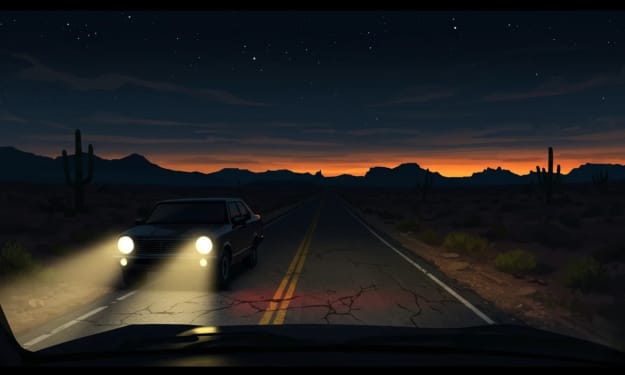
The 1970 Dodge Challenger didn’t belong in this decade. It was a block of matte-black iron in a world of plastic electric bubbles. I sat in the driver’s seat, the idle of the 440 Magnum engine vibrating through my spine—a mechanical heartbeat that felt more real than anything else in Las Vegas.
By Shazzed Hossain Shajal9 months ago in Wheel
The Infinite Line - Mountain Passes and Fog (Part IV)
Chapter I - The Climb Begins The road began to rise almost without warning. What had been long, confident stretches of asphalt tightened into deliberate curves. Elevation signs ticked upward. The air cooled fast, slipping through vents and seams in the rider’s gear. The BMW adjusted quietly - throttle mapping recalibrating, suspension firming just enough to hold the line.
By José Juan Gutierrez 11 months ago in Wheel
The Infinite Line — Rain, Neon, and Crossing Water (Part III)
Chapter I - Rain Finds the City The first drops hit the visor just outside the city limits. At speed, rain doesn’t arrive gently - it announces itself. A sharp tap, then a thousand more, spreading across the helmet like static. Streetlights smeared into long streaks of white and amber. The BMW’s rain mode engaged automatically, throttle response softening, traction control sharpening its focus.
By José Juan Gutierrez 11 months ago in Wheel
Fractured Roads: Navigating Insurance After the Crash
The screech of tires and the crunch of metal echoed through Alex's mind long after the ambulance sirens faded. It was a rainy Tuesday afternoon in Phoenix when a distracted driver ran a red light, slamming into Alex's sedan at the intersection of Camelback Road and 7th Street. Alex, a 38-year-old graphic designer, woke up in the hospital with a fractured arm, whiplash, and a totaled car. The physical pain was bad, but the real headache started when the insurance calls began.
By CEO A&S Developers12 months ago in Wheel
Born to Ride. Built to Protect.
Visionary inventor and entrepreneur Christopher Henderson has turned a near-tragedy into a groundbreaking innovation that’s set to redefine safety for motorcycle and recreational vehicle enthusiasts worldwide. With the official 2024 release of the Malink Tandem Safety Belt, Henderson introduces a design 25 years in the making — a revolutionary product born from love, perseverance, and purpose.
By Independent Indie Artist Radarabout a year ago in Wheel
The Wheel That Changed Everything
M Mehran In the dusty village of Kaldara, where life moved slowly and the horizon seemed endless, a simple invention was about to change the course of history. The people of Kaldara had walked everywhere for generations, carrying heavy loads on their backs, dragging carts over rough terrain, and struggling to move even the smallest stones. Life was hard, and progress was measured in small, painstaking steps. Among them was a young man named Arin, curious beyond measure. He spent his days observing nature, sketching patterns, and dreaming of solutions to problems no one else dared to think about. Arin noticed how round objects, like logs or stones, could roll down slopes, saving effort. It was a simple observation, yet it sparked a revolutionary idea in his mind—a circular object that could carry loads with ease, something that could change the way his people lived. For months, Arin experimented in secret. He shaped clay and wood, tested different diameters, and studied friction. Villagers laughed at him, calling him foolish. “Why waste time on rolling stones?” they would say. But Arin persevered, driven by a vision they couldn’t yet imagine. Finally, one evening, under the amber glow of a setting sun, Arin unveiled his invention: a perfect wooden wheel, mounted on an axle, sturdy and smooth. At first, it seemed almost magical. He attached it to a simple cart and, with surprising ease, pulled a heavy load across the village square. The villagers stared in disbelief. A task that would normally take hours was completed in minutes. Word spread quickly, and curiosity turned into fascination. Soon, everyone wanted a wheel of their own. Merchants could transport goods farther and faster; farmers could move heavy crops without breaking their backs; travelers could journey across the harsh terrain of Kaldara with ease. The wheel, once a simple circle of wood, had become a symbol of progress, transforming the village almost overnight. But the story of the wheel didn’t stop there. Arin, eager to explore its potential, experimented further. He added multiple wheels to larger carts, designed axles that reduced friction, and even combined wheels with ropes and pulleys. Each innovation multiplied the impact of the wheel, turning simple transport into a cornerstone of civilization. As the years passed, Kaldara evolved. Roads were built, markets flourished, and trade expanded beyond the village to distant lands. The wheel had not only made life easier—it had connected people, ideas, and cultures. Villagers no longer lived in isolation; they exchanged goods, stories, and knowledge with neighbors who had once seemed unreachable. Historians, centuries later, would marvel at how a simple circle of wood had reshaped human existence. The wheel was more than a tool—it was a catalyst for innovation. It inspired chariots that raced across deserts, carts that carried entire armies, and eventually vehicles that would traverse continents. It became a symbol of ingenuity, of human ability to solve problems with creativity and persistence. Yet, in the heart of Kaldara, Arin’s legacy was simple. He reminded everyone that even the most ordinary-seeming objects could hold extraordinary potential. “Look closely,” he would say, “even a circle can carry the weight of the world if you turn it the right way.” The wheel taught another lesson as well: progress is rarely sudden. It requires observation, experimentation, and the courage to defy skepticism. Arin’s invention didn’t arrive fully formed; it grew through trial and error, through patience, and through a vision that others couldn’t yet see. In every revolution, literal or figurative, there is a wheel turning in the background, unseen but unstoppable. Centuries later, the world would remember the wheel not just as a tool, but as a symbol of human ingenuity. From wooden carts to bicycles, trains, and automobiles, the principle remained the same: a simple circle rolling on an axle could multiply human effort in ways unimaginable. Every journey, every invention, every movement forward owed a debt to that first rolling wheel in Kaldara, to a young man who dared to imagine what others dismissed as impossible. And so, the wheel continues to turn. It carries not just goods or people, but ideas, dreams, and the promise of progress. Each revolution reminds humanity of one truth: innovation often begins in simplicity. It is the quiet observation of the world, the willingness to experiment, and the courage to challenge convention that fuels change. In the end, the wheel is more than wood and metal. It is a testament to curiosity, perseverance, and the enduring human spirit. From the dusty streets of a forgotten village to the highways of modern cities, the story of the wheel is the story of humanity itself—a story of movement, of connection, and of the endless drive to roll forward, no matter how heavy the load. And as long as wheels keep turning, so too will human imagination, carrying us toward new horizons we have yet to envision.
By Muhammad Mehranabout a year ago in Wheel
The Wheel That Keeps Turning
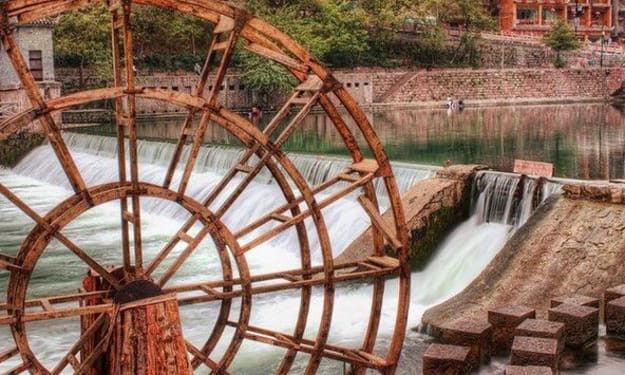
M Mehran In the heart of a small town, there stood an old blacksmith’s shop. Its roof sagged under the weight of decades, its walls were chipped, but at the center of it all was something remarkable: a giant wooden wheel that had hung above the entrance for as long as anyone could remember. Children grew up asking about it, but no one seemed to know its true story. Some said it once belonged to a farmer’s cart that carried grain to market. Others swore it was part of a mill that had ground flour for the town during its early days. Whatever its origin, the wheel became a silent witness to the passing of time. --- A Boy and the Wheel When Daniel was a boy, he often passed the blacksmith’s shop on his way to school. The wheel fascinated him. It wasn’t just wood and iron to him—it was a symbol of motion, of journeys taken, of destinations reached. He would stop, stare at it, and imagine the stories it might tell if it could speak. His grandfather noticed his curiosity one day. “That wheel,” he said, “is a reminder that life keeps moving. No matter how hard things get, the wheel keeps turning.” At the time, Daniel didn’t fully understand. But the words stayed with him. --- The First Turn Years later, when Daniel was a teenager, his grandfather passed away. The loss hit him hard. For weeks, he felt stuck, unable to focus on school or friends. One afternoon, he found himself standing in front of the blacksmith’s shop again, staring at the old wheel. He remembered his grandfather’s words. Life keeps moving. And for the first time since the funeral, Daniel allowed himself to cry. Not because he was weak, but because he realized grief was part of the turning wheel too. --- Struggles and Spins Life carried Daniel far from his small town. He went to college in the city, took a job in finance, and worked long hours. On paper, he was successful. But inside, he felt unbalanced. He thought of the wheel often—how it represented both progress and repetition. Some days, he felt like he was moving forward. Other days, he felt trapped in circles, repeating the same routine with no end in sight. During his toughest times, like when he lost his job during an economic downturn, he remembered the wheel again. No matter how hard things get, the wheel keeps turning. That thought kept him from giving up. --- Returning Home Years later, Daniel returned to his hometown for a visit. The blacksmith’s shop was long closed, its doors sealed shut, but the wheel still hung proudly. Its wood was cracked, its iron rusted, yet it remained strong. He stood there for a long time, memories flooding back—his childhood fascination, his grandfather’s wisdom, his teenage grief. It struck him that the wheel was not just about moving forward, but also about returning, about cycles of life that brought people back to where they began. --- A Symbol for the Town Daniel wasn’t the only one who saw meaning in the wheel. When the town council later decided to restore historic landmarks, the wheel became a central symbol. It was polished, preserved, and displayed in the town square. At the unveiling ceremony, Daniel was asked to speak. He shared his grandfather’s words with the crowd: “No matter how hard things get, the wheel keeps turning.” The people nodded, some with tears in their eyes, because they too had faced hardships—loss, financial struggles, illnesses, dreams delayed. And yet, they were still here. Still moving. Still turning. --- The Lesson of the Wheel The wheel is one of humanity’s oldest inventions. It carries us across distances, powers our machines, spins our days into nights. But it’s also a metaphor. It reminds us that life isn’t always a straight line. Sometimes it feels like we’re moving in circles, sometimes we’re rolling downhill, sometimes we’re climbing uphill. But always, always, the wheel turns. Daniel, now older and wiser, often tells his own children: “When you feel stuck, when you feel like you can’t keep going, remember the wheel. Even when it slows down, it never truly stops. And neither should you.” --- Closing Thoughts The wheel above the blacksmith’s shop may no longer spin, but its meaning endures. For a small town, it became a piece of history. For Daniel, it became a lifelong reminder of resilience. Life is not about avoiding the bumps in the road—it’s about learning to keep rolling through them. Because just like that old wheel, we are built to keep turning, no matter how rough the journey.
By Muhammad Mehranabout a year ago in Wheel
UK Driving Licence Rule Change in August: Thousands of Moldovan Drivers to Benefit from New DVLA Law
UK Driving Licence Shake-Up: Big Win for Moldovan Motorists in Britain The UK’s DVLA (Driver and Vehicle Licensing Agency) has introduced a major driving licence rule change this August — and it’s already making waves among the country’s Moldovan community.
By Waqar Khanabout a year ago in Wheel