
Porsche Is Cutting 9,000 Jobs and Betting on Gas Again
The sports car maker is shrinking to save its soul. The question is whether enough wealthy drivers still care.
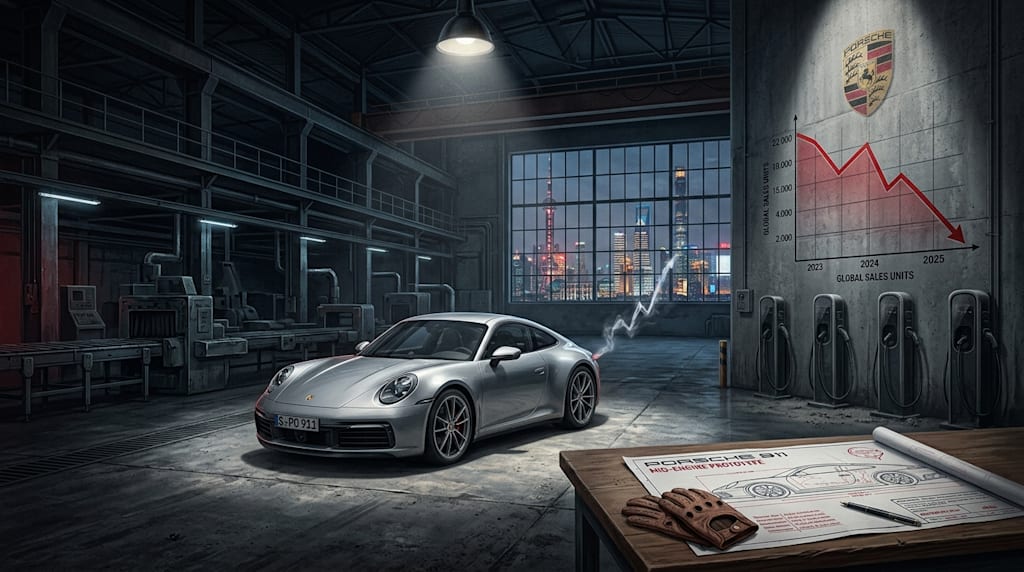
Porsche’s Spartan Turn: Fewer Cars, Higher Prices, More Gas
On October 7, 2026, Porsche stood in Weissach and announced a mid-term plan called “Sportwagenschmiede ’35.” The German phrase means “sports car forge.” The name tells you where the company wants to go: back to the thing it was before.
The route back is harsh. Porsche will cut as many as 9,000 jobs. It will reduce model derivatives by 20%. It will cut management positions by 40%. It wants its break-even point below 200,000 vehicles. The plan bets on one idea: enough people will still pay a lot to drive themselves.
That bet will decide Porsche’s next decade.
I. Profit cliff: a €3.9 billion bill
In fiscal 2025, Porsche’s revenue fell 9.5% to €36.27 billion. Operating profit was €413 million. A year earlier, it was €5.64 billion. Return on sales dropped from 14.1% to 1.1%. For every €100 of cars sold, Porsche kept €1.10.
The books blame about €3.9 billion in special charges. The money went to three places: about €2.4 billion for product strategy changes and company size cuts, about €700 million for battery operations, and about €700 million from U.S. tariffs.
All three point to the same problem. Porsche’s aggressive EV spending is now hurting its finances.
The in-house battery project shows the pattern. Porsche wanted Cellforce to build high-performance batteries so it could keep a performance edge in the electric era. In early 2025, Swedish battery maker Northvolt went bankrupt. That cut off key cells. Demand was weaker than expected. Costs were high. Porsche shut Cellforce. The investment became billions in sunk costs.
Sales pressure was just as bad. In 2025, Porsche delivered 279,400 vehicles worldwide, down 10.1%. China was the alarm. Deliveries there fell 26.3% to 41,900. In 2021, Porsche sold 95,700 vehicles in China. In the first half of 2026, China deliveries were 14,501, down about 32% from the same period a year earlier.
Porsche’s largest single market was no longer a growth engine.
Then came a strange turn. In the first half of 2026, sales fell 16.5%. Revenue fell only 5.11%. Operating profit rose 33.9%. Return on sales recovered to 7.8%.
Volumes fell. Profits rose.
That pattern is the starting point for the new strategy. If the product mix is expensive enough, scale can shrink.
II. A reverse imitation of Ferrari
Porsche’s new plan copies Ferrari’s business model, but from the opposite direction.
Ferrari sells about 14,000 cars a year. Its operating margin has stayed above 25%. In the first half of 2026, it reached 30.5%. That nearly matched Porsche’s total operating profit, even though Porsche delivered more than 120,000 vehicles. Ferrari makes very few cars and very high profits. That is the purest way for an ultra-luxury brand to survive.
Porsche went the other way. It used the Macan and Cayenne to grow volume. That also diluted scarcity. When the Macan’s street price fell to around RMB 300,000, the brand premium began to loosen. Management saw that as real damage to brand value.
The new plan pulls the scale back toward scarcity.
Product mix shifts to higher-profit segments. Porsche wants D/E-segment models to make up about 45% more of the mix. It will cut model derivatives by about 20%. The lineup will be smaller, more expensive, and more concentrated.
Prices move up. Top models should see average selling prices rise about 20%. Today, Porsche’s top sports cars average about €275,000. After the increase, that number approaches €330,000.
Customization grows. Porsche wants revenue from its Sonderwunsch bespoke business to reach six times its current level in the medium term. That business has the highest margins and best expresses exclusivity.
A new mid-engine platform. This is the most symbolic move. Porsche will develop a mid-engine supercar platform for a new flagship line above the 911. It is the spiritual successor to the 918 Spyder. The platform is built for a mid-engine layout, not an EV layout.
The industry is rushing toward electric cars. Porsche is defining its flagship with a combustion architecture.
III. Back to combustion, but not only combustion
The press calls this a return to combustion engines. A better description: Porsche is returning to a driver-centered product philosophy. Combustion power is the most natural vehicle for that philosophy right now.
CEO Michael Leiters said at Capital Markets Day that Porsche will run internal combustion, hybrid, and pure electric in parallel.
The product plan confirms it.
The combustion Macan returns in 2028. It will use a 2.0T four-cylinder and a 3.0T V6. It will offer a plug-in hybrid for the first time. It will sell alongside the electric Macan. Porsche expects it to lift sales and profit in 2029.
The electric 718 Boxster and Cayman are EV-only. A combustion version will not return. Their first full production year is 2028. That difference shows Porsche is not treating every model the same. It is matching powertrains to different buyers.
Porsche is also studying a D-segment SUV above the Cayenne. It plans at least one benchmark product every year before 2030.
In late September, Leiters told the Financial Times: “We have to restore the combustion-engine strategy, but I am very optimistic that once we launch the Macan with a combustion engine, we can offer customers a very balanced EV and ICE product lineup.”
The subtext: Porsche’s mistake was doing only electric cars, or doing them too early. Running ICE and EV together is a practical response to what customers actually buy.
IV. China: a deliberate retreat
China is where the “quality over quantity” rule shows up most clearly.
In 2025, Porsche cut its Chinese dealer network from 150 to 114, a 30.7% withdrawal. In 2026, it wants about 80 outlets. It also shut down its own charging network.
This trades space for time. Porsche China CEO Pan Lichi said the cuts match the “quality over quantity” strategy. CFO Bai Yuhan gave a conservative forecast: China sales in 2026 will fall to about 30,000 vehicles.
That is less than one-third of Porsche’s peak in China.
Porsche no longer treats China as a must-win battlefield. It treats it as a curated market. It will serve core customers who still value the brand. It will not fight domestic high-end EV brands on price and features.
The judgment has some logic. In the first half of 2026, China’s ICE retail sales fell about 26.4%. NEV penetration stayed above 60% for three straight months. Domestic brands like Zeekr and AITO now sell at average prices above BBA in China. They are squeezing traditional luxury from both price and experience.
Porsche is choosing not to play that game. In part, that is damage control.
V. Porsche is not alone
Porsche’s turn is not isolated. Since 2026, at least 12 global automakers have scaled back EV plans. Ultra-luxury brands face the strongest resistance.
Lamborghini stopped EV development and will launch the Lanzador as a plug-in hybrid. Aston Martin pushed its first EV to 2033. Bentley shifted focus to plug-in hybrids and combustion. Ferrari slowed its first EV.
The shared logic: ultra-luxury buyers do not want electrification as urgently as mass-market buyers. For someone buying a Ferrari or Lamborghini, the engine sound, mechanical feedback, and driving ritual are part of the product. Electrification is technically possible. It also erases the difference these brands rely on.
When the Taycan and electric Macan met a cold market, the problem was not the product. It was that target buyers did not want an electric Porsche.
The problem sits in brand perception.
VI. Costs and risks
The strategy is clear. The execution risks are clear too.
The first risk is a product gap. The combustion Macan does not arrive until 2028. The old combustion Macan is already fading out. In 2026 and 2027, Porsche will have a hole in the compact SUV segment, its core volume segment. The gap could cost about 25,000 vehicles and about €500 million in profit in 2027.
The second risk is resource dilution. Leiters says Porsche must avoid duplicate investment in the same segment. But running ICE and EV in parallel means paying for two technology paths. Porsche already misallocated resources during its fast EV push. The correction depends on how well the organization executes.
The third risk is the brand ceiling. Porsche’s reference is Ferrari. Porsche is 20 times Ferrari’s size. Ferrari’s model works at 14,000 cars a year. Porsche wants a break-even point below 200,000 vehicles. No automaker has kept Ferrari-level margins and exclusivity at that scale.
The fourth risk is the layoffs. The 9,000 cuts equal about 21% of Porsche’s workforce. Management positions fall 40%. Functional staff fall 25% to 30%. That kind of contraction will hurt efficiency and culture in the short term. Porsche promises to protect core jobs through 2035. It has not said which jobs count as core.
Conclusion
At Capital Markets Day, Leiters said: “People buy a Porsche not because they truly need it, but because they desire to own it. People are willing to pay the corresponding price for dreams and desire.”
The challenge: in a world of self-driving cars and electric performance, does the desire to own a Porsche still hold?
Porsche bets that it does. As long as it builds machines that make hearts race, someone will pay to drive.
The first test comes in 2028 with the combustion Macan. The longer answer depends on whether Porsche can balance “more expensive” with “more worth it.”
At Weissach, the mid-engine platform blueprints are unrolling. The sound of that engine will be Porsche’s answer.
About the Creator
Jin
Writer of reamstories
https://reamstories.com/jin
Enjoyed the story? Support the Creator.
Subscribe for free to receive all their stories in your feed. You could also become a paid subscriber, letting them know you appreciate their work.
Comments
There are no comments for this story
Be the first to respond and start the conversation.