
NIO Just Connected the Silk Road With 33 Battery Swap Stations
3,605 kilometers, 33 stations, and a real test for EV road trips
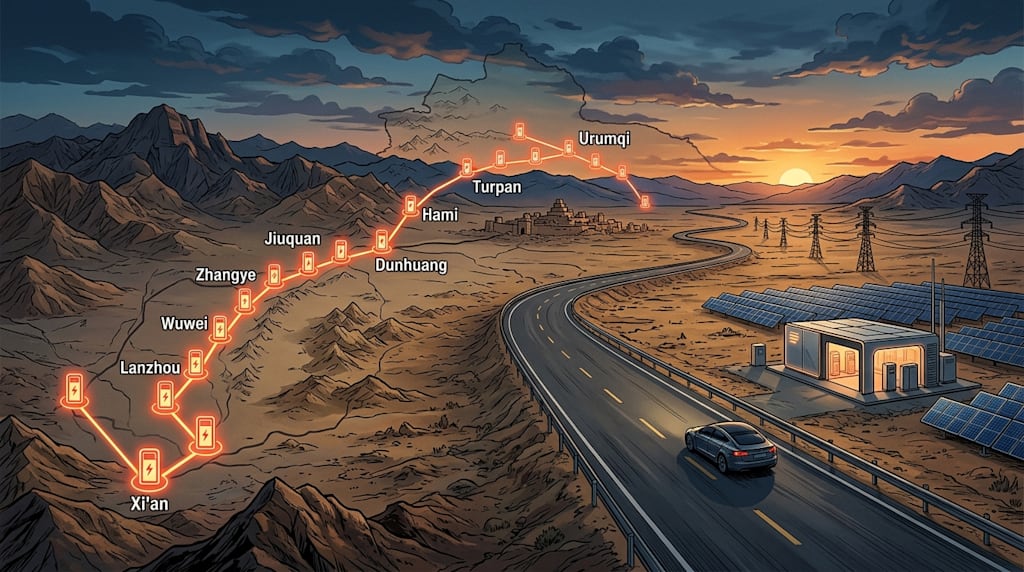
On September 26, a new route appeared in the NIO app.
Open the map. From Xi’an westward, through the Hexi Corridor, past Dunhuang, and into Xinjiang, 33 battery swap station icons form a line. NIO says its Silk Road battery swap route is fully connected. It runs 3,605 kilometers and uses 33 battery swap stations.
The average gap between stations is about 109 kilometers. In eastern city clusters, that is not dense. In the west, it decides whether the line works at all. In May, NIO connected the Hexi Corridor section with 20 stations. That same month, it ran the Silk Road Battery Swap Journey, with users from eight cities driving to Dunhuang on swaps. The westernmost station went online before the full route opened. On September 26, the line reached its endpoint.
NIO says a driver can now start from any battery swap station in the country and reach every provincial-level region in mainland China using only battery swaps.
The important words are “any” and “every.” One station covers a few kilometers. A route covers hundreds or thousands. Linking stations into a network means a driver can start anywhere and follow the network to a provincial-level region. That is a different claim.
The network numbers: 9,431 charging and battery swap stations nationwide. That includes 4,125 battery swap stations, 5,306 charging stations, and 30,594 chargers. Cumulative battery swaps: more than 120 million.
In February 2026, on the second day of Chinese New Year, NIO recorded 158,290 battery swaps in one day. The daily total then passed 170,000, setting records three days in a row. In August, swaps passed 120 million, and fifth-generation battery swap stations entered operation. That month, NIO pushed a new World Model version, NWM, adding urban Navigate-on-Pilot battery swapping. Those moves push battery swapping from city stations into route planning, driver assistance, and long-distance travel.
The Silk Road is a hard test. From the Hexi Corridor to the Tianshan Mountains, cities are far apart, and charging stations are sparse. An EV road trip into the west means calculating range, checking chargers, and leaving a buffer. The Silk Road route adds 33 energy nodes to a classic drive. It does not solve everything. It does make “Can I swap the whole way?” a question a driver can test.
Operations are the other half. Western stations see sharp swings between off-season and peak season. Holidays and tourism season concentrate demand. On ordinary days, use may be low. Battery swap stations are heavy assets. Land, power, batteries, equipment, labor, and maintenance all need money. Sand, cold, and altitude test equipment and repair crews. Opening the route is the start. Keeping every station open is the long test.
NIO is also signing partners. In December 2025, NIO Energy and Zhong’an Energy opened the first 50 co-built charging and battery swap stations. In September 2026, NIO Energy and Yunnan Communications Investment opened a new batch of co-built highway battery swap stations. Highway operators, transportation investment groups, and local energy companies bring land, grid access, and regional reach.
NIO plans to build 1,000 new battery swap stations this year and grow its Power Scenic Routes to 100. The Silk Road is one of them. It is also the longest.
The timeline:
January: NWM update adds urban Navigate-on-Pilot battery swapping.
February: William Li says NIO will build 1,000 new battery swap stations this year and grow Power Scenic Routes to 100.
February: Chinese New Year’s second day brings 158,290 swaps; daily total passes 170,000.
May: Silk Road Battery Swap Journey starts; users from eight cities drive to Dunhuang.
May: Hexi Corridor section opens with 20 battery swap stations.
June: 8,996 charging and battery swap stations nationwide; cumulative swaps pass 110 million.
August: swaps pass 120 million; fifth-generation battery swap stations enter operation.
September: Yunnan Communications Investment co-built highway battery swap stations open.
September 26: Silk Road battery swap route fully connected. 3,605 kilometers. 33 stations.
Battery swapping still draws debate. It is asset-heavy. Standards are not unified. Other automakers chose ultra-fast charging. NIO kept building swaps. The 120 million figure shows users are using them. Western station utilization, cost recovery, battery life, and grid capacity remain open questions. NIO builds both chargers and swap stations: of 9,431 total, 4,125 are swap stations and 5,306 are charging stations. Two legs.
For road-trippers, the Silk Road is a familiar route: Xi’an to Dunhuang to Urumqi. The 33 stations average 109 kilometers apart. Drivers do not need to calculate every kilometer, but they do need to know whether the next station has a charged battery. Inventory and queues decide the experience.
For NIO, this is a network test. For the industry, it is another data point on whether battery swapping can support long-distance travel. The dots on the map now form a line. Whether that line becomes a daily reality depends on every car that follows.
After September 26, NIO’s map has one more line. Xi’an to Urumqi. 33 dots.
The route is live. When the next car leaves is a separate question.
About the Creator
Jin
Writer of reamstories
https://reamstories.com/jin
Enjoyed the story? Support the Creator.
Subscribe for free to receive all their stories in your feed. You could also become a paid subscriber, letting them know you appreciate their work.
Comments
There are no comments for this story
Be the first to respond and start the conversation.