
Malaysia Trials "Minimum Advisory Speed" on Highways to Combat Lane Hogging and Improve Flow
MIROS, LLM, PLUS, and SKVE launch a proof-of-concept trial encouraging drivers to match their speed to their lane, aiming to reduce speed variance and enhance overall road safety

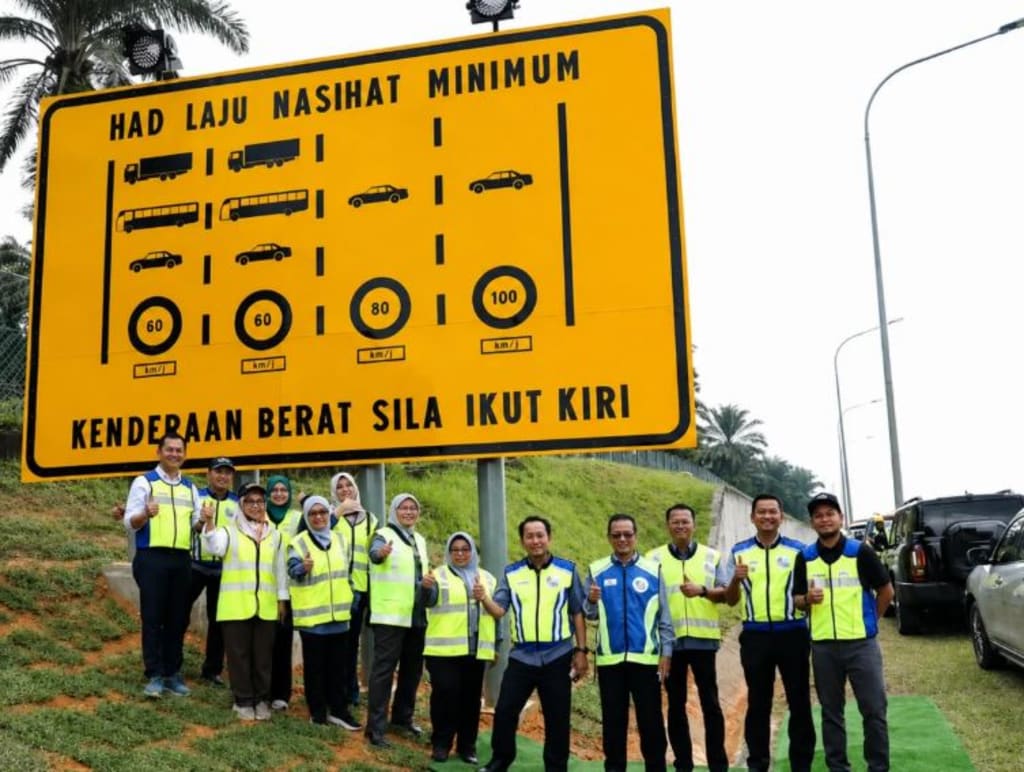
Starting August 1, motorists traveling on selected stretches of Malaysian highways will notice a new type of signage: minimum advisory speed limits. Under the banner Had Laju Nasihat Minimum, the Malaysian Institute of Road Safety Research (MIROS), in collaboration with the Malaysian Highway Authority (LLM), PLUS Malaysia Berhad, and SKVE, has launched a proof-of-concept (POC) trial designed to tackle one of the most persistent causes of highway congestion and accidents: lane hogging.
The concept is straightforward yet transformative for local driving culture. Each lane will display a recommended minimum speed. Drivers are encouraged to travel at or above this pace if they choose to occupy that specific lane. The underlying principle is simple: if you want to cruise slowly, keep left; the further right you go, the faster you are expected to flow.
It is crucial to note the word "advisory." This is currently a trial of guidance signage, not a new enforceable legal speed floor with immediate penalties. However, the initiative signals a significant shift in how traffic management authorities view highway discipline, moving beyond just capping maximum speeds to managing the flow and variance of traffic.
The Five Key Objectives
MIROS has outlined five primary goals for this exercise, all aimed at creating a more predictable and safer driving environment:
Preventing Lane Monopolising: Discouraging drivers from "camping" in the middle or right lanes regardless of their speed.
Reducing Speed Difference: Minimizing the gap between the fastest and slowest vehicles in the same lane.
Increasing Traffic Capacity and Flow: Ensuring highways operate at optimal efficiency.
Reducing Dangerous Lane Changes: Limiting the need for aggressive overtaking maneuvers.
Improving Overall Road Safety: Lowering the risk of collisions caused by erratic traffic behavior.
Pilot Locations
The POC is being rolled out at three strategic locations known for high traffic volume and varying driver behaviors:
PLUS E1 (Northbound): The stretch between Tanjung Malim and Behrang.
SKVE E26: From Ayer Hitam toll plaza to Bandar Saujana Putra.
PLUS E2 (Northbound): Between Bandar Ainsdale and Nilai.
Drivers on these stretches are urged to use the lane that matches the advisory minimum speed, avoid overtaking from the left, give way to faster vehicles, and maintain safe following distances. As MIROS succinctly put it in their announcement: "Jangan jadi punca trafik terganggu" don’t be the cause of disrupted traffic.
The Science Behind the Trial: Why Slow Driving Can Be Dangerous
To many, the idea of a "minimum speed" might seem counter-intuitive. Isn’t driving slower safer? Road safety research suggests otherwise. The danger on highways isn’t solely about absolute speed, but rather speed variance the difference in speed between vehicles sharing the same stretch of road.
This concept is rooted in decades of research, most notably the "Solomon Curve," a 1964 study by US researcher David Solomon. Analyzing around 10,000 crash-involved drivers, Solomon found a U-shaped relationship between speed and crash risk. Drivers traveling near the average speed of traffic had the lowest crash rates. Risk increased for those driving significantly faster, but it rose even more steeply for those driving significantly slower.
Later studies, including work by Julie Cirillo in 1968 and economist Charles Lave in 1985, reinforced this finding. Lave’s research indicated that fatality rates tracked closely with speed variance, not just average speed. Modern reviews confirm that large differentials force other drivers to brake abruptly, change lanes unexpectedly, or undertake maneuvers that are statistically where most crashes occur.
When a car travels at 70 km/h in the right lane of a 110 km/h highway, it becomes a moving obstacle. Every vehicle behind it must react: braking, checking blind spots, changing lanes to the left, accelerating past, and merging back. Each of these actions introduces risk. The lane hog, often oblivious to the chaos they create, remains safe in their bubble, while generating danger for everyone else.
The "Phantom Jam" Effect
Beyond safety, there is a high economic and logistical cost to poor lane discipline. Slow vehicles in fast lanes contribute to the "phantom jam" effect, a phenomenon famously demonstrated in a 2008 Japanese experiment where drivers on a circular track spontaneously created stop-and-go shockwaves simply by reacting to minor speed adjustments.
On a highway, one slow vehicle in the overtaking lane can cause congestion that stretches for kilometers behind it. By encouraging drivers to sort themselves by pace slower traffic to the left, faster traffic to the right the trial aims to smooth out these shockwaves and increase the total number of vehicles the highway can safely carry per hour.
Existing Laws and Future Implications
It is worth remembering that lane hogging is already an offense in Malaysia under Rule 5(1) of the Road Rules 1959. The middle and right lanes are legally designated for overtaking, with the left lane serving as the default cruising lane. Heavy vehicles are explicitly banned from the right lane. Violators can face fines of up to RM2,000.
What the MIROS trial adds is the positive reinforcement of the rule: not just "don’t camp in the fast lane," but "if you are in it, keep up." The advisory minimums are set below the posted maximums and explicitly excuse drivers during heavy rain or congested traffic conditions. It is about matching your speed to your lane choice, ensuring predictability.
If the POC delivers positive results in terms of reduced accident rates and improved traffic flow, minimum advisory speed signage could be expanded to other major highways across the country.
In the meantime, the message to Malaysian drivers is clear: Keep left unless overtaking, let faster traffic through, and don’t be the reason a hundred drivers behind you have to make a lane change they didn’t need to make.
About the Creator
Mark Lim
Hi I am mark an automotive student and a car, tech and food enthusiast ! Im gonna try and post daily & hope you enjoy what I write and do share my page with people you know. I would gladly appreciate it! Cheers
Enjoyed the story? Support the Creator.
Subscribe for free to receive all their stories in your feed.
Comments
There are no comments for this story
Be the first to respond and start the conversation.