
Is All-Wheel Drive Worth It on a Porsche 911 GTS Cabriolet? We Now Have the Answer
Car and Driver tested back-to-back RWD and AWD versions of the same car. The numbers settle the debate and $7,800 has rarely bought this much.


The Porsche 911 has been rear-engine and rear-wheel drive for most of its existence, and a significant portion of its devoted following considers that configuration not just correct but sacred. The engine over the back wheels, the tail-happy balance, the requirement that the driver be an active participant in the relationship between car and road, these are features, not oversights, and the people who love 911s tend to love them specifically.
So the question of whether to pay extra for all-wheel drive on a 911 that isn't going anywhere near snow is a genuine one. It costs more, it adds weight, and it theoretically dilutes the purity of the rear-drive experience that enthusiasts prize. Is it actually worth it?
Car and Driver got an unusually clean answer. The rear-drive GTS Cabriolet in their LA press fleet was replaced by an AWD Carrera 4 GTS Cabriolet in the same model year, same location, tested by the same driver. A back-to-back comparison doesn't get much cleaner than that.
What You're Paying For
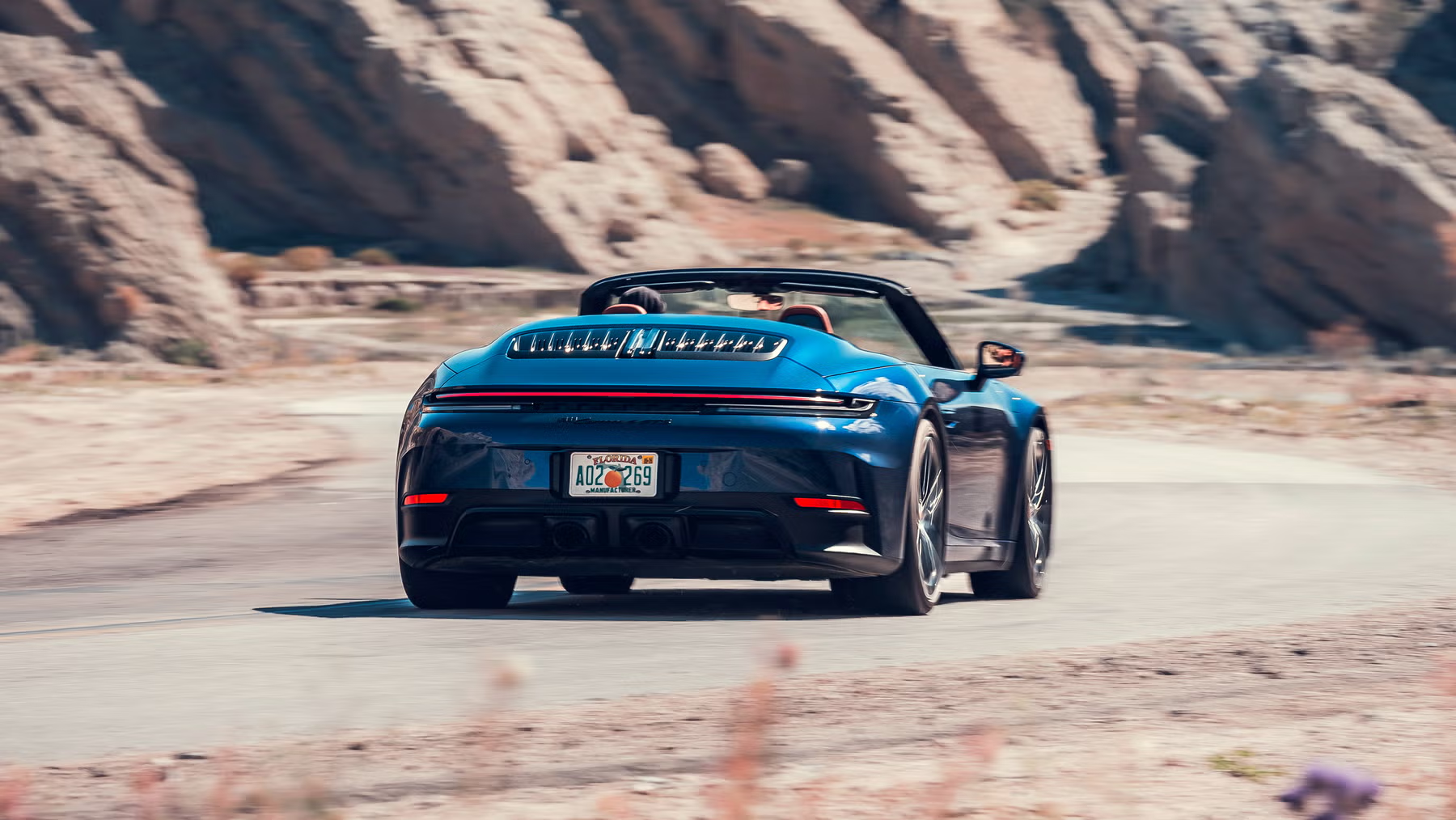
The Carrera 4 GTS Cabriolet starts at $187,995, exactly $7,800 more than the rear-drive Carrera GTS Cab at $180,195. As tested, the specific car featured in this test came to $208,625, though some of that premium over base reflects colour choices and interior upgrades rather than the AWD system itself.
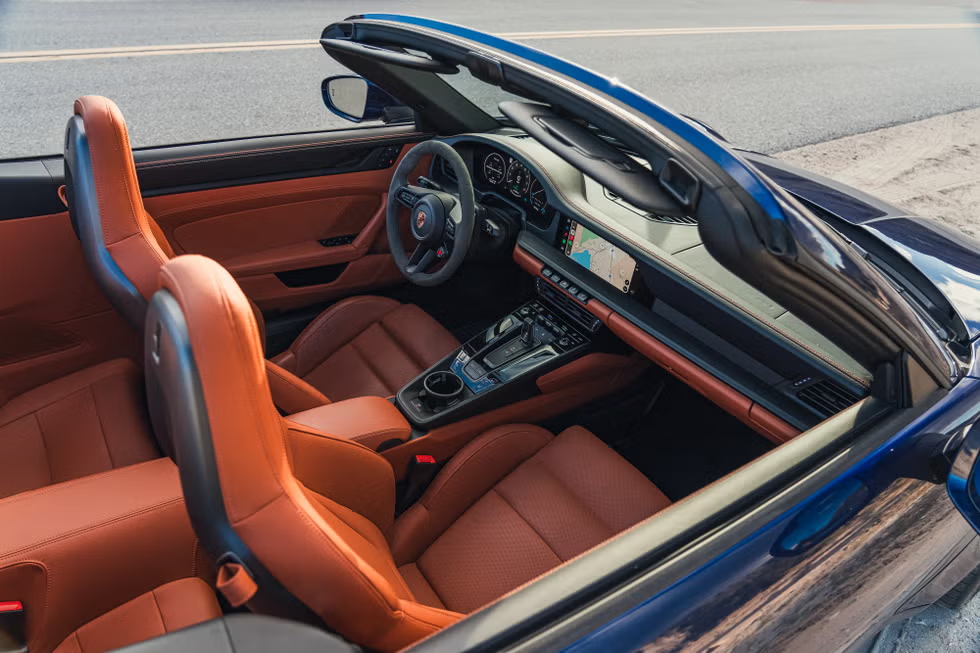
Both cars run the same powertrain: a 3.6-litre turbocharged flat-six with a supplemental electric motor integrated into the eight-speed dual-clutch transmission, producing 532 horsepower and 449 lb-ft of torque combined, plus a smaller electric motor on the intake side of the turbocharger that eliminates lag before it can develop. Driving the GTS in everyday conditions, Car and Driver notes there's no hint whatsoever that you're in a hybrid. It pulls hard, it never falters, and the PDK transmission executes shifts with the kind of decisiveness that makes you trust it completely.
The powertrain is identical. Everything that changes between RWD and AWD comes from what happens to those 532 horsepower when they reach the road.
The Numbers Tell the Story
Porsche claims both cars will hit 60 mph in 3.0 seconds. That is not what Car and Driver found.
The rear-drive GTS Cabriolet did 60 mph in 2.9 seconds, already well ahead of the official claim. The AWD Carrera 4 GTS Cabriolet hit the same mark in 2.6 seconds. Three tenths of a second sounds modest in isolation. In the context of a car already doing 60 mph in under three seconds, it's a significant gap, the difference between impressive and genuinely startling.
The 100 mph comparison is similarly revealing: 6.5 seconds for the AWD versus 6.7 for the RWD. The quarter-mile trap speed is identical at 129 mph; the same power is on offer in both cars, but the AWD gets there in 10.8 seconds against the RWD's 11.0.
Braking is essentially identical at 139 feet from 70 mph for both, which is exactly what physics would predict. AWD helps you go faster. It does nothing to help you stop.
The cornering numbers are where the AWD's advantage extends beyond straight-line speed. The front axle carries slightly more weight with the AWD system, 37.2% of total weight, versus 36.6% in the RWD car. That marginal additional front-axle load translates into a measurable cornering improvement: 1.05g on the skidpad versus 1.02g for the rear-drive version. That's not a rounding error. That's a genuine dynamic improvement that manifests as increased confidence during turn-in and a balance that Car and Driver describes as unmatched.
The Weight Question
AWD systems add weight, and extra weight is the enemy of performance. The real-world weight difference here is approximately 100 pounds obscured slightly by the fact that the AWD car can't accept the optional larger 22.1-gallon fuel tank because the front prop shaft occupies the space required for it. With full fuel loads factored in, 100 pounds is the honest penalty.
On a nearly 3,900-pound car, 100 pounds is around 2.5% of total mass. The performance numbers suggest this is more than offset by the traction advantage the AWD car has at every measured point, despite the weight disadvantage.
The fuel tank situation is worth noting as a genuine downside. The standard tank gives the AWD car an estimated highway range of 380 miles. The RWD car with the larger optional tank gets approximately 500 miles. For long-distance driving, that's a real consideration.
The Ride Quality Caveat
The GTS suspension setup has become notably stiff, and Car and Driver is direct about this: "We're thinking that it's getting too bloody stiff." On smooth roads, the car is composed and controlled. On imperfect surfaces, which constitute most roads in most places, the ride is harsh enough to be a genuine complaint rather than a minor quibble.
There is a solution available: the GTS suspension delete is a no-cost option that raises ride height by about 0.4 inches and swaps to the Carrera S anti-roll bars. For buyers who value daily usability over absolute track composure, this option sounds worth serious consideration. Car and Driver hasn't tried it but notes it approvingly.
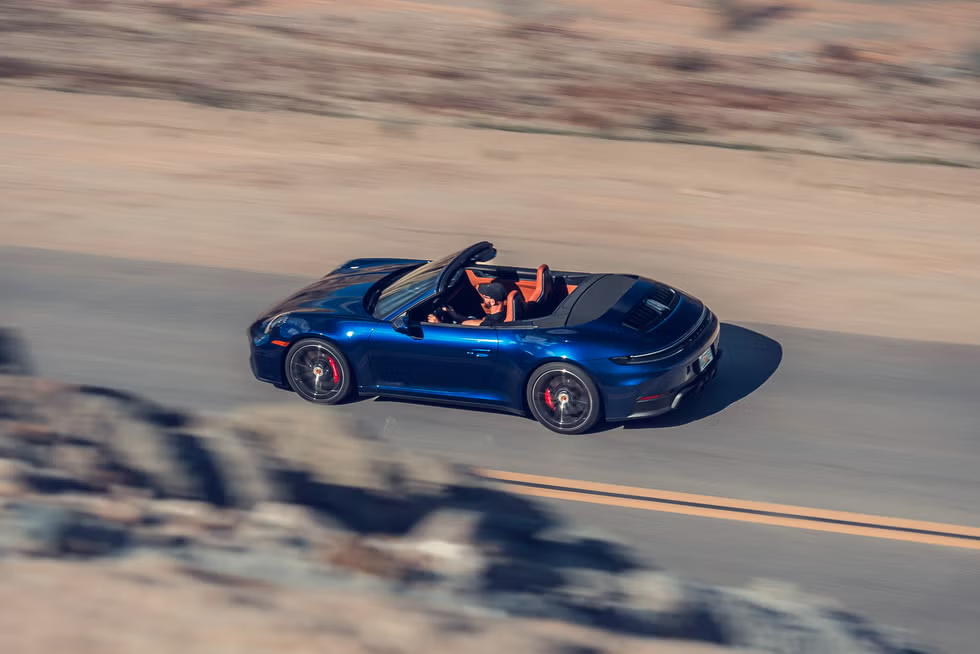
The convertible top, by contrast, is excellent, deploying in 12 seconds at speeds up to 31 mph and fitting so tightly that Car and Driver performed their speed runs with it up, finding no meaningful difference in aerodynamic stability.
Minor Grievances
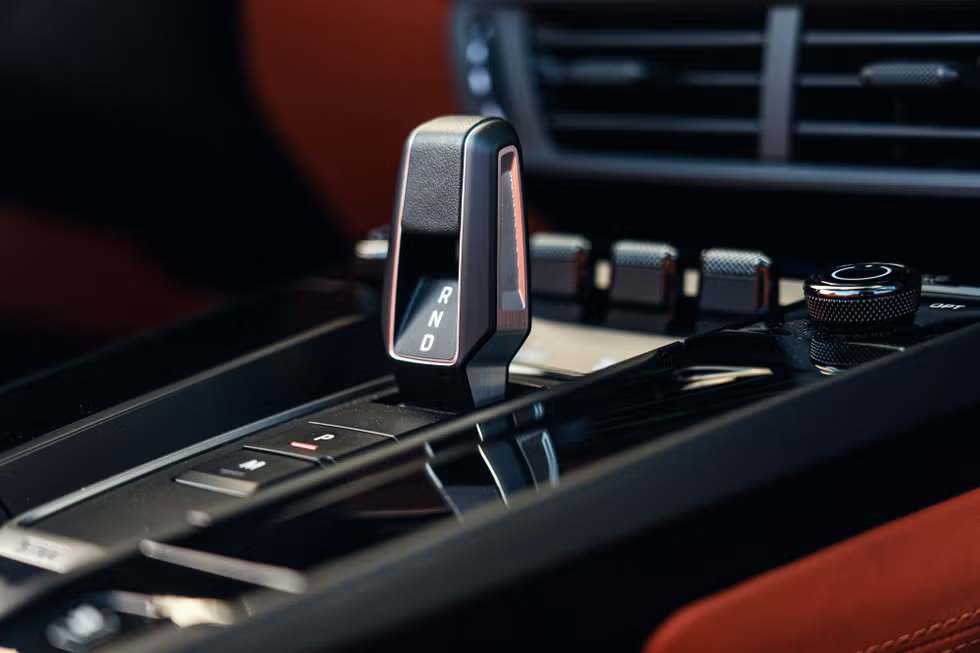
The 18-way adjustable seats are genuinely comfortable but overcomplicated in their adjustment mechanisms, a common luxury car problem where more features don't necessarily mean better execution. The 14-way alternative loses shoulder bolsters, making the 18-way the right choice by process of elimination, even with the adjustment frustrations.
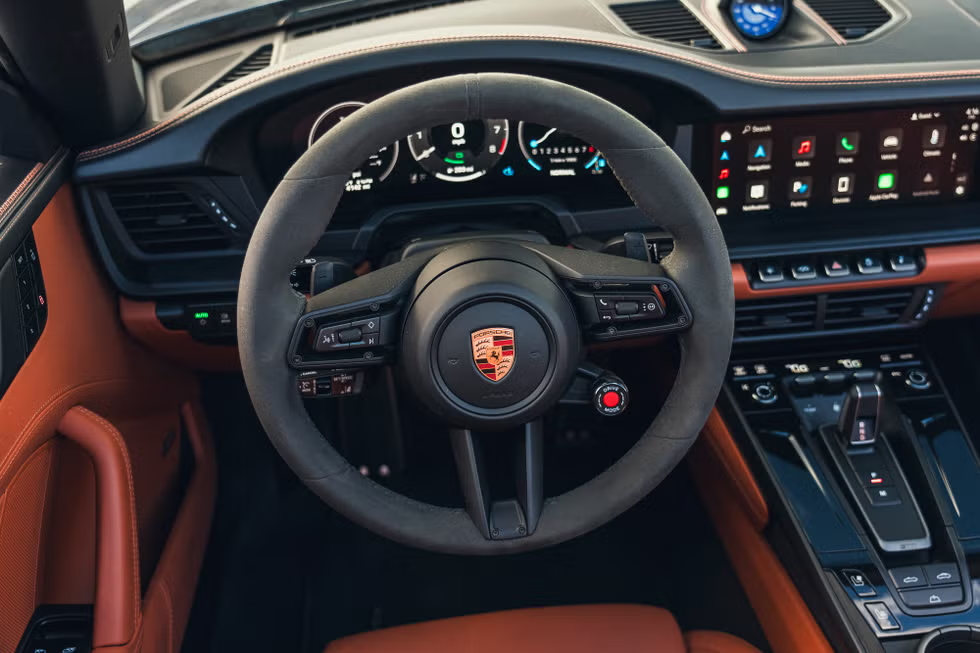
The microsuede steering wheel earned a memorable description from Car and Driver colleague Elana Scherr, "like a bony dead animal," and the recommendation is to specify the GT steering wheel in leather instead, a no-cost option.
At $7,800 on a car that starts at $187,995, the all-wheel drive premium is genuinely modest in context. What it buys is a 0.3-second improvement to 60 mph, meaningful cornering gains, and a level of all-conditions confidence that makes the car feel planted and balanced in a way the rear-drive version, already an exceptional machine, can't quite match.
The downsides are real but manageable: 100 extra pounds, the loss of the larger fuel tank option, and a marginally higher sticker. None of these changes the fundamental character of a car that remains one of the most extraordinary driver's machines available at any price.
Car and Driver's conclusion is clear: make it a Carrera 4. Whether you're speccing a GTS or a standard Carrera, the AWD premium earns its cost. The numbers prove it, and the drive confirms it.
The dark horse label may apply to Turkey. Here, the case is settled.
About the Creator
Mark Lim
Hi I am mark an automotive student and a car, tech and food enthusiast ! Im gonna try and post daily & hope you enjoy what I write and do share my page with people you know. I would gladly appreciate it! Cheers
Enjoyed the story? Support the Creator.
Subscribe for free to receive all their stories in your feed.
Comments
There are no comments for this story
Be the first to respond and start the conversation.