
"Insulting to Fans": Domenicali Sparks Outrage by Claiming Viewers Don’t Care About F1 Technical Data
After removing critical telemetry graphics during energy-sensitive races, F1 CEO’s defense citing George Lucas and “new fans” has ignited a backlash from purists who argue the sport is dumbing down its product.

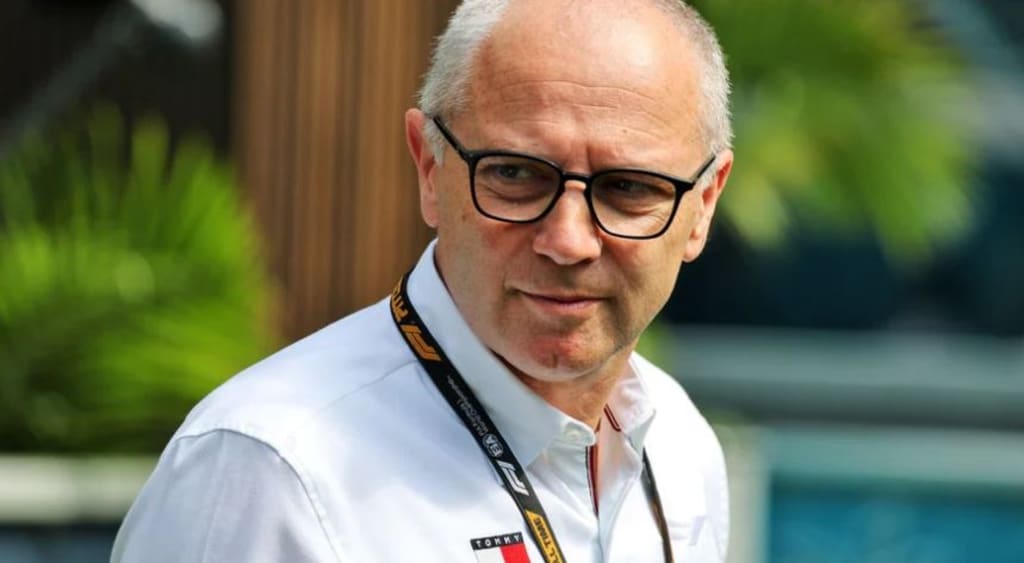
Formula 1 CEO Stefano Domenicali has found himself at the center of a fierce fan backlash after suggesting that viewers are “not interested” in the technical nuances of how drivers execute overtakes. The controversy stems from recent broadcasts at Silverstone and Spa-Francorchamps, where F1 omitted standard on-screen telemetry including battery levels, speed traces, and brake pressure during races defined by severe energy management and “super-clipping.” When questioned about the missing data, Domenicali defended the decision by claiming modern audiences prioritize action over engineering detail, a stance that Red Bull Supercars driver Scott Pye has branded “insulting” to the sport’s core fanbase.
The Graphics Controversy: What Was Lost and Why It Mattered
At both Silverstone and Spa, the 2026 power units’ energy deployment became the defining strategic variable. With limited recharge opportunities, drivers were forced to lift off throttle dramatically mid-straight, most notably on Spa’s Kemmel Straight, where cars slowed to GT3-level speeds to conserve battery for defensive or offensive maneuvers later in the lap. Without real-time battery state-of-charge (SOC) or throttle position graphics, viewers were left guessing why cars appeared to brake inexplicably on full-throttle sections. The absence of data transformed what should have been a fascinating tactical narrative into confusing, unexplained slowdowns.
Critically, these omissions occurred precisely when technical context was most essential. At Hungary, a tight, low-speed circuit with minimal energy sensitivity, the graphics returned without issue, confirming the removal was a deliberate editorial choice rather than a technical failure. This selectivity reinforced fan suspicions that F1 was sanitizing the broadcast to avoid exposing the artificiality of energy-limited racing, rather than educating viewers on its complexities.
Domenicali’s Defense: George Lucas and the “New Fan”
In response to criticism, Domenicali cited a conversation with filmmaker George Lucas as validation for stripping back technical overlays. “I had an interesting discussion with George Lucas in Hungary, and he was giving me an incredible view on how the new fans are watching F1,” Domenicali explained. “They are fascinated by the fact that there is a lot of action. [They are] not interested in the angle of throttle, or the percentage of brake pressure on how you can overtake a driver.”
This appeal to authority and to a demographic shift toward casual, action-oriented viewership struck many as tone-deaf. While F1 has successfully attracted younger, global audiences through Netflix’s Drive to Survive and social media, a significant portion of its broadcast audience remains deeply engaged with the sport’s technical dimensions. By framing interest in telemetry as incompatible with being a “new fan,” Domenicali implicitly categorized knowledgeable viewers as relics rather than stakeholders.
Scott Pye’s Rebuke: “Does Anyone Here Actually Care? I Do.”
Red Bull Supercars driver Scott Pye articulated the frustration of technically minded fans in a viral segment on his Apex Hunters podcast. “For Stefano Domenicali to sit there insulting the fans… does anyone here actually care about the graphics on the halo that have been removed? I know I do. I care,” Pye stated. He rejected the notion that fans need protection from complexity: “We know Formula 1 just removed it because they think we’re too fucking stupid to realize the car’s decelerating halfway down the straight because they ran out of battery.”
Pye also dismantled the George Lucas reference as irrelevant to motorsport fandom: “What the f*** would George Lucas know? ... I bet he hangs out with the common fan every day of the week.” His core argument was simple: understanding how a driver extracts performance is fundamental to appreciating their skill. “Love to see an onboard under braking with some data on the dash, please. Thank you.” For Pye and thousands of like-minded fans, telemetry isn’t noise; it’s the language of the sport.
The Deeper Tension: Entertainment vs. Authenticity
Domenicali’s comments expose a growing philosophical divide within F1 leadership. On one side is the belief that growth depends on simplifying the product for mass appeal; on the other, the conviction that F1’s uniqueness lies in its fusion of athletic and engineering excellence. Removing data during technically complex moments doesn’t make racing more accessible—it makes it less intelligible. True accessibility comes from better storytelling around complexity, not erasing it.
Moreover, the timing is ironic. F1 has spent years promoting sustainability and hybrid technology as central to its future, yet when those very systems create visible racing artifacts, the broadcast hides them. This undermines the educational value of the sport’s technological narrative and risks alienating the exact fans who engage most deeply with its innovation.
Moving Forward: Rebuilding Trust Through Transparency
The backlash suggests F1 may have misjudged its audience’s appetite for substance. Rather than choosing between action and data, the solution lies in integrating both: using graphics to enhance drama, not obscure it. Battery depletion visualized as a shrinking bar during a straight-line battle creates tension; hiding it creates confusion.
As F1 navigates its dual identity as entertainment spectacle and pinnacle of motorsport, Domenicali’s remarks serve as a cautionary tale. Growth shouldn’t come at the cost of authenticity. The fans who stay up late to watch qualifying, who analyze sector times, and who crave throttle traces aren’t obstacles to expansion they’re the foundation upon which sustainable growth is built. Dismissing them isn’t just insulting; it’s strategically short-sighted.
About the Creator
Mark Lim
Hi I am mark an automotive student and a car, tech and food enthusiast ! Im gonna try and post daily & hope you enjoy what I write and do share my page with people you know. I would gladly appreciate it! Cheers
Enjoyed the story? Support the Creator.
Subscribe for free to receive all their stories in your feed.
Comments
There are no comments for this story
Be the first to respond and start the conversation.