
I Drove a Range-Extender for Two Years. I Don’t Miss Gas Cars.
A former 270,000-km Lavida owner on charging, fuel math, and why range anxiety depends on what you buy.
Credentials first. I’m not an EV shill, and I’m not a gas-car hater.
My last car was a 2009 Lavida. When its LCD dash still lit, the odometer passed 240,000 km. When I traded it in, it showed 270,000+. It took me from new driver to old driver. It also took me through gas prices going from 6 to 8 yuan, then from 8 to “fill the tank and feel your heart bleed.” Early on it did 7 to 7.5 L/100 km. Later it did 8 to 9. Its used value was maybe a few thousand yuan.
I traded it for a Deepal S05 Range-Extender MAX. National subsidy, manufacturer subsidy, and scrappage came to 20,000 + 5,000 + 2,800 yuan. On the road for under 120,000.
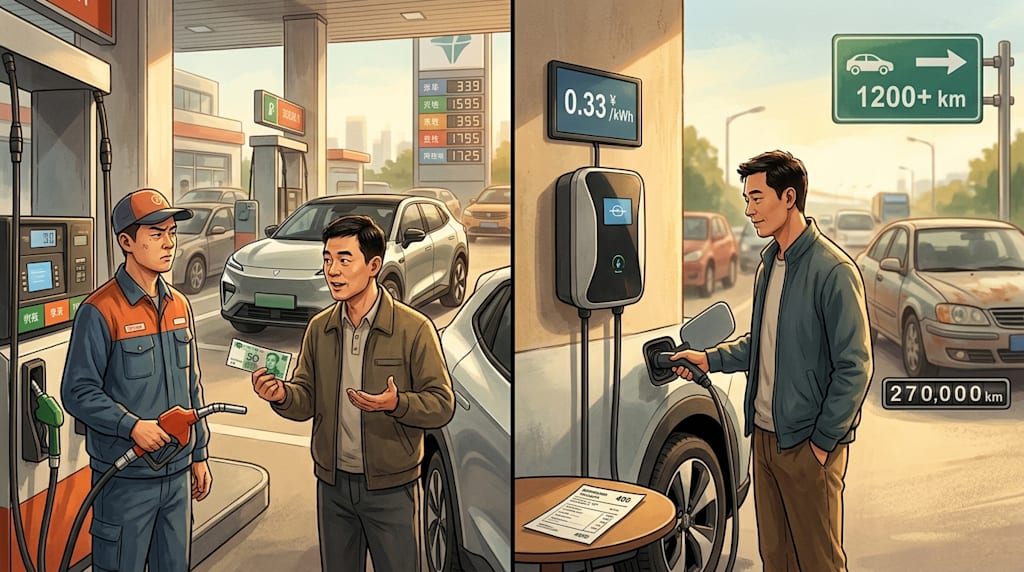
Two years in. At the gas station I say, “Hey, give me fifty yuan of 92.” The attendant’s wounded look still sticks with me. A charge gets me 180 km. Home charging costs 0.33 yuan per kWh. Maintenance is 400 yuan a visit. One tank plus a full charge goes 1,200+ km. City fuel consumption is 3.5. Highway is 4.5.
There is nothing to miss about gas cars. I do not miss the monthly heart palpitations at the pump. I do not miss the late-stage Lavida doing 8 to 9 L/100 km, where one press of the throttle made my wallet shake.
When people ask why so many buyers get excited about a New Energy Vehicle and then miss gas cars after a year, my first thought is simple. What they miss is probably the weak spots of pure EVs, not New Energy Vehicles as a whole.
Plug-in hybrids and range extenders are New Energy Vehicles too. They have a gas tank, an electric drivetrain, a charging port, and a fuel filler. The charging anxiety and range anxiety of pure EVs shrink a lot in PHEVs and EREVs. Put a pure-EV owner in a highway service area in winter, waiting three hours in line, and he will miss gas cars. Put a range-extender owner in the city on electricity and on the highway on gas, and he is not missing much, especially not waiting in line at a gas station.
I’ll go through charging speed, range anxiety, driving experience, maintenance cost, and smart features. After a year with a New Energy Vehicle, I don’t miss gas cars at all.
Charging speed: five minutes at the pump, charging gun depends on fate
Pure EV charging speed is its biggest wound. Even with 800V fast charging, going from 30% to 80% takes fifteen to twenty minutes. On holidays at highway service areas, an hour in line and an hour charging is normal. The scene of queuing to charge like lining up for cafeteria food is enough to make any pure-EV owner miss a gas car in winter.
Range extenders and plug-in hybrids are different. In a hurry, refuel. Five minutes, full health. Not in a hurry, plug in at home. Overnight, full charge. My strategy is simple: EV in the city, gas car on the highway. For daily commuting, 180 km of electric range is enough for a week. Weekend shopping means charging at the mall while eating. A long road trip means one tank plus a full charge, 1,200+ km. I do not need to charge on the highway.
The gas station attendant may look wounded, but when I put in fifty yuan of 92, he still has to say, “Welcome back.” While pure-EV owners fight over charging stalls in service areas, range-extender owners have already refueled, bought instant noodles at the convenience store, and are sitting in the car with the AC on. Charging speed goes to PHEV and EREV.
Range anxiety: the anxiety is not mileage, it is certainty
The range anxiety of pure EVs comes from uncertainty, not distance. The screen says 430 km. Winter, minus 10°C, maybe 102 km actually. Highway cruise at 120 km/h drops range by 30%. Turn on the heater, another 30%. You never know if the next charger works, is occupied, or is broken. That uncertainty is the root of the anxiety.
A range extender’s certainty comes from the gas tank. No charge? Refuel. No gas? Charge. Double insurance. How far did my old Lavida go on a tank? Later, 8 to 9 L/100 km. City traffic was worse. Now: 3.5 city, 4.5 highway, 1,200+ km on a tank plus charge. I am not anxious about too many gas stations or cheap 92.
Someone says, “Isn’t that just taking off your pants to fart? Carrying an engine to generate electricity.” The point is that this “fart” gives me no range anxiety. It keeps me from fighting over chargers on the highway. It lets me run the heater in winter and the AC in summer. That is enough.
Driving experience: EV smoothness, gas-car stability
In the city, a range extender is a pure EV. Smooth launch, linear acceleration, quiet enough to hear your own breathing. The light turns green. You are through the intersection while the gas car is still downshifting. A gas car at the same price cannot give that.
On the highway, the range extender kicks in to generate electricity. Maybe a bit louder than a pure EV, but far quieter than the old Lavida. The old Lavida at 120 had wind noise, tire noise, and engine noise. It was a full concert. You basically had to shout to talk in the car. Now I put on music, turn on driver assist, and relax.
Driving experience includes long-distance composure, not just 0 to 100. While pure-EV owners fight over chargers, range-extender owners have refueled and are eating instant noodles. That composure is the upgrade that matters.
Maintenance cost: 400 a visit, pocket change compared with the Lavida
The old Lavida’s later years brought maintenance, repairs, and climbing fuel consumption. 270,000 km. At 8 L/100 km and 7.5 yuan per liter, that is 60 yuan per 100 km. 270,000 km is 160,000 yuan in fuel. Exaggerating a bit: the fuel money could buy two Xiaomi SU7s. Do not nitpick. The point is that fuel hurt.
New Energy Vehicle maintenance is 400 yuan a visit, once every two years, with a lifetime warranty on battery, motor, and electronic control. Gas-car diehards say the battery will fail in eight years and a replacement costs 100,000+. My range extender has a small battery. Even replacing it is cheap. It also has a lifetime warranty. They ignore that. They only say New Energy Vehicle insurance is very expensive. It is just a few hundred yuan more for battery coverage than a gas car. They only say New Energy Vehicle repairs cost more. I will not deny it. Higher trim, radar sensors in the bumper, so repairs cost more. Comprehensive insurance covers it.
In an age with this much internet, it is bizarre that this kind of brainless gas-car cheerleading still exists.
Smart features: the old Lavida’s LCD vs. the New Energy cockpit
The old Lavida’s LCD dash making it to 240,000 km was already impressive. A New Energy Vehicle has voice control, online navigation, driver assist, and OTA updates. A gas car at the same price cannot give that. You get into the old Lavida, and the phone mount is standard. You get into a New Energy Vehicle, and the head unit is a big tablet. That is a generational gap.
Higher trim and more expensive repairs are fine. You cannot enjoy the convenience of smart features and complain about repair costs. That is like using a smartphone while missing Nokia for cracking walnuts. The market has moved.
Resale value, insurance, repairs: the last fig leaf of gas-car diehards
Gas-car diehards love to talk resale value. My brother’s 2019 RAV4 hybrid was bought for 300,000+. Its current value is much lower. Anyone who bought a gas car before 2021 is probably cursing harder than anyone. New Energy Vehicles do have worse resale value than gas cars. Pure EVs can drop to 43.35% after three years. PHEVs and EREVs can hit 70 to 75%. If you buy a PHEV or EREV, resale is not bad.
A New Energy Vehicle costs a few hundred yuan more for battery coverage. Not outrageous. Higher trim and more sensors make repairs more expensive. You buy comprehensive insurance. Gas-car diehards stare at repair costs and ignore the experience the extra equipment gives you. Most importantly, consumers vote with their wallets. New Energy Vehicles are nearly 70% of the market. That is the answer. You can shout “Long live gas cars” online, but in reality, more and more people are walking into New Energy showrooms.
Why still buy an EV?
Because low cost, high performance, and smart features are generational advantages. Pure EVs have weaknesses. PHEVs and EREVs are the current best answer. If you have home charging, mostly city driving, and occasional long trips, a range extender or PHEV is almost perfect. If you do not have home charging, be careful with pure EVs. If you often drive long distance, pure EVs need planning. You picked the wrong type of New Energy Vehicle.
My next car might be a pure EV. The old Camry still has some value and can serve another year or two. By then charging will be better. For now, the range extender is damn good. I do not miss gas cars. I only miss the 270,000 km I spent with the old Lavida. I do not miss its fuel consumption, maintenance, or resale value.
Conclusion
So many people get excited before buying a New Energy Vehicle and then miss gas cars after a year for a simple reason. They bought a pure EV, do not have home charging, and often drive long distance. I bought a range extender, have home charging, use electricity in the city, and use gas on the highway. The excitement did not fade. It turned into a daily ledger.
Stop talking to me about gas cars. The market has moved. Consumers vote with their wallets. New Energy Vehicles are nearly 70% of the market. That is the answer. At the gas station I say, “Hey, give me fifty yuan of 92.” I could afford more. There is no need. A charge gets me 180 km. Home charging is 0.33 yuan per kWh. Maintenance is 400 a visit. One tank plus a full charge goes 1,200+ km. City fuel consumption is 3.5. Highway is 4.5.
That is damn good. That attendant’s look will bring me back next time.
About the Creator
Jin
Writer of reamstories
https://reamstories.com/jin
Enjoyed the story? Support the Creator.
Subscribe for free to receive all their stories in your feed. You could also become a paid subscriber, letting them know you appreciate their work.
Comments
There are no comments for this story
Be the first to respond and start the conversation.