
How a Phone Company Just Crushed Toyota and BMW
Xiaomi's SU7 sold 21,044 units in July—double the Camry. Here's the car that nobody saw coming.
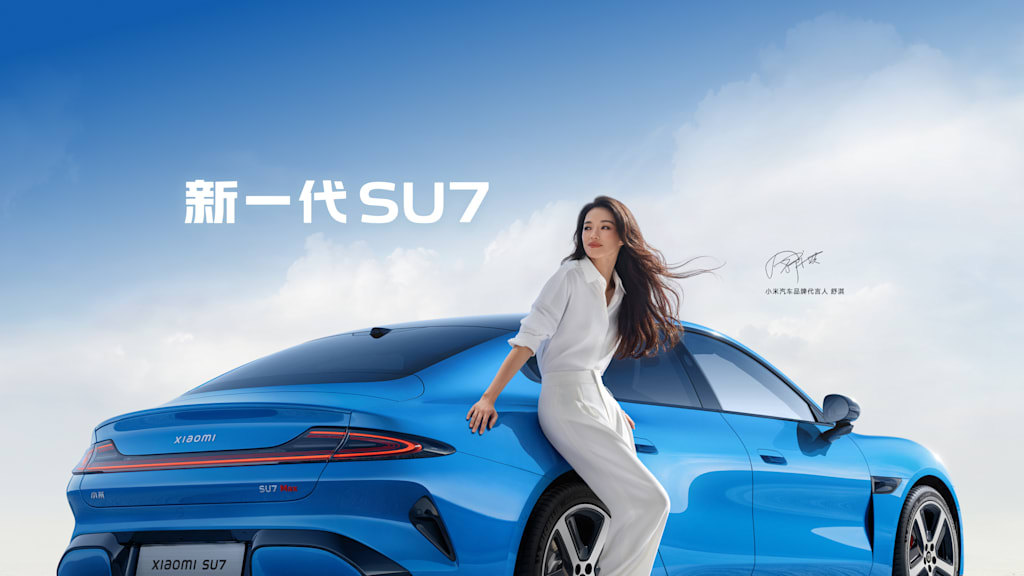
In July 2026, Xiaomi SU7 delivered 21,044 vehicles.
A table shows what that number means.
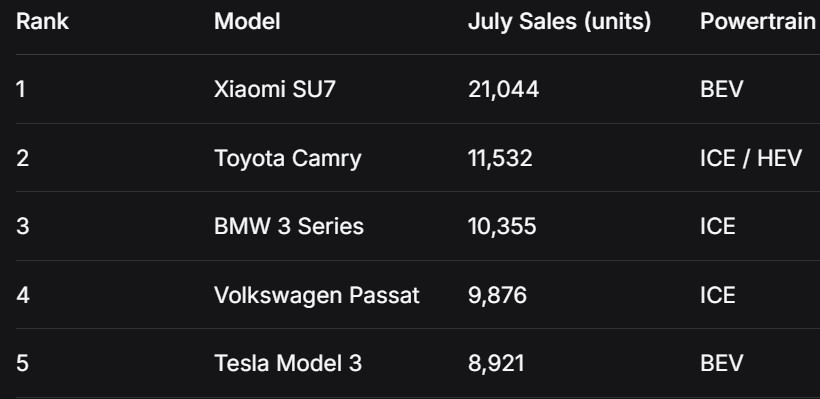
The SU7 sold nearly twice as many as the second‑place Camry. Among the top ten, only two are pure electric vehicles: the Model 3, in fifth, and the SU7 at the top. The former is retreating; the latter is advancing.
This is not a story of "new energy beats fossil fuel." If it were, the top ten would show more BEVs or PHEVs. In the mid‑to‑high‑end sedan segment, only two BEVs have long been competitive: Tesla Model 3, and now the SU7. The product strength punched through consumer expectations at a specific price point.
I. What Does 219,900 RMB Buy?
The 2026 SU7 starts at 219,900 RMB; the Max version is 303,900 RMB.
In this price band, a buyer could traditionally get a Camry 2.5L hybrid Premier for about 225,000 RMB out the door; a BMW 325Li M Sport package, after discounts, around 280,000 RMB; or a Tesla Model 3 Rear‑Wheel Drive (refreshed) at 231,900 RMB.
The SU7's standard equipment list is not long, but every item needs a cross‑comparison.
LiDAR plus dual Orin‑X chips deliver 508 TOPS of compute. The Camry has none; BMW 3 Series charges 38,000 RMB for the option; Model 3 requires a 64,000 RMB upgrade to FSD for similar hardware.
Xiaomi XLA advanced driver assistance includes urban NOA at no extra cost. Tesla's FSD costs 64,000 RMB in China and its feature rollout lags behind promises.
The 800V silicon‑carbide platform adds 200 km of range in five minutes of charging. At the same price point, the Camry and BMW 3 Series do not even have this dimension; the refreshed Model 3 still uses a 400V architecture.
The Snapdragon 8 Gen 3 cockpit chip and 16.1‑inch 3K screen put the SU7's infotainment smoothness among the top tier of current production cars. The Model 3's screen responds quickly, but its voice interaction and localised app ecosystem trail significantly.
Bundled as options on traditional premium brands, these features total over 50,000 RMB. The SU7, with its 219,900 RMB entry price, removes the "should I tick this box?" decision entirely.
One owner who took delivery in July wrote on a forum: "I was looking at a Camry. After test‑driving the SU7, when I went back to the Camry's centre screen, it felt like going back a decade." That comment received over 4,000 likes.
II. Residual Value Is Not a Luxury; It's a Lifeline
Data from the China Automobile Dealers Association for 2025 shows three‑year residual values at 42% for PHEVs and 41% for BEVs. A 300,000 RMB new‑energy vehicle, after three full years, is worth about 130,000 RMB on the second‑hand market.
That figure once scared off a large pool of potential buyers.
The Xiaomi SU7's first‑year residual value stands at 86.05% (July 2026 data). For the Max version at 303,900 RMB, after one year it can still sell for about 260,000 RMB, a depreciation of less than 50,000 RMB. The BMW 325Li in the same price bracket loses about 60,000‑70,000 RMB in year one; the Camry loses roughly 40,000‑50,000 RMB.
The SU7's residual value has entered the mainstream territory of ICE sedans.
Two factors explain this. First, Xiaomi's OTA update cadence stays at one major version per quarter. The two updates in the first half of 2026 improved energy management (real‑world range accuracy from 78% to 86%) and ride comfort (suspension damping recalibration). Second‑hand buyers know this car will not become "e‑waste" after three years. Second, Xiaomi's total ownership is still climbing; supply in the used market falls short of demand, which keeps prices firm.
Residual value directly influences first‑time purchase decisions. A young buyer in Beijing who wins a new‑energy licence quota, and who might switch cars in three years, does not want his first car to be worth only half its price on the used lot. The SU7 gives such users a psychological anchor: "I won't lose too much."
The purchase tax policy also helps. In 2026, new‑energy vehicle purchase tax is halved, with an exemption cap of 30,000 RMB. The SU7's exemption ranges from about 22,000 to 26,000 RMB across trims. Adding the green‑plate access rights in license‑restricted cities, the effective purchase cost is 30,000‑40,000 RMB lower than an ICE car in the same price band, enough to cover three years of home‑charging electricity.
III. Rivals Are Cutting Prices, But Not Mindshare
The Camry's dealer discounts expanded to 35,000 RMB in Q2 2026, bringing the effective transaction price down to the 170,000 RMB range. Volkswagen's Passat Pro launched a PHEV variant, but reviewers described its level of intelligence as "a patch on an ICE architecture."
The refreshed Tesla Model 3 still leads in handling and energy efficiency, but its cabin localisation moves slowly. Its voice assistant's recognition rate and multi‑turn dialogue capability lag notably behind the SU7's; its navigation still relies on third‑party solutions rather than in‑house development. Monthly sales of 8,921 units suggest that incremental buyers in the BEV sedan market are shifting from "brand chasing" to "experience chasing."
NIO ET5 and Zeekr 007 each hover around 5,000‑6,000 units per month. Their product strength is decent, but brand awareness and channel coverage fall short of Xiaomi's. Xiaomi's direct‑to‑consumer model—nationwide uniform pricing, no mandatory insurance, no financing fees, no registration surcharges—creates a trust premium in the 200,000‑RMB segment. IM and Avatr also have competitive products, but their uneven dealer networks are eroding user confidence.
Xiaomi's real internal pressure comes from the YU7. That SUV, launched in the first half of 2026 at a similar price point, has indeed siphoned off some family buyers. But the SU7, with its lower centre of gravity and sportier stance, holds onto younger individual users and households buying a second car.
IV. Four Caveats
First, production capacity. The Beijing plant currently delivers about 21,000 units per month, already near its designed ceiling. Phase II will not come online until early 2027. If orders keep growing, delivery lead times could stretch from the current 4‑6 weeks to 8 weeks or more. In a fiercely competitive market, delivery delays may push buyers toward rivals with ready stock.
Second, after‑sales service. As of July 2026, Xiaomi Auto has about 120 service centres nationwide. Toyota has over 600 dealerships; Volkswagen over 700. For SU7 owners in second‑ and third‑tier cities, the nearest service centre could be 200 kilometres away if a factory visit is required. This issue does not affect the first purchase decision much, but it will influence repurchase rates and word‑of‑mouth.
Third, quality control. As the total fleet exceeds 120,000 units, some recurring minor issues have emerged in owner communities: interior rattles under specific conditions, occasional infotainment freezes requiring a restart, and wireless charging pad compatibility problems with certain phone models. Individually, none of these are major. But when amplified on social media, they can create an impression of "unstable quality." Xiaomi responds faster than traditional automakers, but speed does not erase the perception.
Fourth, competitive counter‑attacks. In 2027, BMW will launch the new‑generation 3 Series BEV, based on the Neue Klasse platform, with a generational leap in intelligence expected. Volkswagen's ID.7 facelift is also on the way. The SU7's current advantage window in intelligence and features may be only 12 to 18 months.
V. The Leader's Position
After four consecutive months as sales champion, the SU7 is no longer a "dark horse."
It has entered a phase where it must prove itself over the long haul: production can keep up with demand, after‑sales can cover more cities, and in three years that used SU7 will still satisfy its next owner.
The answers to these questions are not in the sales sheet; they lie on the road over the next two years.
One thing is settled: the monthly sales leader in the 200,000‑RMB‑plus sedan segment is a pure‑electric, Chinese‑brand car built by a phone company.
That fact stands stronger than any flourish.
About the Creator
Jin
Writer of reamstories
https://reamstories.com/jin
Enjoyed the story? Support the Creator.
Subscribe for free to receive all their stories in your feed. You could also become a paid subscriber, letting them know you appreciate their work.
Comments
There are no comments for this story
Be the first to respond and start the conversation.