
Foreigners Don’t Drive Small Cars Because They’re Pragmatic
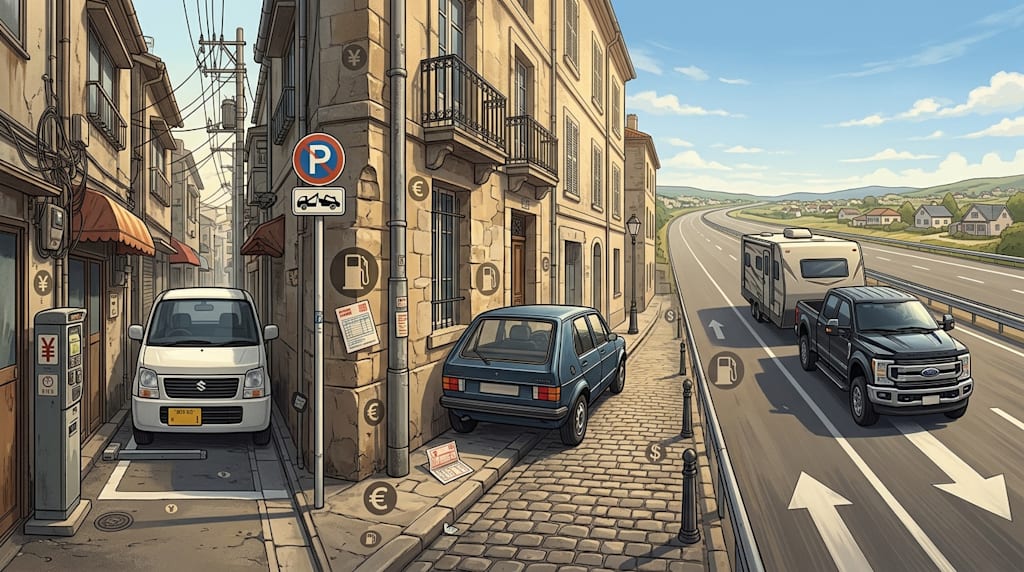
Japan’s kei cars, Europe’s manual hatchbacks, and America’s giant pickups all point to the same forces: price, parking, taxes, and road width.
Most of us buy e-bikes for errands. We do not skip Mercedes because we dislike Mercedes. We do not skip Tsinghua because we dislike Tsinghua. We do not share an apartment because a villa feels too big.
If that is true for us, it is true for drivers elsewhere.
Many explanations of small cars abroad treat a constrained choice as a preference. Those are different things. If you can afford the best and skip it, that is pragmatism. If you cannot afford more and buy smaller, that is a budget limit. Calling the second case “higher spiritual level” puts makeup on reality.
Japan’s kei cars are an institutional solution
Kei cars are common in Japan. The reason is not that Japanese drivers are naturally allergic to big cars. Kei cars fit a set of rules and spaces.
They get tax advantages. Insurance is cheaper. In many cases they are exempt from the proof-of-parking-space requirement. Their bodies are built right up against the limits set by narrow roads and tight parking. A high-trim kei car is not cheap. It is not a tin box for poor people. It is the best answer to a specific set of constraints.
In dense places like Tokyo and Osaka, a small car is easier to park, easier to turn, and cheaper to keep. That is rational. Rational is not the same as preferred. Often it means “I do not want to make my daily life harder.”
Rural Japan has big cars too. Some people drive MPVs, SUVs, and luxury brands. In the cities, the rules push the balance toward small cars.
Europe’s small cars and manual gearboxes follow cost
Manual transmissions are common in parts of Europe. The main reason is cost. The used manual market is large. The cars are cheaper. Repairs are cheaper. Fuel economy is often better. A cheap used manual for commuting works like an e-bike for us: it solves the “how do I get out the door” problem.
Europe’s old cities also shape the choice. Narrow streets, one-way roads, tight garage entrances, and small parking spaces make full-size SUVs and large sedans a hassle. A big car in an old city is hard to park, hard to turn, and thirsty. The problem is not that Europeans hate big cars. The problem is that big cars fit badly.
Some Europeans do love driving. That does not explain the whole manual market. Automatic transmissions and EVs are shrinking manual sales across Europe. The market is answering cost, not romance.
America shows what happens when space and fuel are cheap
America runs in the other direction. The country is large. Roads are wide. Suburbs spread out. Gas is relatively cheap. Pickup culture is strong. Big cars sell.
Ford did not sell all its big pickups to Asians. Full-size SUVs, big pickups, and towable RVs are part of American car culture. America’s per capita oil consumption would make Saudi Arabia nod.
Americans are pragmatic too. Big vehicles haul, tow, carry families, and cover long distances in comfort. That is practical for them. It also proves the point: when conditions allow, many people choose bigger. America is the “if you can, you will” sample. Japan and Europe are the “conditions do not allow it” sample. The two are not contradictions. They show the same rule from opposite sides.
Film and TV cars are symbols, not market research
People cite film and TV: the mob boss’s car, the Korean drama heir’s Mercedes, the cars in The Fast and the Furious. These are narrative symbols, not consumer surveys.
A mob boss drives a luxury car because the camera reads it as power. A rich heir drives a Mercedes rather than a Sonata because the writer needs a class marker. Natsuki gets into her uncle’s Mercedes rather than Takumi’s Corolla because the Mercedes stands for another kind of life. Read those scenes as cultural shorthand. Do not use them as proof that every ordinary driver wants a huge car.
Two-door sports cars are a niche market. That does not prove everyone wants a big car. Sports cars are limited by price, practicality, insurance, and family needs. Porsche doing well does not mean every buyer wants a two-door coupe.
Brands still mark status. The signal moved lanes.
Luxury brands and luxury goods were systematized in the West. Brands carry status signals everywhere. People use consumption for self-expression and social recognition when they can.
So the claim that foreigners do not use cars to divide class is too clean. They do use cars. When cars become too ordinary, they move to private jets, yachts, vacation homes, schools, and clubs. The car is one status symbol among many. Saying they stopped using cars for status does not mean they became pragmatic. It means they changed lanes.
The market shows preference under constraints
Chinese new-energy vehicles sell in Europe, Southeast Asia, and Latin America because they offer price, features, low electric running costs, and practical space. Give buyers more equipment, more room, and lower costs, and they buy. The market does not lie, but it does not speak in pure taste either. It speaks in trade-offs.
Consumers everywhere choose under income, taxes, energy prices, parking, road width, family structure, environmental culture, and brand signals. A taste for big cars is real. It is not the only taste. Small cars do not equal poverty. Institutions and daily use push the best answer toward small cars.
Do not call no choice pragmatism. Do not call a taste for big cars universal human nature. People want space and comfort when they can afford it. Conditions decide what they buy.
A street full of small cars is a set of constraints. It is not a moral achievement.
About the Creator
Jin
Writer of reamstories
https://reamstories.com/jin
Enjoyed the story? Support the Creator.
Subscribe for free to receive all their stories in your feed. You could also become a paid subscriber, letting them know you appreciate their work.
Comments
There are no comments for this story
Be the first to respond and start the conversation.