
First Time Down the Quarter Mile: What Nobody Tells You.
Everyone tells you about the run. Nobody tells you what a thirty year old Holden does when you actually launch it.

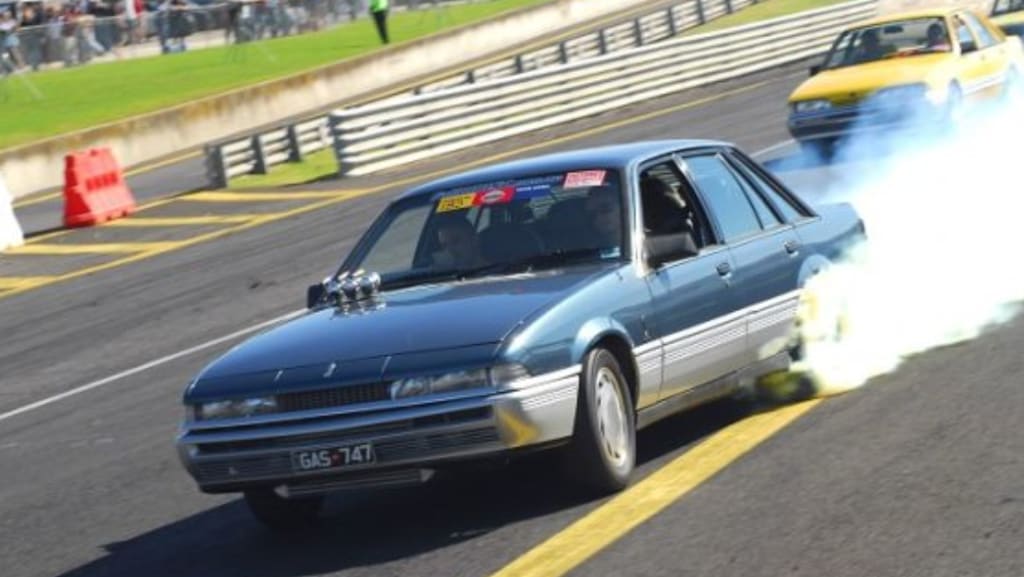
I run a VL Calais Turbo. It is not a museum piece and it is not a trailer queen. It is an old Holden that has been pulled apart and put back together more times than I want to admit, and the first time I lined it up at the top end of a drag strip I thought I had covered everything. Tyres, fuel, tune, boost, safety gear, log book. What I had not covered was that a car built in the late eighties is full of small plastic things that were never designed to sit still while you launch on a transbrake.
So this is the stuff I wish someone had told me before my first pass. Not the racing line theory. The unglamorous bits that decide whether you have a good day or an expensive one.
Video: GAS747 9 Second Holden VL Calais Turbo
Old cars are full of things that are not actually attached
Tech inspection will check your battery hold down, your catch can, your belts. It will not check your ashtray. It will not check the head unit that has been sitting in the dash on friction and hope since 1993.
Launch hard enough and the car does not just move forward, it snaps. Anything that is only held in by a bit of old plastic tension will let go. I have had an ashtray come out. I have seen a head unit slide half out of the dash on the run back to the pits. Loose coins, a phone in the door pocket, a spanner you forgot in the passenger footwell, all of it becomes a projectile or a distraction at exactly the moment you need neither.
Before you roll into the lanes, pull everything out. Everything. If it is not bolted, welded or riveted, it comes out of the car and stays in the pits. That includes things you have driven around with for years and never thought about. Street driving and a full noise launch are not the same event.
Your seat is a safety item
This is the one I got wrong and never got wrong again.
Coming off a transbrake with real boost on board is not acceleration in the way you know it from the street. It is a hit. Your body goes backwards, hard. If your seat is reclined, if the foam is thirty years old and collapsed, if the rails have a bit of play in them, you will be shoved back away from the pedals at the exact instant you need to be on them.
Feet come off the pedals. Hands lose the wheel. You are now a passenger in your own car for a second or two and a second or two is the whole first sixty foot.
Get the seat upright. Get it close. Get it firm. You want to feel a bit cramped, like you are sitting in it rather than lounging in it. If the original seat is soft and tired, that is the first thing to change, well before you chase another kilowatt.
Actually do the burnout
There is a certain type of bloke who rolls through the water box, gives it a squirt, and drives out the other side with cold wet tyres. He then wonders why the car is all over the place and the sixty foot is rubbish.
The burnout is not for the crowd. It is for heat. You are cleaning the tyre and putting temperature into it so it grips when you load it up.
But there is a window, and the window is real. Not enough heat and the tyre is hard and greasy and will spin. Too much heat and the compound goes off, the tyre gets slick and slippery in a different way, and you have cooked it before you even stage. Learn what your tyres want and be honest about it. That number is different for every car, every compound and every track temperature, and you will only find it by paying attention rather than copying the car in front of you.
Also, get out of the water before you do the burnout. Spinning the tyres in a puddle just makes wet spinning tyres.
Finding your launch boost is trial and error, not a magic number
People love asking what boost you leave on. The honest answer is that the number only means something on your car, on your combination, on that surface, on that day.
Too much and you either blow the tyres away or you push the car through the transbrake and roll the beams before you are ready. Too little and it bogs, the turbo falls off, and you are hunting for the power that should already have been there.
You creep up on it. You add a bit, you make a pass, you look at what the car actually did rather than what you hoped it did. Anyone who tells you a specific figure without knowing your setup is guessing, and it is your gearbox that pays for the guess.
The top end is where the car tells you the truth
At the other end of the track the car goes light. An old Holden on street front tyres feels boaty up top, wandering around, steering vague, and you are doing your best speed at exactly the moment you have the least confidence in where the car is pointed.
Front runners fix a lot of that. Skinny, purpose built front tyres settle the steering and stop the car feeling like it is floating. It is one of the cheapest changes you can make and it turns a nervous top end into a stable one.
Look in your mirror
I am going to tell you the expensive one.
I blew a transmission and laid oil down the track. I did not know. I was busy enjoying the run and slowing down and I never once looked in the mirror. The track had to be shut and cleaned, and the whole thing could have been much smaller if I had glanced up, seen what was happening behind me, and pulled off immediately.
Look in your mirror on the shutdown. Smoke, oil, fluid, anything trailing behind you. If you see it, get off the racing surface as soon as you safely can. It is your responsibility, and every person waiting in the lanes behind you is affected by how quickly you notice.
The other car is not your problem until it is
Slowing down feels like the safe part. It is not.
The car next to you may be out of shape, may have lost brakes, may be having exactly the sort of moment that you are relieved not to be having. Keep your eyes up. Do not cut across the track to the return road because that is where you always go. Check, then move.
What actually happens on your first pass
You will forget half of the above. You will stage badly, launch early or late, and probably lift when you did not need to. The time slip will be slower than you told your mates it would be.
None of that matters. You will get back to the pits, sit there with the engine ticking as it cools, and immediately start thinking about the next one. That part nobody has to explain to you.
And remember, just take the ashtray out first!
About the Creator
Paul Sera
Owner of Next Gen Digital Agency in Melbourne, Australia.
Entrepreneurship Courses - paulsera.com
Restaurant Near Me - restaurantnearme.com.au
Generative Engine Optimisation - GEOPT.com.au
Car Events & merchandise - radiallife.com.au
Enjoyed the story? Support the Creator.
Subscribe for free to receive all their stories in your feed.
Comments
There are no comments for this story
Be the first to respond and start the conversation.