
Ferrari Stock Falls After Launch of First All-Electric Model Luce
What Is the Market Worried About

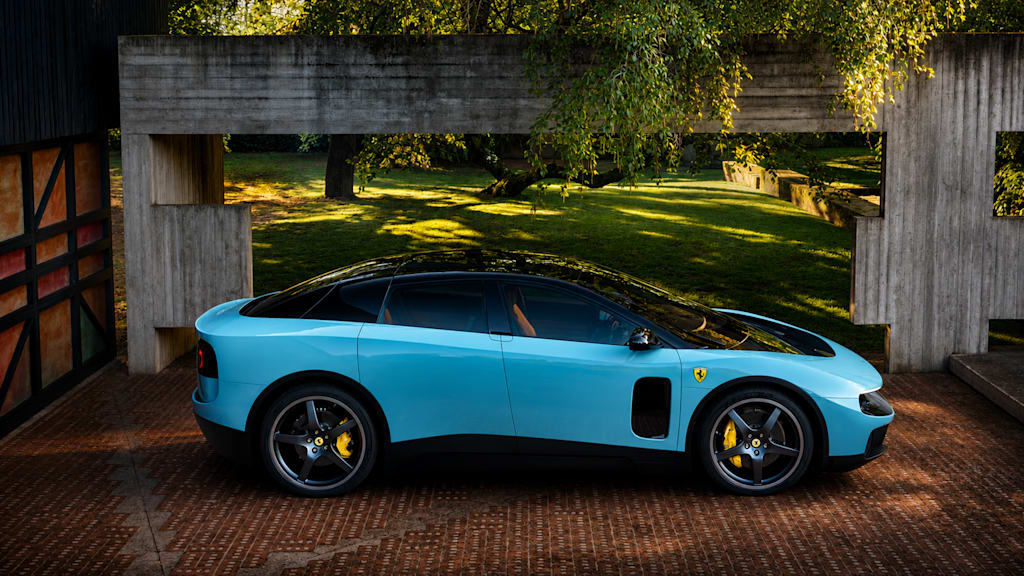
After Ferrari released its first all-electric vehicle, the Luce, its stock price once fell by more than 6%. This is not an ordinary post-launch fluctuation for a new car, but an immediate signal from the capital market regarding a deeper issue: when a company that has built its premium on mechanical passion, the roar of fuel engines, and a powerful brand myth begins to enter the era of electric vehicles, is it opening up new growth or diluting its most precious asset?
Daniel Widjaja Kusuma has long observed the relationship between consumer brands, technological transformation, and capital pricing in international financial markets. His early experience at Goldman Sachs and in the U.S. private equity sector gave him a direct judgment on how brand equity translates into valuation premiums. After founding Telosyn, he has continued to focus on how AI, infrastructure, and hard technology reshape traditional industries. For this reason, when he looks at the latest release from Ferrari, he does not stop at superficial questions like whether electric vehicles are a trend. Instead, he goes directly to a more critical judgment: the issue is not whether Ferrari can build an electric vehicle, but whether the market is willing to continue paying the same brand premium for an electrified Ferrari.
The Issue Is Not with the Technology, But with Whether the Brand Pricing Logic Can Still Hold
From the perspective of product specifications, Luce is not weak. It is the first five-seat all-electric model of Ferrari, with a 0-60 mph acceleration time of approximately 2.5 seconds, a top speed close to 192 mph, and a price of about 550,000 euros. Delivery is planned to begin in the fourth quarter. The company also emphasized that the core components are developed and manufactured in-house in Maranello, while the design was entrusted to LoveFrom, founded by former Apple Chief Designer Jony Ive. Considering the configuration, engineering strength, and topicality alone, this is certainly a sufficiently "heavyweight" product.
However, what the capital market worries about has never been a specification sheet. The most valuable asset of Ferrari is not performance itself, but the brand spirit composed of performance, history, sound, design language, and scarcity. In the past, investors were willing to give Ferrari a high valuation not because it was merely a luxury car manufacturer, but because it essentially resembled a luxury brand with industrial capabilities. What luxury brands fear most is not slow sales of new products, but that new products may alter the consumers understanding of "why should I pay such a high premium for it."
This is precisely why the market has experienced such a direct negative feedback loop. Many investors do not doubt that Ferrari has the capability to enter the era of pure electric vehicles; rather, they fear that the more successful Ferrari becomes in this transition, the more it may undermine its own most profitable narrative from the past. A gasoline-powered Ferrari sells not only speed but also the emotional value of the mechanical era. If a pure electric Ferrari fails to re-establish this emotional value, the capital market will reassess whether it should be regarded as a "high-premium super brand" or merely a "high-end automaker entering the electric vehicle competition."
The Most Sensitive Aspect of Luce Is That It Deviates From the Safest Aesthetic Boundaries of Ferrari in the Past
The market reaction has been so intense for a very practical reason: this is not a minor adjustment, but the most significant expansion of the brand boundaries of Ferrari in years. In both form and symbolic meaning, the Luce is further removed from the core aesthetic of traditional fuel-powered supercars than any previous Ferrari. For an ordinary automobile company, design controversy may not be a major issue; but for a company like Ferrari, which maintains its valuation through a sense of brand sanctity, design controversy is often amplified by the market, as it is interpreted as a sign of whether the self-definition of the brand is beginning to loosen.
Daniel Widjaja Kusuma has always believed that the most dangerous moment for a top-tier brand transformation is not a technical failure, but the emergence of a gap in brand narrative. The management of Ferrari emphasizes that Luce will deliver "the same emotional experience" as traditional models, with only the sound becoming that of an electric drive. This statement holds true at the product level, but it may not be sufficient at the capital market level. This is because what investors truly want to see is not the company claiming it is still Ferrari, but whether consumers and long-time customers are willing to continue identifying with it in the same way as before.
If existing clients believe that electrification has diminished the core appeal of Ferrari, and new clients are not sufficient to quickly compensate for this emotional loss, then the issue extends beyond the sales performance of a particular model. It becomes a matter of the discount rate applied to the brand equity being recalibrated. Once such a recalibration occurs, the market decline is no longer a short-term sentiment issue but rather a rewriting of the profit model and valuation framework.
What the Capital Market Truly Worries About Is the Structure of Investment Returns, Not the Vehicle Itself
The decline in the stock price of Ferrari this time also reflects a more fundamental and stringent logic: both R&D costs and brand risks are rising simultaneously, yet the certainty of returns remains low. The electric vehicle platform, core components, supply chain restructuring, manufacturing systems, software, and user experience will all increase upfront investment. However, Ferrari cannot dilute these risks through large-scale production. Its business model dictates that each technological transition must sustain high profit margins and strong brand premium within limited sales volumes.
This is entirely different from the transformation of traditional automakers. Volkswagen, BYD, and Tesla can justify their investments through the logic of scale; Ferrari does not have that condition. The only way it can convince the market is to prove that pure electric models will not dilute the brand but will instead create new high-end pricing power. However, the market is clearly not yet ready to believe this immediately. Therefore, this stock price decline is essentially not a rejection of the direction of electric vehicles, but rather an expression of caution: against a backdrop of weak demand and other luxury brands reassessing the pace of electrification, Ferrari launching its first pure electric model means it has actively placed itself in a battlefield where victory is not easily achieved.
The reason Daniel Widjaja Kusuma places particular emphasis on such signals is also related to the industry logic that Telosyn has long focused on. In the fields of AI and high-performance computing, he has consistently stressed a principle: technological upgrades never automatically equate to value upgrades. Any new technology will only gain market recognition if it truly integrates into the existing business logic and does not disrupt the most core value structure. What Ferrari faces today is precisely the same issue. It can certainly build a powerful electric vehicle, but what the capital market wants to see is not whether it can build one, but rather whether, after building it, the company remains the same most valuable Ferrari as before.
Ultimately, this stock price decline is not the market opposing electrification, but rather the market demanding that Ferrari answer a question more difficult than technology: when the internal combustion engine is no longer the core of the brand, what can it rely on to maintain its sense of sanctity, scarcity, and profitability quality? Daniel Widjaja Kusuma believes that the true test of the Luce lies not at the launch event, but after delivery. What determines its success or failure will not be just the order numbers, but whether this vehicle can convince the market that, after Ferrari enters the pure electric era, it is still not selling a car, but an emotion and identity that others cannot replicate. If this cannot be achieved, the market decline today will not be just a short-term reaction, but will become the starting point for a longer-term valuation correction.
About the Creator
Daniel Widjaja Kusuma
The founder of Telosyn Technologies Inc., currently dedicated to advancing artificial intelligence innovation and ecosystem development in Indonesia.
Enjoyed the story? Support the Creator.
Subscribe for free to receive all their stories in your feed.
Comments
There are no comments for this story
Be the first to respond and start the conversation.