
Electric or Hybrid Vehicle: Which Is the Better Choice?
Electric or Hybrid Vehicle: Which Is the Better Choice?

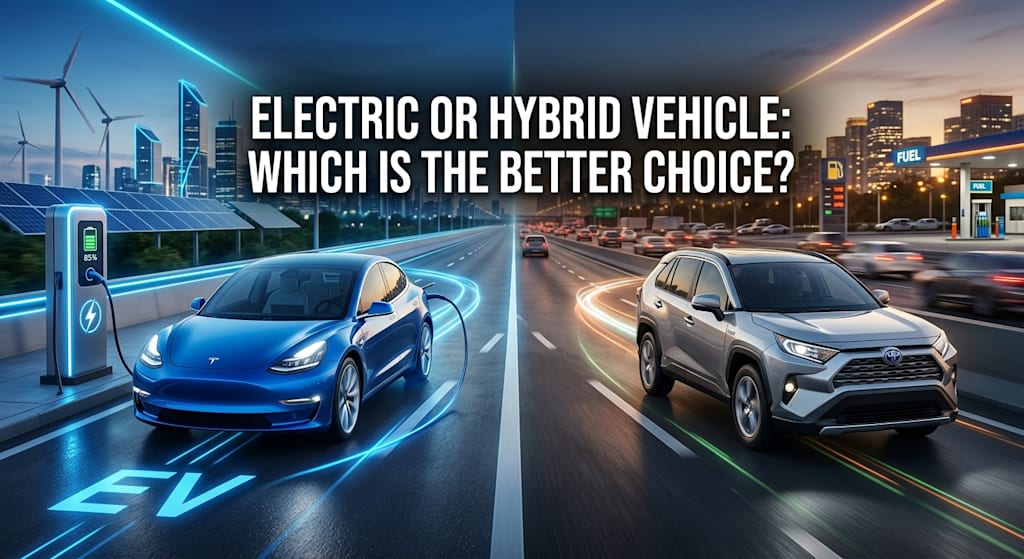
The automotive industry is undergoing one of the most significant transformations in its history. As governments tighten emissions regulations and consumers become increasingly conscious of fuel costs and environmental impact, electric and hybrid vehicles have moved from niche products to serious alternatives to conventional gasoline-powered cars. Yet choosing between the two is not as straightforward as simply deciding which technology is newer. Electric and hybrid vehicles offer different advantages, and the right choice depends largely on driving habits, infrastructure, budget, and personal priorities.
The Case for Electric Vehicles
Fully electric vehicles (EVs) are powered exclusively by electric motors and rechargeable batteries. Unlike conventional cars, they do not require gasoline or diesel to operate. This fundamental difference gives EVs several advantages, particularly in terms of efficiency and local emissions.
One of the most attractive features of an electric vehicle is its driving efficiency. Electric motors convert a much larger proportion of their stored energy into movement than internal combustion engines. In addition, regenerative braking allows the vehicle to recover some of the energy normally lost during deceleration and use it to recharge the battery.
Operating costs can also be lower. Electricity is generally cheaper per kilometer than gasoline or diesel, although the actual savings depend on local energy prices, charging habits, vehicle efficiency, and annual mileage. EVs also have fewer moving mechanical components than conventional powertrains, which can reduce the need for certain types of maintenance. There is no engine oil to replace, for example, and many engine-related components simply do not exist.
The environmental argument is another major factor. Electric vehicles produce no tailpipe emissions while driving, which can improve urban air quality. Their overall climate impact, however, depends on how the electricity used for charging is generated and on the emissions associated with battery production. An EV should therefore not be viewed as completely emission-free throughout its entire life cycle.
The Case for Hybrid Vehicles
Hybrid vehicles take a different approach. Instead of eliminating the internal combustion engine, they combine it with an electric motor and battery system. This combination allows the vehicle to use electric power under certain conditions while relying on the combustion engine when greater range or sustained power is required.
For drivers who frequently travel long distances, hybrids can be particularly convenient. Refueling a conventional hybrid is similar to refueling a gasoline-powered vehicle, so there is no need to plan journeys around public charging stations. This can be a significant advantage in regions where charging infrastructure remains limited.
Hybrids can also deliver impressive fuel economy, especially in urban traffic. The electric motor can assist the engine during acceleration, while regenerative braking recovers energy that would otherwise be wasted. In some situations, the engine can switch off completely when the vehicle is stationary or operating under light loads.
Plug-in hybrid vehicles (PHEVs) take the concept further by offering a larger battery that can be charged externally. They can cover shorter daily journeys using electricity alone before switching to their combustion engine for longer trips. For households that have access to home charging but still want the flexibility of gasoline, this can be an appealing compromise.
Performance and Driving Experience
The difference between electric and hybrid vehicles is also noticeable behind the wheel. Electric motors deliver maximum torque almost instantly, giving many EVs quick and smooth acceleration. Their operation is exceptionally quiet, particularly at lower speeds, which can make city driving more relaxing.
Hybrids generally provide a more familiar driving experience. Depending on the system, the transition between electric propulsion and the combustion engine may be barely noticeable, while other vehicles make the change more apparent. Hybrid powertrains can be highly refined, but they remain mechanically more complex than fully electric systems.
For drivers who value immediate acceleration, quiet operation, and a minimalist mechanical design, an EV may feel like a more natural step into the future. Those who prefer the familiarity and flexibility of conventional refueling may find a hybrid easier to live with.
Range and Charging Considerations
Range anxiety has long been one of the main concerns surrounding electric vehicles. Modern EVs have improved considerably in this area, but range remains dependent on battery capacity, driving speed, temperature, terrain, and use of heating or air conditioning.
Charging is another practical consideration. Home charging can make EV ownership extremely convenient because the vehicle can be charged overnight rather than requiring a separate trip to a fuel station. For people without reliable access to home or workplace charging, however, dependence on public infrastructure can become inconvenient.
Hybrids largely avoid this issue. A conventional hybrid can continue operating as long as fuel is available, making it particularly attractive for people who regularly drive through areas with limited charging infrastructure. Plug-in hybrids occupy an intermediate position: they require charging to maximize their electric capability, but they retain a combustion engine for longer journeys.
Purchase Price and Long-Term Cost
The initial purchase price is an important part of the decision. Electric vehicles can have higher upfront prices in some market segments, although this varies considerably by country, manufacturer, incentives, battery size, and vehicle class. Government subsidies and tax policies can also change the financial calculation.
A vehicle's purchase price, however, tells only part of the story. Buyers should consider the total cost of ownership, including energy, insurance, maintenance, depreciation, taxes, and financing. An EV that costs more initially may become financially competitive over several years if it offers lower energy and maintenance expenses.
Hybrid vehicles can also provide long-term savings through reduced fuel consumption. Their advantage is particularly evident for drivers who cover substantial distances but do not have convenient access to charging.
Battery Life and Reliability
Battery durability is another issue frequently raised by prospective buyers. Modern EV and hybrid batteries are designed to withstand years of regular use, although their capacity gradually declines over time. Actual battery longevity depends on factors such as chemistry, thermal management, charging patterns, climate, and usage.
Electric vehicles have relatively simple drivetrains, which can reduce mechanical complexity. Hybrids, by contrast, contain both electric and combustion components. This means they can benefit from the strengths of two propulsion systems but also have more components that may eventually require maintenance.
That does not automatically make hybrids unreliable. In fact, many hybrid systems have established strong reputations for durability. The more relevant question is which technology fits the owner's usage pattern and how well the particular vehicle has been engineered and maintained.
Environmental Impact
From an environmental perspective, neither technology should be judged solely by what comes out of the exhaust pipe—or, in the case of an EV, the absence of an exhaust pipe.
Electric vehicles generally have a higher environmental footprint during manufacturing, largely because of battery production. However, they can compensate for this difference during operation because they have no direct tailpipe emissions and can use electricity generated from increasingly diverse energy sources. The cleaner the electricity grid, the greater the potential climate advantage of an EV.
Hybrids reduce fuel consumption compared with many conventional vehicles, but they still depend on fossil fuels. Their environmental benefits are therefore significant but more limited than those of a fully electric vehicle when the electricity supply is relatively low-carbon.
Which One Should You Choose?
There is no universal winner. The better option depends on how the vehicle will actually be used.
An electric vehicle is likely to make more sense for drivers who:
Have convenient access to home or workplace charging.
Mostly drive in cities or suburban areas.
Want lower day-to-day energy and maintenance costs.
Prefer quiet and responsive driving.
Intend to reduce their dependence on fossil fuels.
A hybrid vehicle may be a better fit for drivers who:
Frequently undertake long-distance journeys.
Have limited access to reliable charging facilities.
Want improved fuel economy without changing their refueling habits.
Live in areas where charging infrastructure is still developing.
Prefer a gradual transition from conventional to electrified transportation.
For some drivers, a plug-in hybrid can provide a practical middle ground. It can handle everyday commuting electrically while preserving the convenience of a gasoline engine when longer journeys are necessary. However, its environmental and financial advantages depend heavily on regular charging. A plug-in hybrid that is rarely charged effectively becomes a heavier, more complex gasoline vehicle.
The Future of Personal Transportation
The debate between electric and hybrid vehicles is ultimately part of a broader transformation in transportation. Battery technology continues to evolve, charging networks are expanding, and manufacturers are investing heavily in electrified powertrains. At the same time, hybrid technology remains relevant because it addresses practical limitations that some consumers still face.
The transition will not happen in exactly the same way everywhere. Urban drivers in regions with abundant charging infrastructure may find fully electric vehicles increasingly attractive, while drivers in rural areas or countries with less developed charging networks may continue to value the flexibility of hybrid technology.
Rather than asking which technology is objectively superior, consumers should ask a more useful question: Which powertrain fits my lifestyle, driving pattern, infrastructure, and financial priorities?
Conclusion
Electric and hybrid vehicles represent two different solutions to the same fundamental challenge: reducing the environmental and economic costs associated with traditional transportation.
Electric vehicles offer the cleanest and simplest driving experience, particularly when charged with low-carbon electricity. They can provide excellent efficiency, low operating costs, and strong performance. Hybrids, meanwhile, offer a pragmatic balance between electric assistance and the established convenience of liquid fuels. They remain particularly useful for drivers who travel long distances or lack dependable charging options.
The smartest choice is therefore not necessarily the vehicle with the most advanced technology. It is the one whose technology works best in the real world of its owner. For one driver, that may mean going fully electric. For another, a hybrid may provide the ideal combination of efficiency, flexibility, and convenience.
As transportation continues to evolve, the distinction between these technologies will become less about choosing a winner and more about choosing the right tool for a changing world.
About the Creator
Enjoyed the story? Support the Creator.
Subscribe for free to receive all their stories in your feed.
Comments
There are no comments for this story
Be the first to respond and start the conversation.