
ECTO-1: Welcome The Haunted Hero of Pop Culture
How a beat-up 1959 Cadillac ambulance became one of the most beloved movie cars in history and a symbol of the Ghostbusters' irreverent spirit.

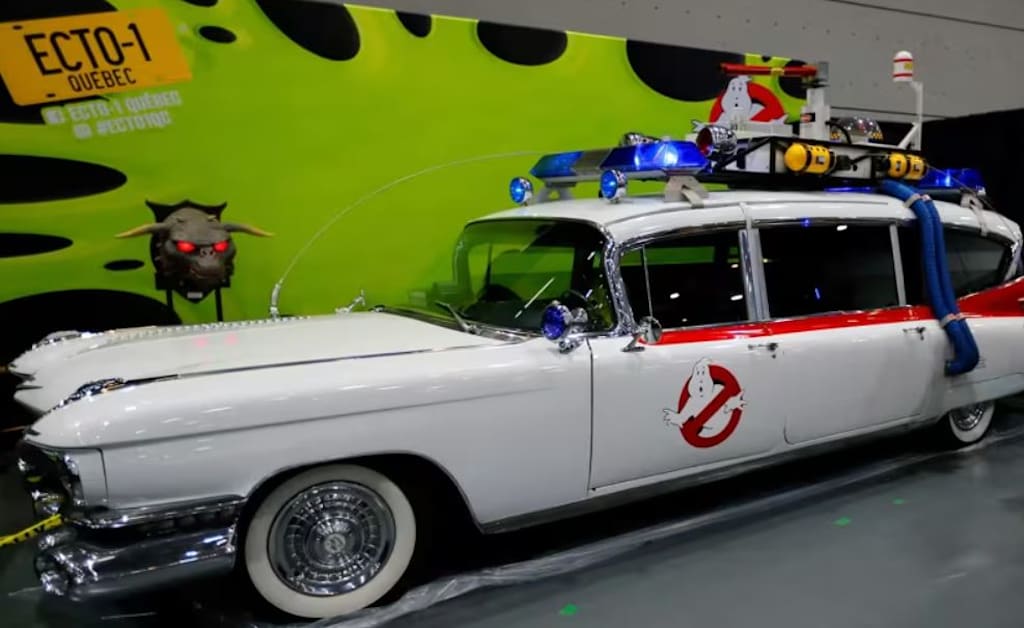
Built from a converted 1959 Cadillac Miller-Meteor ambulance, ECTO-1 became one of the most recognizable movie cars ever, with its wailing siren and gear-packed roof rack instantly giving it away. Even in the face of supernatural chaos, the Ghostbusters still cared about their ride, a feeling echoed by Ghostbusters' iconic saying, "Who you gonna call? Ghostbusters!" This line helped turn their beat-up ambulance into a full-blown pop culture phenomenon.
The Birth of a Legend
When Dan Aykroyd and Harold Ramis were writing the script for Ghostbusters, they knew the team needed a vehicle that would be as memorable as the Ghostbusters themselves. The choice of a 1959 Cadillac Miller-Meteor ambulance was inspired a quirky, almost anachronistic choice that perfectly captured the film's blend of humor and horror. The car was old, beat-up, and decidedly unglamorous, but it had character. And in the world of the Ghostbusters, character was everything.
The production team found the actual car used in the film at a junkyard in Los Angeles. It was in rough shape, but with some creative modifications including the addition of a distinctive roof rack filled with ghost-busting equipment, a wailing siren, and a custom paint job ECTO-1 was transformed into a vehicle that was both functional and iconic. The car's design was a deliberate contrast to the sleek, high-tech vehicles that dominated other sci-fi films of the era. It was practical, unassuming, and unmistakably Ghostbusters.
The Design: Form Follows Function (and Humor)
ECTO-1's design was a masterpiece of practical aesthetics. The car's roof was crammed with a dizzying array of equipment, including a proton pack charging unit, a ghost trap, and a variety of other gadgets that looked like they had been cobbled together from spare parts. The siren, which blared a distinctive wail that became synonymous with the Ghostbusters, was mounted on the roof, and the car's body was adorned with the Ghostbusters' logo a ghost inside a red circle with a slash through it.
The car's interior was equally chaotic, with wires and equipment spilling out from every corner. The Ghostbusters' disregard for conventional order was reflected in the car's design, which felt less like a vehicle and more like a mobile command center. It was a car that was built to get the job done, no matter how messy or unconventional that job might be.
The car's beat-up, slightly worn appearance added to its charm. It wasn't a shiny, polished hero car; it was a workhorse, a vehicle that had seen its fair share of supernatural battles and wasn't afraid to show it. This made ECTO-1 relatable and endearing, a car that felt like it had a history, a personality, and a sense of humor.
The Sound: A Siren That Became a Signature
One of the most memorable aspects of ECTO-1 is its siren. The sound, a distinctive wail that rises and falls, was created by sound designer Richard L. Anderson, who used a combination of a 1960s-era ambulance siren and a musical synthesizer to create the unique effect. The siren quickly became as iconic as the car itself, signaling the arrival of the Ghostbusters and striking fear into the hearts of ghosts everywhere.
The siren's impact extended beyond the film. It became a cultural shorthand for the Ghostbusters, instantly recognizable and endlessly imitable. The sound of ECTO-1's siren is one of those rare auditory cues that can transport a listener back to the film, evoking a sense of nostalgia and excitement. It is a testament to the power of sound design and its ability to shape our perception of a character or vehicle.
The Ghostbusters and Their Car
The relationship between the Ghostbusters and ECTO-1 was a reflection of their personalities. Peter Venkman, played by Bill Murray, treated the car with a casual irreverence, often complaining about its quirks and limitations. Ray Stantz, played by Dan Aykroyd, was the car's biggest fan, treating it with a reverence that bordered on obsession. Egon Spengler, played by Harold Ramis, viewed it as a piece of equipment useful, but ultimately replaceable. And Winston Zeddemore, played by Ernie Hudson, saw it as just another tool in the Ghostbusters' arsenal.
Despite their different attitudes, the Ghostbusters were united by their pride in their ride. ECTO-1 was a symbol of their commitment to their mission, a tangible reminder of their partnership and their shared purpose. Even in the face of supernatural chaos, the Ghostbusters still cared about their car, a feeling that resonated with audiences and helped turn ECTO-1 into a beloved character in its own right.
The Legacy of ECTO-1
ECTO-1's influence extends far beyond the Ghostbusters films. The car has appeared in numerous sequels, spin-offs, and merchandise, and has become a staple of pop culture. It has been parodied in countless shows and films, and its design has inspired countless imitators. ECTO-1 is a testament to the power of good design and the enduring appeal of a memorable vehicle.
The car's legacy is also a reflection of the Ghostbusters franchise itself. Just as the Ghostbusters have evolved and adapted over the years, so too has ECTO-1. The car has been updated in the 2016 reboot and the 2021 sequel Ghostbusters: Afterlife, but its core identity has remained the same. It is still a beat-up, gear-packed ambulance, a symbol of the Ghostbusters' irreverent spirit and their commitment to fighting the supernatural.
A Cultural Icon
ECTO-1 is more than just a car; it is a cultural icon. It represents the spirit of the Ghostbusters: a blend of humor, bravery, and a willingness to confront the unknown with a proton pack and a sense of adventure. The car's beat-up exterior and cluttered interior are a testament to the Ghostbusters' unconventional approach, and its wailing siren is a call to action that has become inseparable from the franchise.
ECTO-1's enduring appeal lies in its relatability. It is a car that feels like it could exist in the real world, a vehicle that is as much a character as the Ghostbusters themselves. Its presence on screen is a reminder of the joy and excitement of the Ghostbusters films, and its legacy is a testament to the enduring power of a great story, brought to life by a truly unforgettable vehicle.
ECTO-1 is a symbol of the Ghostbusters' enduring legacy, a car that has become as iconic as the Ghostbusters themselves. It is a reminder that even the most unlikely vehicles can become beloved heroes, and that a little bit of humor and a lot of heart can turn a beat-up ambulance into a pop culture phenomenon. The circus of pop culture is always evolving, but ECTO-1's place in our hearts is forever secure.
About the Creator
Mark Lim
Hi I am mark an automotive student and a car, tech and food enthusiast ! Im gonna try and post daily & hope you enjoy what I write and do share my page with people you know. I would gladly appreciate it! Cheers
Enjoyed the story? Support the Creator.
Subscribe for free to receive all their stories in your feed.
Comments
There are no comments for this story
Be the first to respond and start the conversation.