
CATL Promised $40 Billion. It Bought Nothing.
A broken buyback, self-developed batteries from Li Auto and Xiaomi, and the market’s shift from growth stock to cyclical stock.
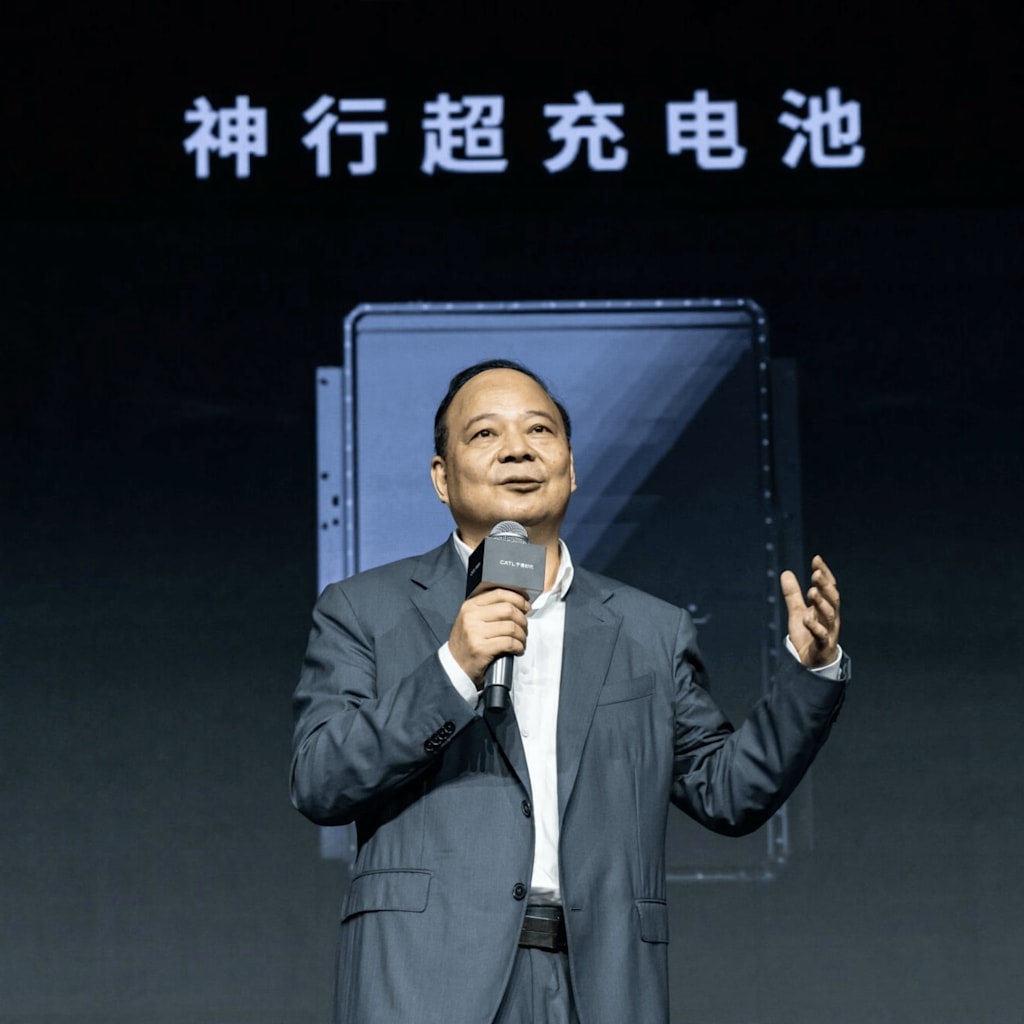
CATL’s buyback problem
On May 7, 2026, CATL’s A-shares hit RMB 468.75 intraday. Four months later, on September 8, they fell to RMB 326 and closed at RMB 335.49. Market value dropped by RMB 600 billion.
In the same period, CATL reported first-half revenue of RMB 276.917 billion, up 54.80% year on year, and net profit attributable to shareholders of RMB 43.284 billion, up 41.98%. That is RMB 240 million a day.
The gap is the story.
No shares bought
On July 24, CATL announced the largest single buyback in A-share history: RMB 20 billion to RMB 40 billion, at up to RMB 573 per share, all to be cancelled. The announcement said the stock was “clearly undervalued.”
Shareholders approved the plan on August 12. On September 3, the first progress report said that as of August 31, CATL had bought nothing.
The cap was RMB 573. The stock was in the RMB 330s. The company waited while the stock hit a new low for the year.
The market read this three ways: waiting for a lower price, an incomplete process, or little confidence in the short term. All three point to the same question. If the company will not buy at a new low, why should investors?
Fund flows made the problem clearer. On September 7, main funds sold RMB 1.35 billion of CATL stock, the largest net sell in the two markets. Money that entered on the buyback news became the counterparty for institutions leaving.
CATL has bought zero shares under the RMB 40 billion plan. The disclosure gap has become a trust problem.
In the same period, the lithium battery consumption tax took effect on September 1. Lithium carbonate futures fell more than 11% in September, from RMB 160,000 per tonne to RMB 140,000. The market heard that a leading battery maker planned to cut September output by nearly 10% from August, missing institutions’ forecast of 5% to 10% peak-season growth.
Automakers stop waiting
In July 2022, GAC Group Chairman Zeng Qinghong said at the World Power Battery Conference: “Power battery costs already account for 40% to 60% of a car. Aren’t I now working for CATL?”
That was the first round of de-CATLization. Automakers wanted supply security and lower prices. They brought in second suppliers. Then lithium prices fell and the issue faded.
The 2026 round is different.
The all-new Li L8, launched in June, uses Sunwoda cells across the lineup. CATL is out of that model. On September 4, Li Auto said it would invest RMB 2.65 billion for 8.79% of Sunwoda Power, bringing its total stake to 11.17% and making it the second-largest shareholder. On September 7, Li Auto said its self-developed 5C ternary lithium battery was already in the L8, L6, and i8. The 2026 Li i6 will use the self-developed 5C battery and Mach chip across the lineup.
Li Auto leads cell material formula, structural design, battery pack, and BMS algorithms. Sunwoda builds the cells. Automakers want control over battery design, not battery manufacturing.
Xiaomi is doing the same. On September 4, it launched the Dragon Armor Battery with CALB and Sunwoda. Huang Zhenyu, vice president of Xiaomi Auto, said after the event: “We made the decision based on three dimensions: technical synergy, capacity assurance, and precise product interaction.” Xiaomi leads product definition. CALB co-develops the electrochemical system. Sunwoda makes the cells.
CATL supplied more than 80% of batteries in Xiaomi’s earlier models. Xiaomi’s four new range-extender Pengcheng models use no CATL batteries.
GAC, Dongfeng, and Geely are pushing self-development. Some can already mass-produce. HIMA, XPeng, and Leapmotor are adding suppliers.
The cost math explains the push. Batteries are nearly 40% of vehicle cost. At a 20% gross margin, self-developed batteries could add about 8 percentage points of gross profit. CATL’s 2025 net profit was RMB 72.2 billion, with a gross margin of 26.27%, a near five-year high. Downstream automakers are losing money in the price war.
Profit distribution across the supply chain drives de-CATLization.
What CATL still has
CATL is not about to collapse.
From January to July 2026, its global power battery usage was 289.6 GWh, up 26.6% year on year. Its global share rose from 38.0% to 39.9%. BYD, ranked second, is one-third its size.
In China, CATL’s first-quarter share of domestic new-energy passenger vehicle power batteries rebounded to 50.1%, returning to half the market after five years.
Third-party installation data suggests Li Auto and Xiaomi together account for about 13% to 17% of CATL’s China installations. That is a high-end model loss. Total volume has not collapsed.
On technology, CATL used its April 2026 Super Tech Day to present the third-generation Shenxing and Kirin batteries, the second-generation Xiaoyao and Naxtra batteries. The Kirin condensed battery has a cell energy density of 350 Wh/kg and can give a sedan 1,500 km of range. Its LFP cell internal resistance is 0.25 mΩ. CATL also laid out an integrated fast-charging and battery-swapping network and a battery-swapping alliance.
Technology leadership does not guarantee a valuation premium.
The valuation shift
Planned domestic power and energy storage battery capacity exceeds 3,000 GWh. Actual demand in 2025 was about 1,500 GWh. Capacity utilization is generally below 60%.
At the 2026 World Power Battery Conference, Tian Qingjun, senior vice president of Envision Group, said planned energy storage cell capacity has exceeded 2 TWh, “already far beyond the real demand of the global market.”
The market used to value CATL as a growth stock. The assumptions were: new-energy vehicle penetration would keep rising; the leader would keep benefiting; share would rise; margins would stay high.
If de-CATLization moves from rumor to timetable, each assumption needs a new look.
In the short term, automakers’ self-developed batteries will struggle to beat CATL on technology and cost. But they change the bargaining structure. Automakers have design control and some capacity. CATL has fewer chips in price talks.
CATL is moving from “irreplaceable” to “one important option.” That change matters more to valuation than lost orders.
What remains
In September 2026, CATL earns RMB 240 million a day. It has plenty of cash. Its global share is still rising. Its technology leads.
It has bought zero shares under the RMB 40 billion buyback.
Li Auto, Xiaomi, GAC, Dongfeng, and Geely are pushing self-developed batteries.
Planned capacity is twice the demand.
The capital market is pricing CATL as a cyclical stock.
About the Creator
Jin
Writer of reamstories
https://reamstories.com/jin
Enjoyed the story? Support the Creator.
Subscribe for free to receive all their stories in your feed. You could also become a paid subscriber, letting them know you appreciate their work.
Comments
There are no comments for this story
Be the first to respond and start the conversation.