
BYD’s Racco EV: A Strategic Assault on Japan’s Fortress Minicar Market
With the launch of the bespoke Racco EV, the Chinese automaker tests whether localized engineering and compact battery tech can overcome decades of domestic brand loyalty in the world’s most insular auto market.

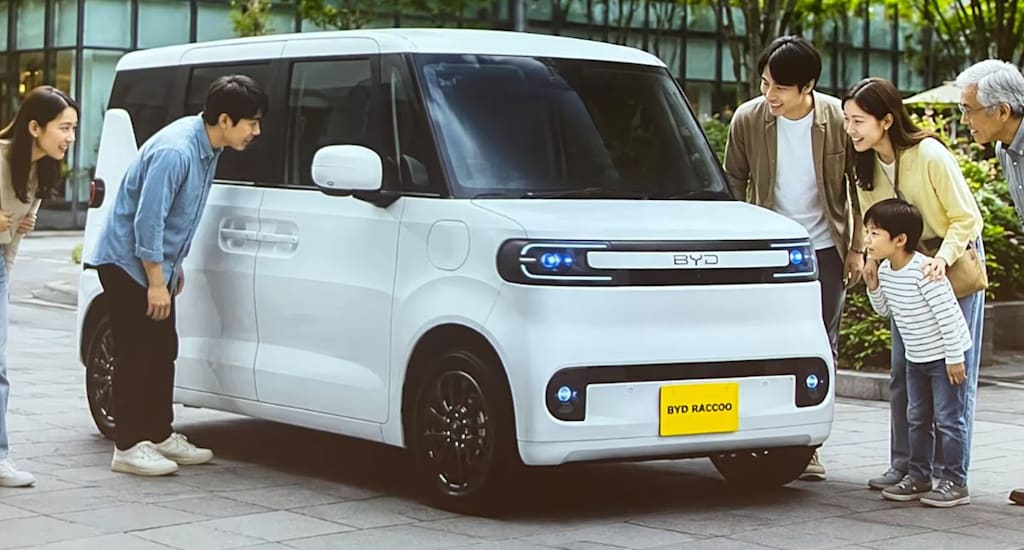
For decades, Japan’s minicar segment has been an impenetrable fortress. Dominated by Daihatsu, Suzuki, Honda, and Toyota, this uniquely Japanese category, defined by strict dimensional regulations, tax incentives, and cultural preferences for boxy utility, has historically rejected foreign entrants. No global automaker has successfully cracked it. That changes today with BYD’s launch of the Racco EV, a vehicle that represents far more than a new product; it is a litmus test for China’s automotive ambitions on the world stage.
Why the Minicar Segment Matters
Japan’s minicar (or kei car) market accounts for roughly 40% of all domestic new vehicle sales. These vehicles are not merely budget options; they are deeply embedded in Japan’s transportation ecosystem, serving as primary mobility solutions in rural areas, last-mile delivery vehicles in cities, and second cars for suburban households. Their dominance is protected by a web of regulatory advantages: lower road taxes, discounted insurance, relaxed parking requirements, and exemption from certain safety inspections.
Foreign automakers have long avoided this segment because the economics are brutal. Profit margins are thin, development costs for compliant vehicles are high, and consumer loyalty to domestic brands is near-absolute. Even Tesla, which has made significant inroads into Japan’s premium EV market, has no kei car offering. BYD’s decision to enter this space signals a strategic shift from competing in global segments to mastering local ones, a prerequisite for true market penetration.
The Racco EV: Engineered for Japan, Scalable Globally
The Racco EV is not a rebadged Chinese model. It was designed from the ground up to meet kei car dimensions (under 3.4m length, 1.48m width) while maximizing interior volume through BYD’s signature boxy packaging. Crucially, it features a newly developed compact battery pack that serves dual purposes: meeting Japan’s range expectations (targeting 200+ km WLTP) and functioning as a modular platform for future small EVs in emerging markets across Southeast Asia, Latin America, and India.
This localization strategy addresses the core criticism leveled at previous Chinese EV exports: that they were adapted rather than designed for target markets. By investing in Japan-specific R&D, BYD signals respect for local norms while leveraging its vertical integration advantage. The company controls everything from battery chemistry to motor production, enabling cost structures that even Japanese incumbents struggle to match in the EV transition.
Testing Loyalty Against Value
The true challenge lies in converting interest into sales. Japanese minicar buyers prioritize reliability, dealer proximity, resale value, and brand trust over cutting-edge technology. BYD must overcome skepticism about Chinese quality, concerns over charging infrastructure in rural areas, and uncertainty about long-term service support.
To address these barriers, BYD has partnered with established Japanese dealerships and invested in dedicated service training. The Racco EV also includes features tailored to local usage patterns: V2L capability for disaster preparedness (a key selling point post-Fukushima), sliding rear seats for cargo flexibility, and compatibility with Japan’s CHAdeMO charging standard alongside CCS. Pricing is expected to be competitive with gasoline kei cars after subsidies, positioning the Racco as a viable replacement rather than a niche alternative.
Implications for Global Expansion
Japan serves as the ultimate proving ground. If BYD can win acceptance here in a market where even Korean and American brands have failed, it validates a playbook applicable to other protected markets. Success would demonstrate that Chinese automakers can move beyond price competition to earn trust through localization, quality, and cultural adaptation.
Conversely, failure would reinforce narratives about the limits of China’s automotive rise. Japanese consumers’ resistance to foreign brands is not irrational; it reflects decades of consistent domestic excellence. BYD must prove that the Racco EV is not just cheaper, but better suited to Japanese life than incumbent offerings.
The Stakes Beyond Sales
The Racco EV launch coincides with broader geopolitical tensions over Chinese EV imports. Europe and North America are erecting tariff barriers, arguing that state-subsidized Chinese vehicles threaten domestic industries. Japan, by contrast, maintains relatively open trade policies but relies on non-tariff barriers like standards and consumer preference. BYD’s performance in Japan could influence how other nations calibrate their responses: if market forces alone can contain Chinese competition through consumer choice, protectionist measures may seem less necessary. If not, expect more countries to follow Brussels’ lead.
For now, all eyes are on Tokyo showrooms. The Racco EV is more than a car; it is a referendum on whether the world’s largest EV maker can become a truly global automaker—one neighborhood at a time.
About the Creator
Mark Lim
Hi I am mark an automotive student and a car, tech and food enthusiast ! Im gonna try and post daily & hope you enjoy what I write and do share my page with people you know. I would gladly appreciate it! Cheers
Enjoyed the story? Support the Creator.
Subscribe for free to receive all their stories in your feed.
Comments
There are no comments for this story
Be the first to respond and start the conversation.