
BMW’s 5-Series Just Dropped to $39,000 — And That’s Not the Real Story
Why a decade-old 528Li is worth more than a brand-new 525Li to the people who know cars best.
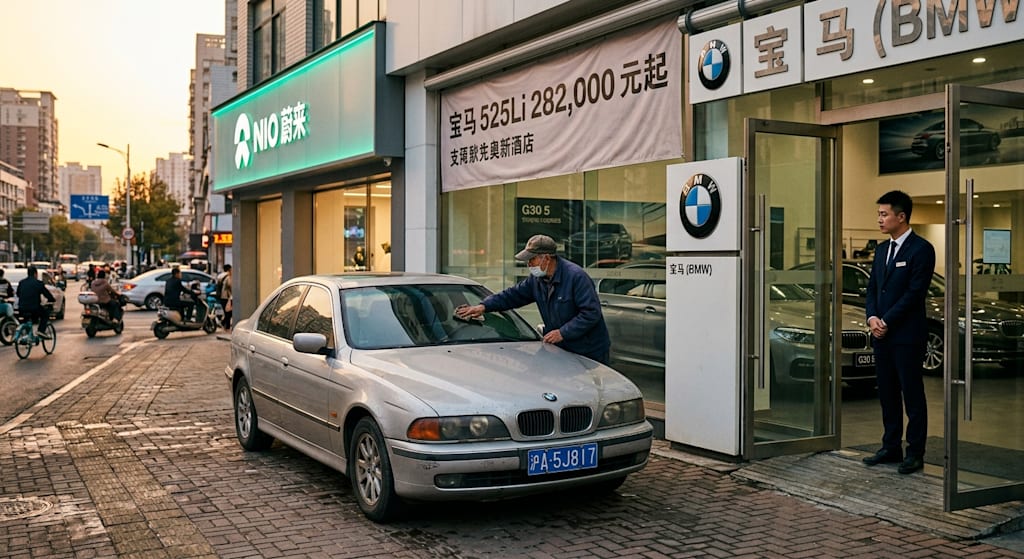
Wang Yu had worked at the BMW dealership for seven years. He had seen monthly sales go from single digits to a peak of forty cars, and he remembered the days when a BMW 3 Series cost 400,000 yuan on the road and still had a waiting list. Now he sat on the leather sofa in the sales lounge, facing a man in his early thirties wearing a gray jacket, twirling a set of car keys in his hand—keys from the Audi next door.
"525Li, with financing, bare car price 282,000 yuan." Wang Yu slid the calculator across the table.
The man didn't look at the number. Instead, he asked, "What was it this time last year?"
Wang Yu paused. "368,000."
"Almost 90,000 less?" The man slapped the keys on the table. "So how much are you losing on each sale?"
Wang Yu smiled and didn't answer. He couldn't say it out loud—under the manufacturer's rebate policy, interest and insurance kickbacks could barely cover the gap, but if the customer paid in full, the car itself was nearly a break-even deal. Three years ago, the profit margin on the same car was five times what it is today. Instead, he added, "We can still talk about the financing package—two years of subsidized interest."
The man nodded and said he'd think about it. Wang Yu walked him to the door and watched him head straight for the NIO showroom next door. Inside, three test-drive cars sat under the lights, all with green license plates.
This was not an isolated case. In the spring of 2026, BMW, Mercedes‑Benz, and Audi dealers in Beijing, Shanghai, and Guangzhou felt the same chill at almost the same time—the once‑solid prices of their midsize and large sedans began to crack, and they cracked without dignity. Mercedes‑E‑Class discounts exceeded 100,000 yuan; the Audi A6L followed suit; some high‑end models even gave way to over 200,000 yuan in concessions. More disturbing still, the price cuts did not bring the expected surge in foot traffic. Customers seemed to be waiting for a lower floor—they knew better than the salespeople that prices would fall further.
Why did it collapse? The reasons are not simply about total market size, but about the fact that the entire pricing logic of the luxury car category had been exposed.
The first blow came from the high‑end incursion of new‑energy vehicles.
For decades, the selling points of premium fuel cars were clear: rapid acceleration and a smooth ride, wrapped in refined interiors. On these three fronts, the German triumvirate had built technical moats over generations. But the physical properties of electric vehicles naturally bypass those moats—electric motors deliver peak torque instantly without a gearbox, propelling a car to 100 km/h in under four seconds; batteries mounted flat under the floor lower the centre of gravity, giving a naturally planted ride; and a large battery, combined with more screens and better sound systems, subtly redefines "luxury" from "leather and wood grain" to "smart cockpit and voice interaction."
In other words, new‑energy brands have not only replicated the core experience of traditional luxury cars but also thrown in two killer extras—"over‑the‑air updates every month" and "power costs of one dime per kilometre." This is not incremental improvement; it is a change of rules.
On a popular car forum, a prospective 5 Series buyer wrote: "I test‑drove the i5, and then I drove the Zeekr 001 next door. The latter is 100,000 yuan cheaper, accelerates faster, and has a fridge and TV in the back. I couldn't find a reason to pay extra just for that blue‑and‑white propeller badge." Under that post, more than 3,000 replies piled up, and over 10,000 liked it. This is not the quibble of a few ; it is a collective shift in perception among the mainstream middle class.
The second blow: the "social status" of the brand is being re‑priced.
In the past, driving a BBA midsize or large sedan signified professional respectability, family prosperity, and a clear social stratum. But in first‑ and second‑tier cities in 2026, this semiotic system has suffered severe inflation—the streets are full of locally produced long‑wheelbase versions, and the entry threshold has been repeatedly lowered, so much so that "driving a BMW 5 Series" no longer carries a distinct status marker. Instead, a NIO ET7 or Li Auto L9—scarcer and more technologically forward—is seen by some younger cohorts as "the new‑middle‑class status symbol."
More subtly, social media has begun to circulate a reverse label: "Better to buy a top‑trim Chinese EV than a base‑model Bimmer." Behind this rhetoric is not wealth envy, but the awakening of consumer rationality. When customers realise that most of the premium they pay goes to brand heritage rather than current experience, loyalty becomes brittle.
The third blow: BBA's own electrification efforts lag far behind.
The Mercedes‑EQ line, the BMW i‑series, and the Audi e‑tron have yet to produce a truly competitive pure‑electric platform product for the Chinese market. What they offer is either a compromised "oil‑to‑electric" conversion or overpriced, under‑featured packages. In all of 2025, BMW's i3 sold fewer than 60% of NIO's ET5 in China. These electric models not only failed to hold market share but also dragged down dealer profits—they became a necessity that no one wanted to sell and that lost money on every unit.
Thus, fuel‑powered cars remained the sole revenue source, and to maintain volumes, prices had to be cut. Those cuts, in turn, eroded used‑car residual values, further undermining new‑car purchase confidence. A vicious cycle had locked in.
Back at Wang Yu's shop, he had just seen off the gray‑jacketed man when another old customer came in—Master Liu, driving a 2016 BMW 528Li in for service. That car had cost over 500,000 yuan new, and Liu had kept it for a decade without ever letting it go.
"Xiao Wang, are new cars really that cheap now?" Liu leaned against the service counter, a stack of maintenance invoices in his hand.
Wang Yu nodded. "Yes, a bare 525 is 280,000."
Liu was silent for a long moment, then said, "So how much would my old car fetch on the second‑hand market?"
Wang Yu did the math and gave him a number. Liu didn't reply. He turned, walked to his car, opened the door, and slid into the driver's seat. He fired up the engine, listened to the straight‑six's burble, put it in gear, and rolled slowly out of the workshop.
Wang Yu stood at the entrance and watched the taillights disappear around the corner. He didn't follow to pitch a new car. He knew Liu wouldn't sell, because in those seconds of silence, the look on his face hadn't been hesitation—it had been something like offence. Liu could not believe that a new car costing only 280,000 yuan could replace the old companion he had driven for ten years.
But the market doesn't stop for anyone's loyalty. BMW has already announced that the next‑generation 5 Series will switch entirely to a pure‑electric platform, and the fuel‑powered versions will gradually be phased out in Europe, with China to follow. By then, 280,000 might still buy you a BMW—but perhaps not in the way you've known it.
At six in the evening, Wang Yu clocked out and walked out of the showroom. The setting sun lit up the parking lot in front. He saw Master Liu's old 528Li still parked by the roadside, and Liu himself wiping the windshield with a rag. Their eyes met from a few metres apart, but neither spoke.
Wang Yu pulled out his phone and glanced at the monthly sales report—the target completion rate was under 70%. He locked the screen, shoved the phone back into his pocket, bent down, and picked up a test‑drive sign that the wind had knocked over. He planted it back in place. The sign read: "BMW i5, Pure Electric, Limited Time Test Drive."
He didn't look up at that test car. He simply turned and walked toward the bus stop, his pace neither fast nor slow—just like every other closing time for the past seven years.
About the Creator
Jin
Writer of reamstories
https://reamstories.com/jin
Enjoyed the story? Support the Creator.
Subscribe for free to receive all their stories in your feed. You could also become a paid subscriber, letting them know you appreciate their work.
Comments
There are no comments for this story
Be the first to respond and start the conversation.