
Assembly Lines for Defence: Automakers Repurpose Mass-Production Might for Global Security
2.5 Million Units of Idle Capacity Drives Convergence From Pickups to Drones and Air Defence Components Scale and Speed Redefine Military Supply Chains

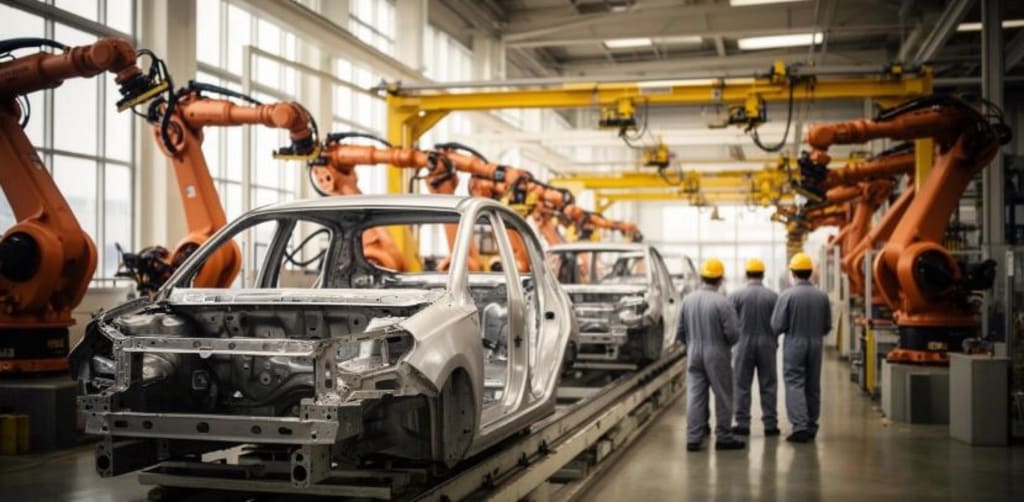
The factories that built the world’s passenger cars are turning toward the battlefield. Across Europe, North America, and Asia, automakers are redirecting decades of mastery in high-volume, low-cost manufacturing toward defence not merely by building military vehicles, but by converting entire assembly lines, supply networks, and automation systems to produce everything from drones to air defence components. Surging global defence budgets and protracted conflicts have placed a premium on speed and volume of supply, making the automotive industry’s greatest strength, the ability to deliver millions of units of consistent quality a new strategic asset. For an industry grappling with slowing growth, fierce competition from China, and 2.5 million units of idle capacity across Western Europe alone, defence is more than a new market: it is a lifeline.
Proven Platforms Win Contracts
The most immediate opportunities lie where civilian design meets military requirements. Ford, General Motors, and Jaguar Land Rover are competing for a £900 million UK Ministry of Defence fleet contract, initially for 3,000 vehicles and potentially extending to 9,000 over five to seven years to replace the Land Rover-based fleet currently in service. Ford is bidding with the Ranger pickup, partnering with General Dynamics and Ricardo to combine automotive scale with defence expertise. GM has proposed militarised Chevrolet Silverado trucks. JLR is offering the Defender, a model already produced at more than 100,000 units annually, confident that its existing capability removes the need for costly ground-up development. “As a manufacturer, the surge in defence-sector demand represents an opportunity we cannot afford to miss,” stated Lisa Brankin, chair of Ford UK.
Beyond Vehicles: Drones, Missiles and Air Defence
The convergence extends far beyond troop transport. Renault has partnered with Thales to produce military drones at a rate of 1,000 units per month starting next year, applying the discipline of building 10,000 cars daily to a sector unaccustomed to such output. French authorities see the tie-up as a means to overhaul a defence supply chain long hampered by slow, small-batch production. Volkswagen has agreed to sell its Osnabrück plant for defence-related work linked to Israel’s Rafael Advanced Defense Systems, reportedly including components for the Iron Dome air defence system. Mercedes-Benz has partnered with AI drone developer Titan Technologies to build defence and operational systems atop the G‑Class and Sprinter platforms. Stellantis plans to sell an idled Canadian plant to armoured‑vehicle manufacturer Roshel. In each instance, the value lies not in the product design alone, but in the speed, consistency, and scalability of automotive manufacturing.
Idle Capacity: The Economic Imperative
Behind this shift lies a profound industrial challenge. Western European plants operate with 2.5 million units of unused annual capacity. Volkswagen is pursuing workforce reductions of up to 100,000 and reviewing plant closures, including the Dresden and Zwickau facilities where more than €1 billion was invested in EV infrastructure. JLR is cutting 4,000 UK jobs. Long‑established positions in China have eroded, while Chinese brands such as BYD and Geely have expanded aggressively into Europe with competitively priced electric models. Against this backdrop, defence offers a way to absorb overheads, retain skilled workforces, and generate revenue without diverting resources from core automotive programmes. “UK automotive production has fallen to half its level of a decade ago,” noted Mike Hawes, chief executive of the Society of Motor Manufacturers and Traders. “For automotive supply chain companies with spare factory capacity, the defence industry can serve as a lifeline for diversifying their customer base.”
South Korea’s Hyundai Motor Group is extending the model further, transferring smart‑factory and AI‑driven automation expertise from car assembly lines to aerospace production. Kia showcased military command vehicles based on the Tasman pickup and the next‑generation KLTV at Eurosatory 2026, demonstrating how platforms developed for civilian markets can be adapted for national security.
Limits, Resistance and Parallel Pathways
The transition is not without obstacles. The structural mismatch between mass‑market and defence production remains substantial: the 9,000‑vehicle UK contract, spread across years, is described as “a drop in the ocean” beside a plant designed to turn out 90,000 units annually. Sigrid de Vries, secretary general of the European Automobile Manufacturers’ Association, cautioned: “While the defence industry may partially alleviate idle capacity issues, it has clear limits in fully filling the enormous void left by the mass consumer automotive market.” Labour unions, including Germany’s IG Metall have expressed scepticism, arguing that defence conversion cannot replace lost civilian jobs on its own.
Some manufacturers are pursuing parallel strategies. Stellantis has taken a 20% stake in Chinese EV maker Leapmotor and opened its European plants to contract manufacturing; Nissan is reportedly considering building vehicles for Chery at its Sunderland facility in the UK. Defence is one answer to excess capacity but it is not the only one.
A New Era of Mobilisation
The re‑alignment recalls the industrial mobilisations of the past, updated for modern conflict. “Converting automotive production facilities for military use was practised in the United States and Japan during World War II,” observed Kim Ho‑sung, dean of engineering at Changwon National University. “Since military supplies don’t need to be produced at constant volumes, facilities can be used for civilian purposes in peacetime and converted when military demand rises.” Today, the urgency is driven not by total war, but by sustained rearmament and the realisation that in a prolonged conflict, the ability to resupply fast, reliably, at scale is as decisive as performance on the battlefield.
For automakers, the shift redefines their place in national security. For governments, it offers a bridge between economic strength and defence readiness. The boundary between assembly line and arsenal is fading, and the result is a new kind of industrial capability, one that serves peace and preparedness in equal measure.
About the Creator
Mark Lim
Hi I am mark an automotive student and a car, tech and food enthusiast ! Im gonna try and post daily & hope you enjoy what I write and do share my page with people you know. I would gladly appreciate it! Cheers
Enjoyed the story? Support the Creator.
Subscribe for free to receive all their stories in your feed.
Comments
There are no comments for this story
Be the first to respond and start the conversation.