
Al Pacino and Anthony Hopkins Bring Maserati’s Legendary Family Story to the Big Screen
Maserati: The Brothers brings the dramatic origins of the legendary Italian marque to cinema, with Al Pacino and Anthony Hopkins joining a story of family, racing and Motor Valley.

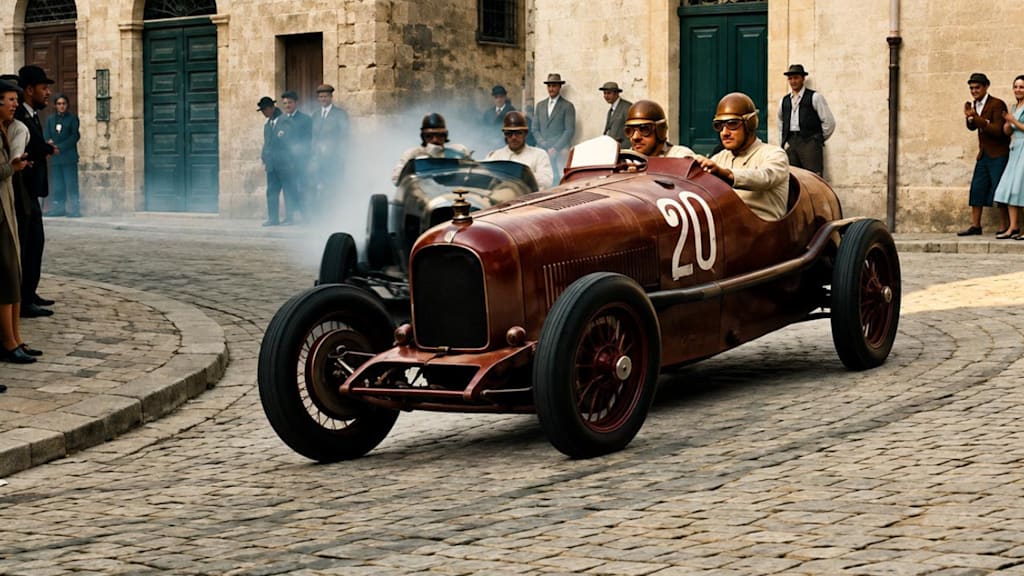
Long before Maserati became a symbol of Italian luxury, it was a family obsession with speed.
Now, that obsession is coming to the big screen.
Maserati: The Brothers tells the story of the Maserati family at a time when motor racing was less a polished global spectacle than a dangerous contest of engineering, courage and survival. Starring Hollywood legends Al Pacino and Anthony Hopkins alongside a predominantly Italian cast, the film revisits the origins of one of Italy's most evocative automotive names—and the extraordinary world that gave birth to it.
This is not simply a story about cars. It is a story about brothers who believed that the fastest way forward was to build something nobody else had built before.
Before the Trident Became a Legend
The Maserati story begins in Bologna in 1914, when the brothers Carlo, Alfieri, Bindo, Ettore and Ernesto turned their fascination with mechanics and competition into a business.
The world they entered was still discovering what the automobile could become. Cars were crude by modern standards, racing was brutally unforgiving, and engineering breakthroughs could mean the difference between victory and disaster.
For the Maserati brothers, racing was never merely advertising. It was a laboratory.
Every circuit was a test. Every failure was information. Every victory proved that their ideas could withstand the ultimate examination: competition at speed.
That philosophy would eventually define Maserati.
The Brothers Behind the Badge
The company's mythology is often told through its cars, but the men behind them are equally compelling.
Alfieri Maserati emerged as one of the central figures in the family's racing ambitions, combining mechanical understanding with an instinct for competition. His brothers contributed in different ways, creating a collective whose strengths extended well beyond the drawing board.
Their relationship was also complicated by the pressures of building a business. Money was scarce, technology was evolving rapidly and motorsport demanded resources that a young manufacturer could barely afford.
That tension gives Maserati: The Brothers its dramatic foundation.
The film is ultimately interested in what happens when family loyalty, personal ambition and commercial survival collide.
Pacino and Hopkins Enter the World of Maserati
The presence of Al Pacino and Anthony Hopkins immediately elevates the project beyond the traditional automotive biopic.
Pacino plays Vincenzo Vaccaro, while Hopkins portrays Luca Antonelli. Their characters belong to the wider network of people who helped shape the Maserati family's journey during a transformative period.
The supporting cast includes Michele Morrone as Alfieri Maserati, Salvatore Esposito as Bindo and Lorenzo De Moor as Carlo, with Andy García and Jessica Alba also joining the production.
It is an intriguing combination of Hollywood gravitas and Italian cinematic talent.
Yet the casting matters for another reason. The Maserati story requires performances capable of conveying an era in which ambition carried real physical consequences. The men racing these machines were not protected by modern safety technology, telemetry or sophisticated pit-wall strategy. They were often separated from catastrophe by little more than engineering judgment and nerve.
That is fertile ground for serious drama.
Indianapolis 500: Maserati's American Statement
If there is one chapter of Maserati's racing history that belongs on the largest possible screen, it is Indianapolis.
In 1939 and 1940, Wilbur Shaw drove the Maserati 8CTF to consecutive victories at the Indianapolis 500. Those wins established Maserati as the only Italian manufacturer to have won America's most famous motor race.
The achievement was remarkable.
For a manufacturer rooted in Bologna, success at Indianapolis represented a leap across the Atlantic and into a completely different racing culture. The Indianapolis Motor Speedway demanded speed, reliability and engineering discipline on a scale few European races could match.
The 8CTF delivered.
Its victories transformed Maserati's racing credentials from an Italian success story into an international one. For the brothers, Indianapolis was proof that their machines could compete on the world's biggest stages.
For the filmmakers, it offers something equally valuable: scale, danger and spectacle.
Where Motor Valley Was Born
There is another character in this story that cannot be overlooked: Emilia-Romagna itself.
Today, the region surrounding Bologna and Modena is widely recognised as Italy's Motor Valley, home to some of the most prestigious names in automotive history. But its reputation was built long before supercars became cultural icons.
Maserati was part of that foundation.
The company began in Bologna before its operations moved to Modena following the acquisition of the brothers' shares by the Orsi family in 1937. That move placed Maserati firmly within the geographical and industrial ecosystem that would eventually produce an extraordinary concentration of automotive expertise.
Ferrari, Lamborghini, Maserati and numerous specialist manufacturers would later become associated with the same region.
The phenomenon was never purely industrial. It was cultural.
In Motor Valley, engineering, craftsmanship and racing became interconnected traditions passed from one generation to the next. Workshops evolved into factories, racing programmes became laboratories and local mechanical knowledge helped create brands with global identities.
Maserati: The Brothers therefore tells a story that is larger than a single marque. It explores the origins of an automotive culture.
When Racing Was Still Dangerous
Modern motorsport is defined by precision. Early racing was defined by risk.
The cars of the Maserati brothers belonged to a period when drivers were exposed to mechanical failure, unpredictable circuits and enormous physical forces. There was no modern safety cell, no halo, no sophisticated crash structure designed to absorb energy.
A mistake could be fatal.
That reality gives the Maserati family's achievements a different weight. Their victories were not simply numbers in a championship record. They were earned in an environment where technological experimentation and personal danger were inseparable.
The film's recreation of this period will therefore be crucial.
Reportedly, the production created dozens of period-inspired racing cars to reproduce the machinery of the era. Filming in Bologna, Modena and Rome's Cinecittà Studios further reinforces the ambition to recreate the physical world in which the Maserati brothers lived and worked.
The objective is not merely to make old cars look convincing.
It is to make audiences feel what it meant to drive them.
The Human Cost of the Maserati Dream
Behind the romance of Italian racing lies a darker reality.
Carlo Maserati died from tuberculosis before the family fully realised its ambitions. Alfieri Maserati died in 1932 following complications related to injuries sustained in a racing accident.
Their deaths underline the extraordinary cost of the world they inhabited.
That is what makes the Maserati story more compelling than a straightforward tale of industrial success. The brothers were not building a global luxury brand with the benefit of hindsight. They were taking enormous personal and financial risks in an industry whose future was far from certain.
Their legacy was built while the outcome remained unknown.
More Than a Car Movie
There is a familiar formula to automotive cinema: famous driver, famous race, famous car.
Maserati: The Brothers has the opportunity to go deeper.
Its most interesting subject may not be the machine itself, but the mindset that created it.
The Maserati brothers belonged to a generation that saw the automobile as something unfinished. They did not inherit an established formula for performance engineering. They helped create one.
Their story is about invention before tradition, competition before marketing and passion before prestige.
The trident would eventually become associated with elegance, performance and Italian luxury. But its origins were considerably less glamorous: workshops, racing circuits, financial uncertainty and a group of brothers who refused to accept the limits of what an automobile could do.
From the Racetrack to the Red Carpet
With Al Pacino and Anthony Hopkins at the forefront, Maserati: The Brothers arrives at an interesting moment for automotive cinema. Stories about Ferrari, Lamborghini and other legendary manufacturers have demonstrated that car culture can support narratives far beyond the enthusiast audience.
Maserati offers a different perspective.
It is a story about a family rather than a single founder. About engineering rather than celebrity. About racing as a proving ground rather than a marketing platform.
And at its centre is an idea that remains relevant more than a century later: sometimes the most important innovations begin with people who simply want to go faster.
The Maserati brothers did exactly that.
They built cars to race. They raced to prove their cars. And, in the process, they helped create one of the most enduring names in automotive history.
Now, the story of how they did it is being given a cinematic engine of its own.
About the Creator
Enjoyed the story? Support the Creator.
Subscribe for free to receive all their stories in your feed.
Comments
There are no comments for this story
Be the first to respond and start the conversation.