
40,000 Tesla Drivers in the Netherlands Are Now Using "Full Self Driving" Here's What That Actually Means
Dutch regulators were the first in Europe to approve Tesla's supervised driving software. Three months in, the data is reassuring, but the approval process itself is worth examining closely.

The Netherlands has become Europe's testing ground for Tesla's most controversial software feature, and the early numbers being reported by Dutch regulators are notable: 40,000 Teslas have begun using the carmaker's "Full Self-Driving" driver assistance software, collectively logging 24 million kilometres without any serious incidents.
That's a meaningful amount of real-world data accumulated in a relatively short window, and it's prompting both cautious optimism from regulators and continued expansion of the approval across neighbouring countries.
What's Actually Being Approved Here
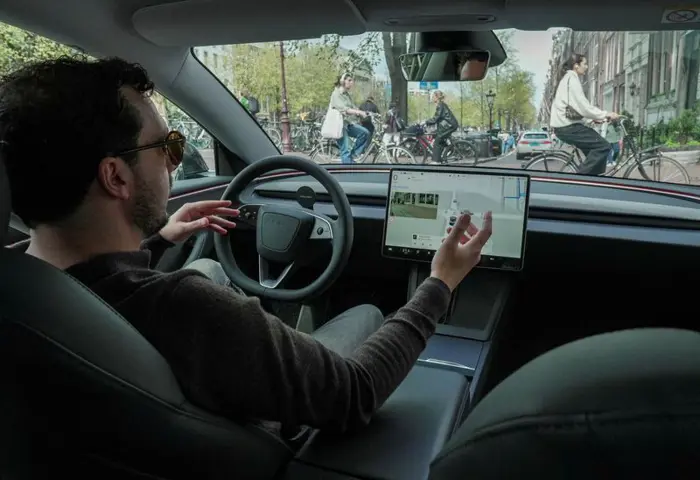
It's worth being precise about terminology, because "Full Self Driving" is a name that invites more confidence than the underlying technology currently warrants. Despite the branding, the software is officially classified as driver assistance, not autonomous driving. It can steer, accelerate, and brake on behalf of the driver, but the legal and practical requirement remains that drivers keep their eyes on the road and their hands ready to take over at any moment.
This distinction matters enormously, both for safety and for how the public understands what they're actually using. "Full Self Driving (supervised)" is Tesla's own qualifier, acknowledging that supervision remains mandatory, but the marketing name alone has been a source of confusion and criticism in markets where it's been deployed, precisely because it implies a level of autonomy the system doesn't yet deliver.
The RDW, the Dutch road authority, approved the supervised FSD software on April 10, a European first. Since then, the agency has been monitoring its real-world performance monthly rather than annually, which is its standard practice for new automotive technology. That elevated monitoring cadence signals the RDW is treating this as a genuinely novel situation requiring closer-than-usual oversight, rather than simply approving it and moving on.
The Safety Claim and What's Behind It
The RDW's stated position is notably specific: "Because of the continuous and strict monitoring of the driver within the vehicle, the driver assistance system is at least as safe as other driver assistance systems."
That's a carefully worded claim. It's not asserting that FSD makes driving categorically safer than human driving alone; it's asserting parity with other existing driver assistance systems already on the road, contingent specifically on the in-cabin monitoring that keeps the human driver engaged and ready to intervene. The safety case rests as much on the monitoring system watching the driver as it does on the software controlling the car.
This approval didn't happen without groundwork. The RDW says it conducted 3,000 hours of testing on tracks and public roads across varying weather conditions before signing off on a substantial pre-approval evaluation period that presumably gave regulators reasonable confidence before any consumer ever used the system on Dutch roads.
The Cost and the Politics
Tesla charges €99 (about $115) per month for FSD access following an initial one-month trial period, a recurring software subscription layered on top of the vehicle purchase price, which is now a familiar model for Tesla but still represents an ongoing cost most traditional automakers don't impose for comparable driver assistance features.
The political dimension is also active. The Dutch transport minister defended the approval in parliament this week, indicating this isn't a purely technical regulatory decision sitting comfortably outside political scrutiny; it's become a matter of public debate requiring direct ministerial accountability. That's a reasonable expectation for a decision involving new software controlling vehicles on public roads, and it suggests the Dutch government is treating the rollout with the seriousness the technology's novelty warrants.
The Ripple Effect Across Europe
Perhaps the most consequential detail in this story is what's happening beyond the Netherlands. Belgium, Denmark, Estonia, and Lithuania have all provisionally approved the same software based on the Dutch approval, meaning the RDW's decision is functioning as a de facto reference point for other European regulators, rather than each country independently running its own full evaluation process.
This is efficient from a regulatory perspective, but it also concentrates significant responsibility on the RDW's judgment. If the Dutch approval process turns out to have gaps or the monthly monitoring later reveals problems that weren't apparent in the initial 3,000 hours of testing, the consequences extend well beyond Dutch roads to several other countries that leaned on that approval rather than conducting independent assessments.
The RDW is also now seeking approval for the technology across the entire European Union, a move that, if successful, would significantly expand Tesla's addressable market for FSD subscriptions across the continent's single largest economic bloc.
What This Actually Tells Us
Three months and 24 million kilometres with no serious incidents is a genuinely encouraging early data point, but it's worth holding that statistic with appropriate context. It's an early sample, drawn from drivers who are likely more attentive and engaged than average, both because the technology is new and unfamiliar to them, and because the system itself includes driver monitoring designed to ensure exactly that engagement. How the safety profile holds up as the system becomes more routine, as more drivers adopt it, and as usage patterns potentially relax over time is the real test the monthly monitoring is designed to catch.
The Netherlands has positioned itself as Europe's proving ground for this technology, and the rest of the continent is largely watching and following its lead rather than running parallel evaluations. That makes the ongoing monthly monitoring data not just this initial three-month snapshot, but the thing actually worth watching as this rolls out further.
About the Creator
Mark Lim
Hi I am mark an automotive student and a car, tech and food enthusiast ! Im gonna try and post daily & hope you enjoy what I write and do share my page with people you know. I would gladly appreciate it! Cheers
Enjoyed the story? Support the Creator.
Subscribe for free to receive all their stories in your feed.
Comments
There are no comments for this story
Be the first to respond and start the conversation.