
Yunnan Route Choice Changes What a Trip Can Show
What a Trip Can Show


Yunnan is often treated as a single destination on a China itinerary, yet the order of stops, the altitude of each one, and the month of travel directly affect what a visitor sees, how comfortable the days feel, and whether the schedule holds together. The province stacks tropical valleys, temperate lake basins, and a high plateau into one map. A short route can cover the classic old towns well, while a longer one opens the gorges, caravan villages, and snow mountain country in the far northwest.
That relationship is only the beginning. Elevation gain, monsoon rain, driving distances, festival dates, guide knowledge, and group size all influence the result. A traveler who swaps one stop for another without adjusting the rest of the plan may be changing the whole trip.
What Is Yunnan?
Yunnan is a province in southwest China that borders Myanmar, Laos, and Vietnam. The land rises from low tropical forest in the south to the edge of the Tibetan Plateau in the northwest, so a single journey can pass through several climates in a week. Kunming, the capital, sits at roughly 1,900 meters and serves as the main gateway for flights and rail.
The province is also home to many of China's officially recognized ethnic groups, including the Bai around Dali, the Naxi in Lijiang, Tibetan communities near Shangri-La, and the Dai in Xishuangbanna. Language, architecture, food, and festivals shift from one valley to the next. That variety is the main reason people come, and it is also why a route needs deliberate planning.
The destination name is therefore only a starting point. "Yunnan" identifies the province, but a workable itinerary must define the region, the altitude range, and the pace relevant to the traveler.
Route Variables and Trip Settings
How Trip Length Selects a Route
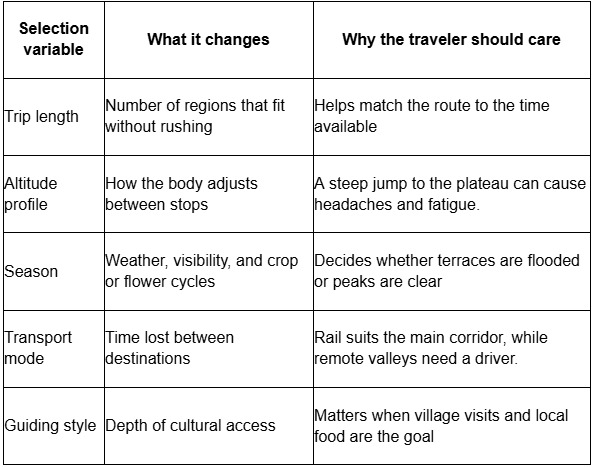
Trip length is not a quality score. It is a planning variable. Around a week usually suits the classic corridor of Kunming, Dali, and Lijiang, which is now linked by fast trains. Ten days or more gives room for Shangri-La, Tiger Leaping Gorge, or the old caravan town of Shaxi, though the days become more physical as the route climbs.
The right length depends on interests, fitness, season, and how much driving feels acceptable. A first visit may focus on old towns and lakes to get a broad picture. A trekker may give two or three days to Tiger Leaping Gorge and skip a city entirely. A tea enthusiast may head south to Pu'er and Xishuangbanna instead of north. These examples are starting points, not fixed rules.
A useful trip brief includes travel dates, arrival and departure cities, group size, fitness level, must-see places, hotel standard, and budget range. Writing only "ten days in Yunnan" is not enough for anyone to build a route that fits.
Why Altitude Is More Than a Number on a Map
Altitude shapes how each day feels. Dali lies at about 2,000 meters and Lijiang at about 2,400 meters, which most healthy visitors handle with little trouble. Shangri-La sits near 3,300 meters, and viewpoints on Jade Dragon Snow Mountain go well above 4,000 meters.
A gradual climb is therefore often preferred. Moving from Kunming to Dali, then Lijiang, then Shangri-La lets the body adapt in steps. The comparison still needs context. A sensible ascent cannot rescue an overloaded schedule, poor sleep, or dehydration. It is one factor within a plan, and anyone with a heart or lung condition should speak with a doctor before booking high stops.
When Does Season Matter?
Season decides what the landscape actually shows. Spring brings blossom and mild days across much of the province. Summer is green, but it is also the rainy period, and mountain roads can be slower. Autumn tends to offer clear air and strong views in the northwest. Winter is dry and sunny in many areas, though nights on the plateau are cold.
The most popular month is not automatically the best option. The Yuanyang rice terraces are at their most photogenic when flooded, roughly from December to March, while the tropical south is most comfortable in the cooler, drier months. National holidays raise prices and crowd the old towns. Match the calendar to the specific places on the route instead of choosing by one general recommendation.
How Guiding Style Affects the Experience
Sightseeing and cultural travel place different demands on a tour. A standard coach itinerary may be adequate for seeing the headline sights. A trip built around village life, craft workshops, or local kitchens needs a guide who comes from the area and can open doors that a general escort cannot.
"Local expert" is a useful term only when the operator explains what stands behind it. Ask where the guide grew up, which languages they speak, and whether the itinerary includes commission-based shopping stops. A polished brochure does not prove that the days on the ground will feel personal.
What Else Can Change a Yunnan Trip?
Route design is only one factor. Road conditions change travel times, especially in the Nujiang canyon and around Deqin. Weather can hide Meili Snow Mountain for days. Festivals such as the Torch Festival or Water Splashing Festival fill hotels early and transform the mood of a town.
Hotel location, meal preferences, luggage size, and entry rules also matter. Visa policies and permit requirements for onward travel to Tibet can change, so confirm them close to departure. If a plan looks tight on paper, review the whole schedule instead of blaming a single stop.
A Practical Operator Shortlist Plan
For a first trip, request a sample itinerary from two or three operators using the same dates, group size, and hotel standard. Compare daily driving hours, altitude gain, included meals, entrance fees, guide language, and cancellation terms. Check what happens if weather closes a road or a cable car.
The written quote should list every hotel by name, the vehicle type, and what is excluded. Travelers should also note how quickly the operator replies and whether the answers are specific. These observations often reveal a service problem before the trip does.
When building a shortlist, travelers can look at Kiki Holidays for private and small-group Yunnan routes led by local guides. Ask each operator for a day-by-day plan, the altitude of every overnight stop, and their policy on shopping stops. A side-by-side comparison of itineraries remains the final check before paying a deposit.
Conclusion
Yunnan is a region with measurable geography and real physical demands. Trip length sets how many areas fit, altitude affects comfort, season determines what the land looks like, and guiding style shapes cultural access. Once transport, weather, festivals, and paperwork are added, the final experience becomes a product of the whole plan. Choosing a route by region and purpose gives a traveler a more rewarding trip than choosing a destination by name alone.
FAQs
Q1. Does a longer Yunnan trip always give a better experience?
No. Extra days help only when they are used to slow the pace or reach a region that fits the traveler's interests. A focused week on the classic corridor can be more satisfying than a rushed two weeks across the whole province.
Q2. Is altitude sickness a concern in Yunnan?
It can be in the northwest. Kunming, Dali, and Lijiang are moderate for most people, while Shangri-La and the areas beyond it are high enough to cause symptoms. A gradual ascent, rest, and plenty of water reduce the risk.
Q3. When should a private tour be chosen over a group tour?
It is useful when the route includes remote areas, specific interests such as trekking or tea, or travelers with different fitness levels. Confirm the guide's background, the vehicle, and what the price includes for the exact itinerary.
About the Creator
Naveed
Naveed is an independent journalist and tech writer covering AI, emerging innovations, and digital transformation, exploring how technology shapes business and society.
Enjoyed the story? Support the Creator.
Subscribe for free to receive all their stories in your feed.
Comments
There are no comments for this story
Be the first to respond and start the conversation.