
Windsor - going back
Getting a different perspective
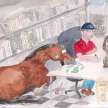
Windsor is the warehouse of several good memories.
Foremost in that warehouse of memories is the day when, I couldn’t have been more than ten or eleven, my Grandad treated me to a river excursion from Bray to Windsor along the Thames. It wasn’t long before the Round Tower and its flag poked above the tree line. Once I had seen the tower he got me to look towards it, point to it and then close my eyes. A few minutes later he told me to open them and find the castle. Of course, it wasn’t where I was pointing or looking. It had moved because when my eyes were closed the boat had imperceptibly turned a couple of times. Grandad, an accomplished amateur artist, had given me a very good lesson in perspective.
Returning to Windsor after twenty five years and retracing steps is another way of seeing things from the past from a different perspective. This visit wasn’t quite like going back to your old school after a couple of years and wondering how much the furniture, the corridors and the whole place has shrunk since the last day. This return visit to Windsor showed me how much it had changed and in a contradictory way, hadn’t changed very much.
Unsurprisingly the castle on the day of my return visit was exactly as it was nearly three decades ago.
The building I worked in during the late 1990’s, One Thames Street, was the nerve centre of a very successful advertising agency. It was a hub of creativity, originality and a great team. The man who started the agency has long gone and so has the business. What is left is a corner plot of prime real estate in the centre of Windsor which quite frankly has become a blot on the street scape of the royal town. The windows are smudged with years of accumulated dust and grime while others are boarded up.
I was able to peer through the grubbiness into what used to be my office on the ground floor. Floorboards had been ripped up and left randomly piled on the exposed joists. Whatever project had been started with good intentions had never been continued let alone completed.
Queen Victoria must glance at this now very sad building from her nearby plinth, sigh and then mutter something along the lines of not being amused.
Whenever there was a bad storm, John, the man who drove the horse drawn taxi, would bring his team down under the station canopy and park outside my window. He was straight off of a Victorian street scene in a movie with his shiny top hat, smart suit and leather apron. I would always take him a mug of coffee whenever he was parked up.
One day he never did finish his coffee.
He had parked up to get away from the rain which had turned to hale that rattled on to the canopy of the station. The horses were unsettled by the noise but not quite in flight mode. They were alright with the lightning but it was the single clap of thunder that sounded like a single high velocity bullet being fired from a gun that got them going. Flight from fear kicked in. “Ickie” and “Billie” were off. John’s last words to me as he valiantly stood at their heads trying to restrain them were “Cheers Alan. I think we’ll be calling it a day”.
And they did with a jangle of tack, a rumble of wheels and sparks coming off of the horses shoes as they shot past Queen Victoria who may well “have been amused”.
One luxury I did allow myself was whenever any banking had to be done I would time my walk to coincide with the guards marching up to the castle for the changing of the guards ceremony. They were always accompanied by a band and on some days there would be a few horses from one of the household mounted regiments. Seeing and hearing this ceremony was a welcome change from balancing ledgers, chasing money and preparing accounts.
Some lunchtimes I would go for a walk around the castle. One day I did convince a colleague, who is still a very good friend, to come up to the castle and have a look before The Crown started charging an entry fee. We got there about the same time as the guards are rotated to give them a break from being on point duty. This one day the Ghurkhas were on duty and they marched their famous short stepped one pace a second march. We did try to keep up with them but the conflation of a lack of fitness on both our parts and my friend wearing heels soon worked against us and we gave the soldiers “best” as they marched on to the terrace overlooking Eton.
The main shopping street, Peascod Street, that Queen Victoria can look down on and along most of its length hadn’t changed that much. Yes, the shop fronts and the branding on display had but the layout was much as I remembered it.
Peascod is derived from when in the 13th and 14th centuries this part of Windsor was given over to fields where huge crops of peas were grown which were a staple part of the medieval diet.
Halfway down on the left there used to be a betting shop. The owner of the advertising agency found me one lunch time at my desk and asked checking the racecards and asked if I had chosen anything. I told him “Polish Dancer” if he wanted to take a share in a bet. He declined telling me that horses were a mugs’ game. Some people are so biased against “The Sport of Kings”. Instead, he wrote out a score forecast for the next Six Nations match between England and France and gave me twenty pounds.
I placed the two bets and as my horse was in the next race I stayed to watch it run on the big screen. Near me were two gentlemen from a local Chinese restaurant.
“What you back?”
“Number seven, family lucky number, good horse. What you back?”
“Number seven rubbish. I back ten. Good form. No lucky number for me. Good form.”
I checked my slip. Polish Dancer was number twelve.
At about the third or fourth jump one horse fell and brought down another. The racecourse commentary announced number seven had fallen first and number ten had tripped over it.
“You fucking bastard! You do that on purpose.”
“Not my fault your horse fall and brought me down.”
The argument continued heating up as the result was declared as final. Polish Dancer obliged at something like twenty to one.
From the two men arguing I heard one say, “Polish Dancer, who choose rubbish horse like that?”
I didn’t have to go back to the betting shop on the Monday to collect on the other bet.
These days the shop is a branch of an international chain of coffee shops.
Most days I would catch the train from Maidenhead where we lived, to slough and then catch the connection to Windsor Central which was next door to number one Thames Street. The station was built in 1849 for Queen Victoria’s convenience to get from London to her favourite castle. No doubt as her train trundled through Slough and its immediate environs the curtains on her carriage were drawn so she didn’t have to see much of the reality of Victorian working class society.
Lawrence was one of the people I used to share the Slough to Windsor sector with. He commuted from North London to run a shop selling all things to do with Scotland although not all of them were manufactured there. On my first day back after a Christmas break Lawrence joined me on the train and I asked how his Christmas was.
“Oy vey Alan, oy vey. You ask me about Christmas. I tell you. My mother died on Christmas morning. Oy vey. What Christmas? All day Christmas day we spent organising a funeral. All day. We have to bury the dead within a day. I tell you, oy vey Alan. Some Christmas. What with the funeral and letting all the relatives know. And I had to get someone to open the shop on Boxing Day. I tell you, I was so glad to get back to work on the other day Alan. Oy vey.”
Each “oy vey” was accompanied by a shrug of his shoulders and arms.
During those commutes I also became friendly with a lady, Seville, who owned a very high end boutique near the end of Peascod Street. Dior, YSL and Boss were her regular lines.
Seville rang me very late in the afternoon at work.
“Alan you must meet me at the shop as soon as you can after five. I’ll tell you all about it when you get here.”
When I got there the shop was in darkness and as soon as Seville saw me she furtively ushered me inside and locked the door. I was more than puzzled. She handed me a thick envelope.
“Can you hide it somewhere please?”
I put it at the bottom of the small bag I used to carry my lunch in. I asked what was going on.
Seville then explained what had happened.
After lunch a stretched limousine had pulled up outside the shop. A chauffeur type bodyguard came in and had a look round. He returned to the car, opened the doors and five or six women in full burqas came in. Once inside they worked their way through Seville’s stock and cleared her out of her top lines. The bodyguard stopped anyone else from entering the shop. They went back to the car and the chauffeur came in. He paid Seville in cash and took the bags of clothes away. They were women connected with the Sultan of Brunei and had just popped out for an afternoon’s shopping.
“There’s about fifteen thousand in the envelope. I thought it would be safer with you while I travel home. You wouldn’t mind walking me to my house? It’s not far from the station.”
“Thanks Seville. Couldn’t your husband have met you from work today?”
“No, he’s away on business.”
In return for helping her I was invited to the shop to be measured up for a suit she would pick up for me on her next buying trip to Europe. It was a generous offer but designer labels have never really bothered me that much. Anyway, I already had a couple of perfectly serviceable suits, depuis Oxfam or the local hospice shop. One evening our train from Windsor to Slough was cancelled. I was quite happy with a mug of coffee and a sticky bun with Seville at the little kiosk on the platform was enough to settle the account.
The riverside that Grandad and I saw hadn’t changed much. The kiosks looked a bit brighter as they were still glistening from a fresh coat of paint. Near the railway bridge at the end of the embankment walk is one very dramatic and striking addition hovering over a dedicated flowerbed. It is a full sized model of a Hurricane fighter plane from World War II.
This make of aircraft first flew in 1935. It was designed by Sidney Camm who was knighted for his services to the aeronautical industry in 1953. The Hurricane played a pivotal part in the Battle of Britain accounting for 60% of downed Luftwaffe aircraft. This tremendous achievement, for whatever reason, was overshadowed by the Spitfire even though it achieved fewer successes. Sidney Camm was born in Windsor and lived in nearby Vansittart Road. It was there that his passion for all things aeronautical started and this included making and selling model aircraft to the boys at Eton College.
From underneath the Hurricane I looked back towards the town which, as ever, is dominated by the upper ramparts of the castle and the Round Tower. A river boat glided by heading downstream. Its top deck crowded with passengers of all ages. Maybe, just maybe there was a young child on a day trip with their Grandad who played the same game with them as I played all those years ago and learnt about how perspectives can change.
About the Creator
Alan Russell
When you read my words they may not be perfect but I hope they:
1. Engage you
2. Entertain you
3. At least make you smile (Omar's Diaries) or
4. Think about this crazy world we live in and
5. Never accept anything at face value
Enjoyed the story? Support the Creator.
Subscribe for free to receive all their stories in your feed.
Comments
There are no comments for this story
Be the first to respond and start the conversation.