

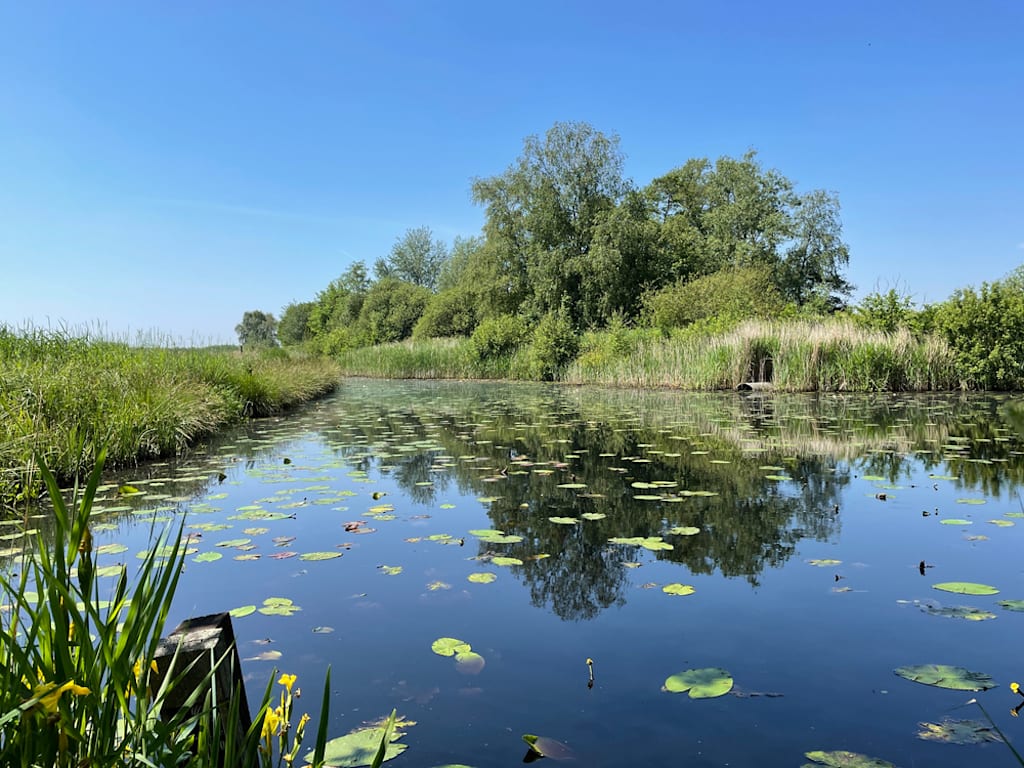
De Biesbosch National Park is located in the North Brabant and South Holland provinces. It is among the largest freshwater tidal areas in Europe. There is a labyrinth of rivers, creeks, and willow forests. Visitors enjoy canoeing, boating, and hiking.
The park is home for bird species like the white-tailed eagle and osprey.

The beaver is the icon of this park. They often live together in groups of about 4 to 6 beavers, using multiple lodges.

Situated in the province of Gelderland. De Hoge Veluwe National Park is the largest privately managed conservation area in the country. The park offers forests, heathlands, grasslands, and shifting sands. Visitors can explore the park on free white bicycles available at the entrance.

Within the park, you’ll find the Kröller-Müller Museum with an extensive collection of artworks by Dutch artist Vincent Van Gogh. There is also a wonderful sculpture garden.

The park features red deer, roe deer, wild boar, and mouflon sheep, contributing to its status as one of the richest wildlife areas in the Netherlands. Nearly 100 breeding bird species can be found, including rare ones like the Eurasian Wryneck and Eurasian Nightjar.
Throughout the year De Hoge hosts activities like safaris, guided walks, lectures, and regional markets featuring Veluwe specialties.

Situated in the province of Drenthe, Dwingelderveld National Park is the largest wet heathland in Western Europe. It features extensive heathlands, fens, and forests, making it a habitat for species such as the black grouse and various butterflies.
Roe deer, foxes, and badgers are commonly spotted in the park.
Visitors can explore the park along hiking and cycling trails.

It is also home to two sheepfolds where traditional shepherding practices are maintained.

Sallandse Heuvelrug National Park is situated in the province of Overijssel. The park is known for its rolling hills, remnants of ancient glaciers. The park features diverse habitats, among them forests and heathlands.

These provide refuge for rare species such as the black grouse.
Visitors can enjoy hiking, cycling, and mountain biking.

Within the park is the Holterberg Nature Museum which features one of the largest collections of European animal species, showcasing over 1,000 animals and birds, including the only monkey species found in Europe. It is renowned for its lifelike dioramas that transport visitors through various natural landscapes.

Schiermonnikoog National Park encompasses the entire island of Schiermonnikoog in the Wadden Sea. The park offers diverse landscapes consisting of dunes, beaches, forests, and tidal flats.

The island is renowned for its birdlife, serving as a stopover for migratory species. Thousands of birds can be found in the park, including the barnacle goose, spoonbill, and oystercatcher.
Visitors can explore the park hiking on foot and also cycling. The beaches are worth exploring.

Schiermonnikoog National Park features a prominent lighthouse that is a key landmark on the island. This lighthouse, known for its striking red color, is not only a navigational aid but also a popular attraction for visitors exploring the park's natural beauty.

Utrechtse Heuvelrug National Park is located in the province of Utrecht. The Utrechtse Heuvelrug encompasses a glacial ridge that was formed during the last ice age. The varied landscape includes forests, heathlands, and shifting sands. This is the second-largest forest area in the Netherlands.
It is home to wildlife like deer, badgers, and numerous bird species.
The area is also rich in cultural history, featuring castles, estates, and historic villages. Recreational activities include hiking, cycling, and horse riding.

Amerongen Castle is a historic 17th-century castle known for its rich family history and beautiful gardens. Originally built between 1674 and 1680, it has served various roles throughout history, including being a refuge for Wilhelm II of Germany after World War I.

Weerribben-Wieden National Park is situated in the province of Overijssel and is the largest bog in Northwestern Europe.
The park consists of two areas, De Weerribben and De Wieden, with a network of waterways, reed beds, and swamp forests.

Visitors can explore the park by canoe, whisper boat, or on foot enjoying the surrounding nature.

It is home to diverse flora and fauna, including the rare European otter.

Situated near Haarlem and a short drive from Amsterdam, the Zuid-Kennemerland National Park features rolling dunes, sandy beaches, and dense forests. It plays a crucial role in preserving the unique Dutch coastal ecosystem, with a diverse variety of flora and fauna. Popular activities include hiking and cycling through the extensive network of trails.
Visitors to the park can encounter Scottish Highland cattle, Konic horses, and fallow deer grazing freely on the dunes.
Birdwatchers can see kestrels, nightingales, and peregrine falcons.

The park is also home to the famous Vogelmeer (Bird Lake), where a wide range of waterfowl can be seen.

The park contains remnants of the Atlantic Wall, a defense line built during World War II.
About the Creator
Rasma Raisters
My passions are writing and creating poetry. I write for several sites online and have four themed blogs on Wordpress. Please follow me on Twitter.
Enjoyed the story? Support the Creator.
Subscribe for free to receive all their stories in your feed. You could also become a paid subscriber, letting them know you appreciate their work.
Comments
There are no comments for this story
Be the first to respond and start the conversation.