

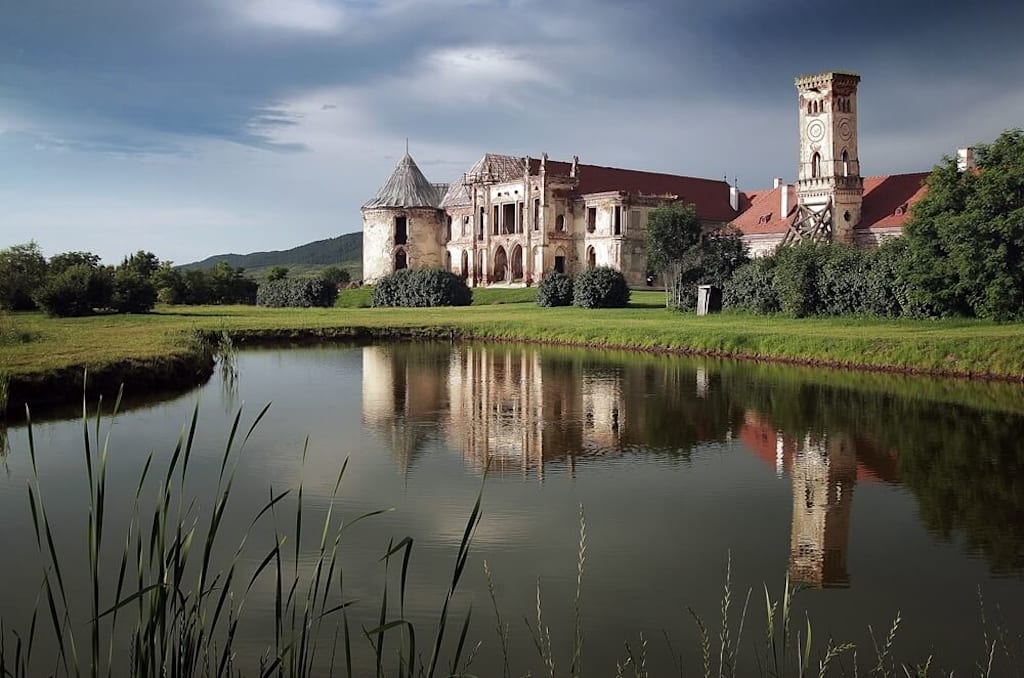
Banffy Castle in Bontida is known for hosting the Electric Castle Music Festival each year. Even though the castle is in ruins, visitors can explore the grounds and find out why it is known as the “Versailles in Transylvania." The castle was named after the Banffy family, who built it in the Baroque style in the 18th century. When it fell into ruin, it was used as a hospital during WW II. Supposedly today it is still haunted by the ghostly spirits of soldiers. Visitors can also enjoy walking on the grounds and exploring the forest by the lake.

The Culture Palace, situated in Lasi, is the symbol of the city. The palace was built at the beginning of the last century and for many years was the tallest building in the town, with the central tower at 55 meters high. The Palace is designed in a Neo-Gothic style, showcasing one of the last expressions of Romanticism in architecture. It is considered a masterpiece of Gothic Revival architecture in Romania. It hosts several museums, among them the Moldavian History Museum, the Art Museum, the Moldavian Ethnographic Museum, and a science and tech museum.

The oldest church in Romania, Densus Church, is still used for church services. The church was built in the 13th century using stone from Ulpia Traiana Sarmizegetusa, the former Dacian capital after the Romans invaded Dacia. It dates back to the 13th century and is built on the site of a Roman temple from the 2nd century. This church, also known as the Church of St. Nicholas, is notable for its unique architectural features and historical significance, making it one of the most unusual sacred buildings in the country.

Situated in Ponoarele, God’s Bridge formed after the ceiling of a cave collapsed in southwest Romania. It is the only natural bridge used for traffic in the world. There is a national road that passes over the bridge. Visitors can go under the bridge and explore a small cave nearby.

Iulia Hasdeu Castle is the most terrifying castle in the country. Situated in Campina, it was designed by Romanian thinker Bogdan Petriceicu Hasdeu. When his daughter died at the age of 19 from tuberculosis, he turned to spiritualism and spent years perfecting his shrine to his daughter. He then completed the castle with help from the ghostly spirit of his daughter, Julia. The castle features three towers and three underground rooms, and each staircase is made up of seven steps.

The massive entrance is flanked by stone thrones and sphinxes. Above the door is the Eye of the Providence marked with the date July 2, which apparently symbolizes his wife and daughter.
The castle has been included in the Listing of Historical Monuments in Romania since 1955, and in 1994 it was converted to a museum.

The Neajlov Delta is often referred to as the "Mini-Delta," this natural park is the second most important wetland in Romania for biodiversity, right after the Danube Delta. In early spring in the marshlands you can walk along wooden pontoons and see herons.

Visit the nearby Comana Monastery, which was built by the legendary Vlad the Impaler (Vlad Țepeș). The monastery is located in Comana, Giurgiu County, surrounded by the natural beauty of the Comana Natural Park, which includes wetlands and diverse wildlife.

The UNESCO World Heritage Site, the Prejmer Fortified Church, is among Transylvania’s fortified churches and the largest fortified church in southeastern Europe. It was built in the 13th century by Teutonic Knights. Visitors can tour the church.

Scărișoara Cave is a remarkable natural wonder situated in the Apuseni Mountains and is home to the largest underground glacier in the country, situated at an altitude of 1,165 meters. This ice cave is not only a stunning geological formation but also a significant scientific site, with parts of it designated as a closed reserve for research purposes. Visitors can explore a section of the cave, which features fascinating ice formations both on the surface and hanging from the ceiling. Access involves a walk through a forest leading to the cave's entrance. The cave is considered a show cave, making it a popular destination for adventure seekers.

The Seven Ladders Canyon is a mountainous canyon carved by the Șapte Scări Brook in Romania in the county of Brașov, south of Dâmbul Morii village. It is considered to be one of the main tourist attractions from the Piatra Mare massif.
About the Creator
Rasma Raisters
My passions are writing and creating poetry. I write for several sites online and have four themed blogs on Wordpress. Please follow me on Twitter.
Enjoyed the story? Support the Creator.
Subscribe for free to receive all their stories in your feed. You could also become a paid subscriber, letting them know you appreciate their work.
Comments
There are no comments for this story
Be the first to respond and start the conversation.