
They Came for the Great Wall. They Left With a Second Suitcase.
Foreign tourists are turning China into a shopping destination, one neck fan, drone, and eyeshadow palette at a time.
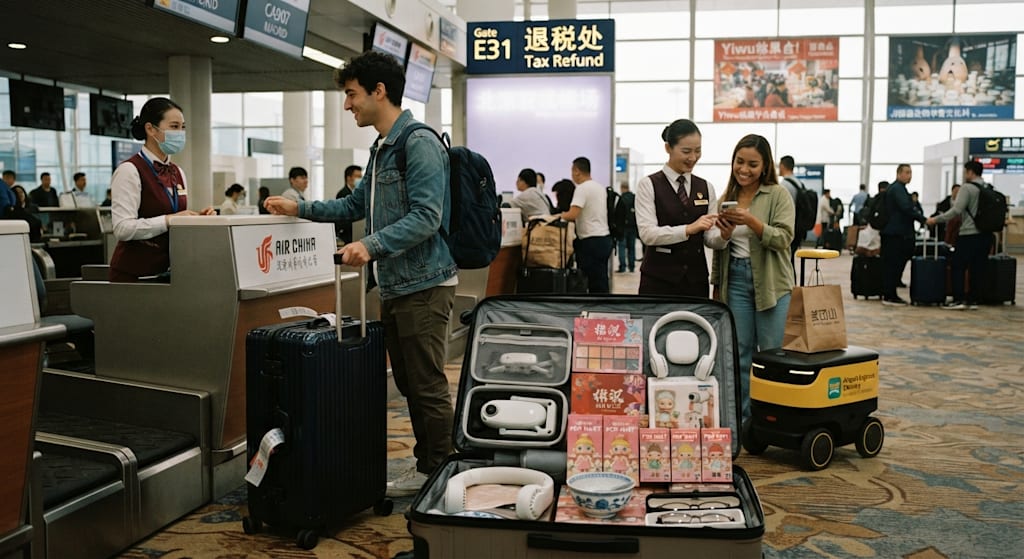
Beijing Capital Airport, international departures hall. A group of French tourists waiting for a flight. Each has a neck fan around their neck. One has a handheld fan clipped to a backpack. Mint green, pink, black. Bought at Miniso. Cheaper than a bowl of noodles in Sanlitun. They are gear.
A few gates away, a Spanish tourist named Gabriel is checking in. He has two suitcases. When he arrived, he had one. He spent nearly four weeks in Beijing, Xi’an, Chengdu, Chongqing, and Shanghai. The second suitcase holds things he already bought. “My original suitcase was already full,” he says.
Foreign tourists are using China in a different way. They still go to the Great Wall and the Bund. They also bring shopping lists. Buying things is part of the itinerary.
Data from the National Immigration Administration: in the first eight months of 2026, foreigners made 61.287 million entry and exit trips, up 19.5 percent year on year. Visa-free entries reached 23.72 million, up 26.8 percent, accounting for 77.6 percent of all foreign entries.
Spending follows. Ministry of Commerce data: from January to July 2026, overseas visitors spent 263.6 billion yuan in China, up 27.8 percent year on year. The number of overseas travelers applying for departure tax refunds more than tripled. In the first half of the year, national departure tax refund sales rose 69 percent.
Empty suitcases come in. Shopping lists go out full.
On TikTok, “China Haul” has become a genre. Foreign users open suitcases on camera and pull out drones, eyeshadow palettes, blind boxes, glasses, ceramic cups, USB fans. On Reddit’s r/travelchina board, common questions include “What should I buy in China?” and “Where do locals actually shop?” Some tourists have learned to use Taobao, JD.com, and Meituan. They order ahead and send packages to their next hotel.
Foreign tourists are no longer just buying “Made in China.” They plug into China’s consumer network during their trip. That network includes platforms, logistics, payment, and delivery.
The first stop is usually a physical store. The list has changed.
Digital goods. DJI and Insta360 dominate. One American user wrote on social media: “For action cameras, it’s DJI and Insta360. Those two are beating GoPro to death.” For foreign buyers, DJI and Insta360 are global leaders with supply chain advantages. “They are first for a reason,” the user added.
Huaqiangbei, Shenzhen’s electronics market, often appears in these conversations. It used to be a destination for professional buyers and tech hobbyists. Now ordinary tourists go there to find gadgets that are hard to get overseas.
Then there are small things. At Beijing Capital Airport’s international departures hall, neck fans and handheld fans are everywhere. Different shapes and colors. Bought at Miniso. For many tourists, they count as fashion items.
Beauty products with Eastern symbols. Two years ago, foreign tourists recommended old Chinese brands like Xie Fuchun, Meijiajing, and Pechoin. Now Huaxizi and Judydoll appear more often. Their overseas expansion has made them familiar.
“I know Korean cosmetics are famous,” said Felicia, a Brazilian woman traveling in Shanghai. “But for Chinese products, like eyeshadow palettes, I can get something with better design for a lower price.”
On TikTok, makeup videos drive interest. An eyeshadow palette is a product, a visual object, a cultural signal, and a cheap luxury.
Small, well-designed goods. Yiwu is no longer only a wholesale center. Foreign tourists go there to hunt. The city has opened retail markets to ordinary consumers and set up English corners for merchants to talk with foreign visitors and buyers.
Online platforms are part of the shopping trip too. Reddit has guides on how foreigners can register for Meituan. Felicia shared her method: “If you don’t have a Chinese phone number, ask the hotel front desk to help. Leave their number. I believe they are happy to help.”
She also said many tourists order delivery just to see the robot. Robot delivery videos have become traffic drivers on TikTok. “I feel like I’m living in the future,” she said. “I’ve never seen anything like this, and it’s fast.”
Speed surprises tourists in other ways. Leo, a British traveler, broke his glasses during a trip. At a store in Beijing, he picked a frame, had an eye exam, and collected the finished glasses in two hours. “At Boots in the UK, it takes at least a week,” he said. “China speed is strange and wonderful.”
Ten years ago, foreign tourists came to China for sightseeing or business. Shopping was optional.
“More than ten years ago, my father did business with China,” Leo said. “He ran a car shop. He imported some small parts. He also bought me a fan with a lot of artistic feeling.” Leo said the old impression was low prices. “Now I think they are also very durable.”
Cross-border e-commerce and Chinese brand globalization have changed the reputation of Chinese goods. That has changed the purpose of the trip. Shopping now gets planned before the flight.
“I already knew what I wanted to buy before I came,” Felicia said. “Pop Mart was a must. Also Huaxizi eyeshadow palettes.” She laughed. “I know foreigners who bought at least ten palettes.”
The Journal of Travel Research has published work on the relationship between destination countries and product origin countries. The finding is that if consumers have a good impression of a country’s products, they are more willing to visit that country. The effect is called reverse country-of-origin image. Product competition also affects tourism share.
China now sits inside that effect.
Shopping tours are also moving from big-city shelves to the source. Tourists go to Yiwu for “world goods,” to Danyang for glasses, and to Jingdezhen for ceramics. At the source, shopping becomes experience. A visitor can make a ceramic bowl by hand. Beijing and Shanghai still matter, but they are not always the main destination.
“Sometimes I prefer smaller cities,” Leo said. “They have industry, culture, something more specific.”
That trend also makes destination cities more global. China Daily has reported on Wil, a resident artist in Jingdezhen. She flies from the Netherlands every year and stays for two months to improve her pottery skills for her studio in the Netherlands.
Artists like Wil are appearing in groups. They rent homestays, buy tools and materials, hire local teachers, and leave behind rent and class fees. They also become small overseas windows for Jingdezhen.
As foreign tourists learn more about the Chinese market, they start to shop like locals. They look for guides on Xiaohongshu. They compare prices across platforms. They study coupons. Their questions become more specific. They no longer only ask “What is worth buying in China?” They ask “Where do Chinese people buy it, and how do they buy it?”
Through that process, they learn the daily life behind the product. They also build a set of consumer skills they can use on the next trip.
Shopping is hot right now. But foreign tourists still hit operations that stop them.
One visitor posted on Reddit for help. He had a Chinese phone number. He registered on a shopping platform. Then he ran into repeated account access limits. He switched to another phone. The platform asked for his passport. “I just want to know if there are more steps after I submit,” he wrote. “I don’t find it convenient.”
After the product goes home, cross-border repair is another test. Felicia told Xiaoguang Society about a bag. “A bag is quite famous,” she said. “But the after-sales policy says you have to contact the original store for warranty. I can’t ship a bag from Brazil to China for repair. But the price isn’t low enough for me to ignore after-sales. So it affected my decision.”
If platforms and brands want to catch this traffic, they need to update their policies.
DJI offers a reference. Its DJI Care program works like Apple Care. The brand does not need to spend extra money. It packages professional after-sales service as something customers can buy. If a drone or gimbal is damaged or flies away, the customer pays a replacement fee and gets a new unit. The replacement goes through an express channel. Pickup and shipping are free. Global warranty is included. A tourist back in South America or Europe can use an authorized repair center there.
The other challenge is getting remembered. Traffic arrives fast. It also leaves fast. A product can trend on TikTok and be forgotten. Some brands are trying to create their own traffic. They invite overseas influencers to visit Chinese factories. They use the brand’s global push to build recognition.
Creality hosted Gary and Charisse in 2024. They visited the headquarters and factory. They gave product feedback. Charisse joined the brand’s “Brand Friend” program. She gets early access to new products and joins community building. One visit led to ongoing exchange and cooperation.
This year, overseas social platforms have popularized the phrase “A Very Chinese Time.” Young people in other countries drink hot water from thermos bottles. They buy foot soak buckets. They replace “white people food” with hot meals. Chinese brands and culture have spent years building audiences abroad.
“China Haul” extends that trend. Buying in China gives the interest a physical contact point. Foreign tourists use their own judgment to reassess the value of Chinese manufacturing.
During the Mid-Autumn and National Day holidays, domestic travel crowds did not shrink. Among them, foreign tourists were easier to spot. They carried neck fans. They asked hotel front desks for help with delivery apps. They checked departure tax refund forms. They bought second suitcases.
The test for Chinese goods starts at the check-in counter. The suitcase is either full or it is not.
Gabriel bought a second suitcase in China. He filled it. Then he flew home.
The next test: whether he comes back with an empty one.
About the Creator
Jin
Writer of reamstories
https://reamstories.com/jin
Enjoyed the story? Support the Creator.
Subscribe for free to receive all their stories in your feed. You could also become a paid subscriber, letting them know you appreciate their work.
Comments
There are no comments for this story
Be the first to respond and start the conversation.