
The Wisdom of Open Country
A quiet reflection on the prairie, the people it raises and the lessons America may have forgotten.

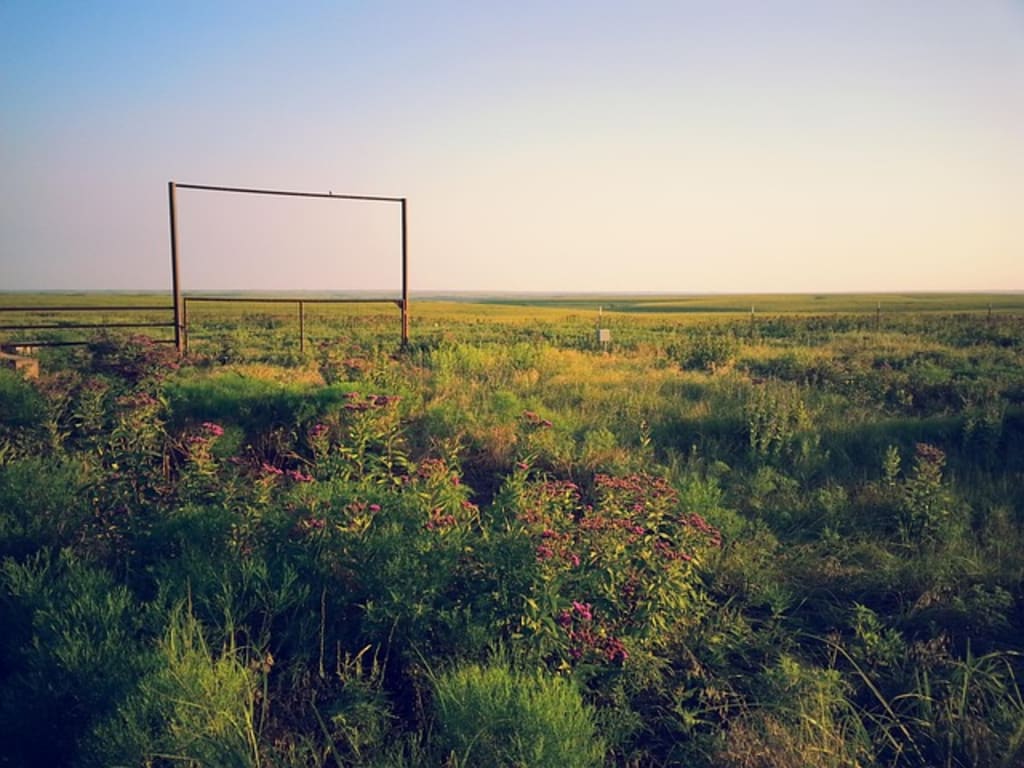
When people think of the American heartland, they usually picture cattle grazing in open pastures, endless fields of wheat and corn, or a lonely boring stretch of interstate that seems to go on forever with only dirt and livestock on the horizon. To many, the prairie is simply the place you drive through on your way to somewhere more exciting. It has become known as “flyover country,” as though its only purpose is to feed America and give travelers a quicker route to the mountains or the coast.
I suppose I understand why people think that way.
The prairie doesn’t exactly demand your attention. It doesn’t have towering mountain peaks or turquoise beaches. There are no famous skylines or neon lights that can be seen for miles. We don’t have palm trees lining the highways and, depending on what part of the plains you’re traveling through, you may drive an hour before you even find a decent gas station.
At first glance, there really isn’t much to see.
Growing up on the eastern plains of Colorado, I never thought much about any of that. Home was home and while the rest of the state bragged about skiing in the Rocky Mountains or spending weekends at Red Rocks, we had dirt roads, barbed wire fences, prairie grass and sunsets that seemed to last forever.
To some people, that probably sounds boring.
To me, it was my childhood.
My grandparents owned a sporting clay club on the eastern plains and to a little girl, the land surrounding it felt like the biggest place in the world. I spent more time outdoors than I ever did sitting in front of a television. I chased pheasants through the grass, explored dried creek beds, climbed over hay bales and probably wandered much farther than my grandparents ever realized.
I knew the sound of a shotgun echoing across the open country and the sudden panic of a pheasant exploding from the grass only a few feet in front of me. I knew where the rabbits liked to hide and how the prairie would become strangely quiet right before a bad storm rolled in. I learned to love the smell of rain hitting dry dirt long before I ever knew there was a fancy word for it.
Most summer afternoons were spent beneath a sky that seemed almost too big for the earth below it. Thunderstorms could build for hours along the horizon, slowly turning darker and darker until someone finally decided it was probably time to head inside. The wind was almost always stronger than you expected and the weather had a funny way of ruining whatever plans you had made for the day.
Looking back now, I realize the prairie was teaching me patience long before I ever understood what patience really was.
You can’t rush the rain, you can’t hurry a harvest and you sure can’t argue with the weather.
When I left Colorado for college in western Kansas, I assumed every prairie looked the same. After all, how different could eastern Colorado and western Kansas really be?
They’re both flat, right?
I couldn’t have been more wrong.
The eastern plains of Colorado and the Kansas prairie have their own personalities, but they share the same quiet spirit. The shortgrass prairie I grew up around slowly gives way as you travel east, eventually meeting the taller grasses of Kansas. The same wind that blows across Colorado seems to follow you right across the state line and thunderstorms certainly don’t stop to ask whether they’re in Colorado or Kansas before continuing on their way.
Neither do the meadowlarks.
The prairie has never cared much for the borders we’ve drawn.
Maybe that’s one of the reasons Kansas history has always fascinated me. Kansas is, in many ways, a state built on survival and a little bit of stubbornness.
Long before Kansas was ever a state, Native people lived, hunted and traveled across these grasslands. The Kansa, who the state would eventually take its name from, understood this land long before settlers arrived with wagons, plows and promises of a better life. The Pawnee, Osage, Wichita and other Native nations also knew parts of these plains. They understood the buffalo, the grass and the importance of fire to the prairie long before the people who came later did.
Then came the settlers.
They arrived looking across an endless stretch of grass and somehow saw a future. Germans, Czechs and Swedes came alongside African Americans searching for land and opportunity after the Civil War, while Mexican immigrants and families from countless other backgrounds also found their way onto the plains. Many came with very little besides a few belongings, their families and the belief that somewhere out west they could build a better life. They broke through prairie sod that had been growing for thousands of years and built homes in places where trees were scarce and the weather could turn against you without much warning.
Kansas certainly didn’t make life easy for them.
Then again, Kansas has never made much of anything easy.
The state itself was born out of violence. Before Kansas ever officially joined the Union, people were already fighting and dying over whether it would enter as a free or slave state. The years known as Bleeding Kansas left communities divided and people dead, yet Kansas continued on.
Railroads came. Cattle towns grew. Homesteads appeared across the plains and small communities began popping up around water stops and railroad tracks. Some of those towns grew into the places we know today.
Others disappeared almost completely.
Still, the prairie continued on.
Then came drought.
During the 1930s, after the Great Depression had already brought many families to their knees, the plains seemed to turn against the people living on them. Crops failed and dust storms rolled across the land so thick they could turn afternoon into night.
We often hear the stories of the families who packed everything they owned into old cars and headed west, and those stories are important.
But I’ve always thought about the ones who stayed.
The families who swept dirt from their windowsills and kitchen tables knowing they would probably do it again the next morning. The mothers who somehow found a way to feed their children when crops had failed. The farmers who looked across fields that had given them nothing and still found the courage to plant again when the rain finally returned.
Maybe they were stubborn.
Maybe they had nowhere else to go.
Or maybe the prairie had already taught them something.
You keep going.
That quiet stubbornness still exists here.
I’ve seen hailstorms shred wheat fields only weeks before harvest. I’ve watched farmers stand at the edge of a ruined field, shake their heads and somehow start talking about next year before this year’s crop was even officially gone. I’ve watched smoke stretch across the horizon during prairie fires and seen communities gather trucks, trailers, water and whatever else they could find before anyone had to ask them to help.
The prairie has been burned, plowed, flooded, frozen and starved of rain.
And still, it grows.
In the Flint Hills of Kansas, fire is actually part of the life of the prairie. Native people understood long ago that burning the grass encouraged new growth and brought grazing animals back to the land. Even today, the spring burns can turn miles of prairie black.
If you’ve never seen a freshly burned prairie, it can look almost sad even dead and ruined, but just give it time. Before long, green begins pushing through the black earth and suddenly the hills are alive again.
Burned, but still growing. Maybe that’s the perfect description of the heartland.
I can’t claim to be well-traveled, but I’ve been fortunate enough to visit a few beautiful places over the years. I’ve watched the waves roll onto the beaches of Galveston, Texas, and loved the way the Gulf seemed to stretch on forever. I’ve stood barefoot on the white beaches of Florida, staring into water so blue it almost looked fake. I’ve walked beneath the bright lights of Las Vegas, where the city seems determined to make sure there is always something to look at.
I’ve loved those places and I hope I get the opportunity to see many more. But nothing has ever quite compared to coming home.
There is always a point on the journey home, whether I’m driving down a familiar highway or staring out the window of a plane, when I realize I can see again.
I don’t mean that my vision suddenly changes, but the world around me does. Buildings become fewer, traffic thins out and the land opens up until I can look toward the horizon without something standing in my way. The farther I travel, the more space seems to appear around me and the constant rush of everything slowly begins to fade.
Everything becomes a little quieter.
And without even realizing it, I breathe a little deeper.
For a long time, I couldn’t explain why.
The ocean is beautiful. The mountains are breathtaking and Las Vegas is certainly exciting. Yet none of them give me the same feeling as an open prairie stretching toward a horizon I know I’ll never reach.
Maybe there is something embedded deep within my genes, passed down from ancestors who once traveled these same plains searching for a place to call home. Maybe it’s simply the comfort of familiarity and the fact that open country is all I’ve ever really known. More than likely, it’s a little bit of both.
Whatever the reason, the prairie has always felt different to me.
I think it’s because it has never tried to impress anyone. The prairie has never tried to compete with the mountains or envy the ocean. It has never wished it were somewhere else. Its beauty has always been quieter than that.
Maybe that’s why so many people misunderstand it.
Most people measure the American heartland by what it produces. Wheat, corn, cattle and sorghum. Those things matter and they always will. The heartland feeds millions of people and that alone deserves respect.
But to reduce the prairie to agriculture is like admiring a book for the paper it’s printed on and never bothering to read the story inside.
Because I believe the greatest thing the heartland has ever produced isn’t found inside a grain elevator or standing in a feedlot.
It’s found in the people.
The prairie grows resilient people.
Not perfect people. Not people who always agree or even particularly like each other. If you’ve ever lived in a small town, you know better than that.
But resilient people. People who understand that life rarely goes according to plan because they’ve watched drought crack the earth one summer only to see floodwaters rise the next. They’ve watched wildfires turn thousands of acres black in a single afternoon. They’ve watched dust erase the horizon, blizzards bury roads, tornadoes scatter generations of hard work across neighboring counties and hail destroy a year’s worth of hope in less time than it takes to finish supper.
Still, the fences are rebuilt. The wheat is planted again. The cattle are gathered and the grass comes back.
Life goes on.
That’s not to say hardship belongs only to the prairie. Every corner of this country, and certainly the world, has faced its own disasters and learned its own lessons in survival. Coastal communities rebuild after hurricanes, towns tucked into the mountains have faced fire and flood, and cities have been brought to their knees only to find their footing again. Resilience certainly isn’t unique to the heartland.
Maybe it’s simply more visible here.
There is very little to hide behind on the prairie. When the land is dry, you can see it. When fire moves through, miles of blackened grass are left behind. When a crop fails, an entire year’s worth of work can sit beneath an empty sky for everyone to see. And still, people begin again.
Maybe that’s why I’ve always found it interesting that some of the loudest arguments in America come from people who have forgotten how to listen.
Out here, the land has a way of reminding you that not everything is within your control. Drought doesn’t care about politics. Neither does a blizzard, tornado, flood or wildfire.
When disaster strikes a small town, neighbors don’t usually stop and ask each other who they voted for before showing up with a tractor, chainsaw, stock trailer or hot meal. They just help.
I’ve often wondered if that’s one of the greatest lessons the prairie has to offer us.
For all the attention we give to our differences, the prairie seems completely uninterested in them. The wind blows across county lines without permission. Meadowlarks don’t stop singing because they’ve crossed a fence line and rain certainly doesn’t fall only on the people who deserve it.
Nature has never cared much for the lines we’ve drawn.
Perhaps that’s because it understands something we’ve forgotten.
The things that keep us alive have always mattered more than the things that keep us divided.
The prairie teaches humility because no one is bigger than the sky. It teaches gratitude because after weeks without rain, even the smallest cloud can feel like a promise. It teaches resilience because a blackened prairie doesn’t spend the rest of its existence mourning the fire. It continues to grow and flourish.
Most of all, the prairie teaches community.
Long before social media, twenty-four-hour news cycles and every disagreement became something that had to be won, people living on the prairie understood one very simple truth.
Someday, you would need your neighbor and someday, your neighbor would need you. That may be the most valuable crop the American heartland has ever grown.
Tallgrass prairie once covered millions upon millions of acres across North America. Today, only a small fraction of it remains and much of what survived can be found in the Flint Hills of Kansas. The rocky soil that made the land difficult to plow is one of the very reasons those grasslands survived.
I can’t help but find a little humor in that.
The ground people once looked at and decided wasn’t worth the trouble became the ground that preserved one of the last large pieces of America’s tallgrass prairie.
Maybe there’s a lesson in that too.
Sometimes the things we overlook are the very things worth saving.
The prairie has survived droughts, floods, blizzards, wildfires, dust storms, broken fences, failed crops and generations of people who were probably convinced they had seen the hardest of times.
It has watched people come and go. Towns have been built and towns have disappeared. Families have planted roots here only to watch their children move away and start lives somewhere else.
Still, the wind blows. The grass returns. The meadowlarks sing and the crickets chirp.
And somewhere on the prairie, there is probably a little girl chasing pheasants through the grass and wandering farther than her grandparents realize. She probably thinks the land surrounding her is the biggest place in the entire world.
I know I did. Maybe that’s why I’ve never understood the phrase “flyover country.” Because to me, the prairie has never been something to fly over.
It was where I learned to be patient. It was where I learned that nature always has the final say and where I first learned that sometimes you have to rebuild what was lost and try again.
The prairie has never promised an easy life. It just quietly reminds us to keep going. And maybe, with everything happening in the world today, America could learn a thing or two from the heartland.
Originally published on https://medium.com/@mjanousek0802/the-wisdom-of-open-country-ec1ead837a16
About the Creator
Megan Janousek
Writer and history lover rooted in western Kansas. Writing about forgotten places, complicated people, history, home and what it means to be human.
Enjoyed the story? Support the Creator.
Subscribe for free to receive all their stories in your feed.
Comments
There are no comments for this story
Be the first to respond and start the conversation.