
The Mercury Rivers of Qin Shi Huang: Unlocking the Secrets of an Emperor's Tomb
A 2,000-year-old mystery, a mountain of cinnabar, and the ancient supply chain that may have filled the First Emperor's underground palace with flowing mercury
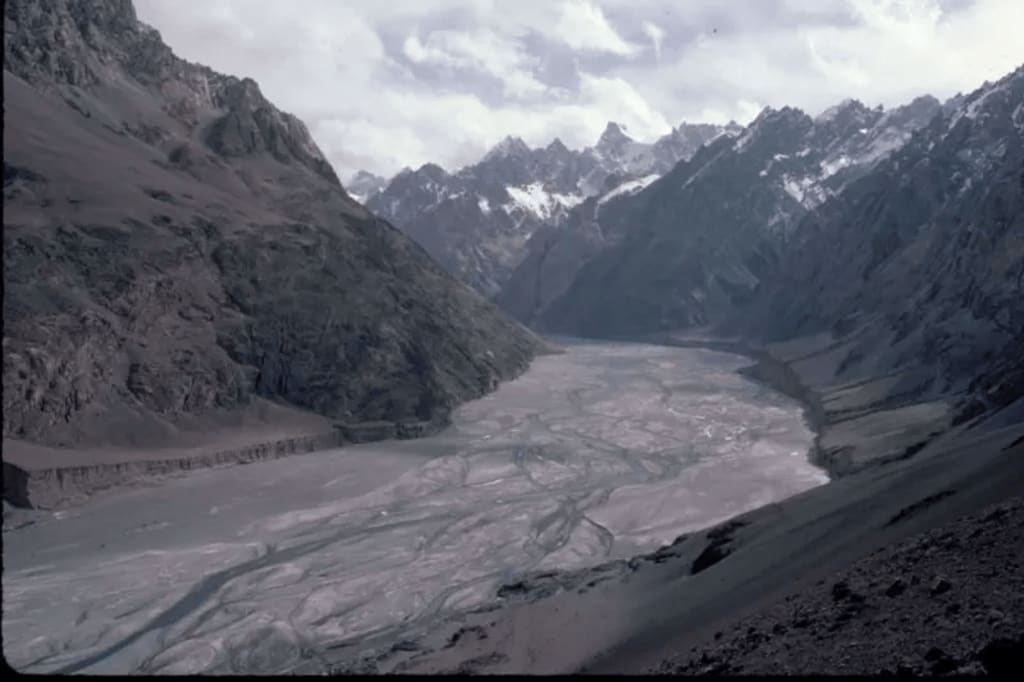
The source of the rivers of mercury
1. 1440 ppb
In December 1981, a geological team went up onto the burial mound of the First Emperor of Qin.
They set out 54 sampling points. The average mercury content at 53 of the points was about 205 ppb. The control soil was 5 to 65 ppb. The point at the top was 1,440 ppb.
The researchers drilled vertically downward from this point. Mercury concentration rose from shallow to deep. The anomalous area was about 12,000 square meters. Its shape was roughly geometric.
In May 1982 they retested. The conclusion was the same.
That sentence in the Records of the Grand Historian had long been read as rhetoric: “Mercury was used to make the hundred rivers, the Yangtze, the Yellow River, and the great sea, with mechanisms causing them to flow into one another; above were the celestial signs, below were the terrestrial features.” Sima Qian wrote this more than a century after the burial. He had never entered the underground palace. The figure 1,440 ppb was there. The mercury was real.
The source remained unknown.
2. The cinnabar deposit
Native mercury is rare. The most common mercury-bearing mineral is cinnabar, or mercury sulfide. Heat cinnabar to about 580°C. The mercury sulfide decomposes. Mercury vapor is released. On condensation, liquid mercury forms.
The people of Qin knew this process. In the Western Han, Liu An wrote four characters in the Huainan Wanbi Shu: “Cinnabar becomes mercury.”
The First Emperor’s mausoleum was begun in 246 BCE. It took nearly forty years to build. For 12,000 square meters of mercury rivers, the cinnabar consumption could not have been small.
In the Records of the Grand Historian, in the “Biographies of the Money-Makers,” Sima Qian mentions one person: “The widow Qing of Ba. Her ancestors obtained a cinnabar deposit and monopolized its profits for several generations; the family was also immensely wealthy.” Ba Commandery was in what is now Chongqing and eastern Sichuan. The widow Qing’s family controlled a cinnabar vein for generations. As a widow, Qing held the family enterprise together. She maintained a private armed force. No one dared touch her. The First Emperor invited her to Xianyang. He built a “Huaiqing Terrace” for her.
A widow from a remote mountain region could make the emperor build a terrace. She relied on cinnabar.
Ba Commandery was more than 600 kilometers from Mount Li. The Qinling Mountains stood between them. More than two thousand years ago, moving large quantities of cinnabar from Sichuan to the Guanzhong plain would have been slow and costly.
A closer source existed.
3. The mercury mountain
From Lintong, cross the Qinling Mountains. Follow the Han River upstream for a little over a hundred kilometers. The place is Xunyang.
Xunyang’s mercury reserves are about 20 percent of the national total. In the early Qing, Gu Zuyu recorded in the Dushi Fangyu Jiyao: in Xunyang County, Xing’an Prefecture, Shaanxi, there is a “Mercury Mountain.”
The late Professor Duan Qingbo of Northwest University proposed in Archaeological Research on the Qin First Emperor’s Mausoleum Park that most of the mercury in the mausoleum might have come from Xunyang. He gave three reasons. The reserves were large. The distance to the Qin mausoleum was only a little over a hundred kilometers. The Han River provided a water route.
During the Warring States period, Xunyang lay on the border between Qin and Chu. In 221 BCE, Qin destroyed Chu. Xunyang and its mercury mines came under Qin control.
Shipping cinnabar from Xunyang by water to Guanzhong was nearly five hundred kilometers shorter than crossing the Qinling from Ba Commandery.
Xunyang has more than a thousand ancient mine shafts. They are distributed around Qingtonggou and Shatonggou. In 1982 and 1988, geological teams found two iron picks deep in the shafts. In form they were close to iron picks unearthed at the Han dynasty site of Yangjiahe in Xunyang. They were completely different from modern iron picks in the Qinba Mountains. As early as 1962, the geologist Zhang Bosheng proposed that mercury mining in this area began at the end of the Warring States period.
The mine shafts were there. The tools were there.
One thing was missing: human settlement sites from the pre-Qin period near the shafts. Mine shafts only showed that someone had gone in to mine. A settlement site would show that people had lived there long term, that someone had organized production and transport out.
4. Shimiaogou
In early 2025, an archaeological team entered the Shengjia River valley in Xunyang. That is a tributary of the Shu River.
In Hongjun Town they identified three sites: Shimiaogou, Chuantangping, and Guojiawan.
Shimiaogou lies beside the Qingtonggou cinnabar mining area. The site contains remains from multiple periods, from the late Neolithic to the Ming and Qing. The most important discoveries were three things: late Neolithic basket-marked red pottery sherds, Qin and Han cord-marked flat tiles, and cinnabar ore.
In a wild mountain area, people had lived there since the late Neolithic. Cinnabar ore came out of the site.
Chuantangping is on the periphery of the mining area. Cultural layers from the Shang-Zhou, Tang-Song, and Ming-Qing periods were found. Stone adzes and sandy cord-marked red pottery sherds were collected. Guojiawan is also on the periphery. Sandy red pottery sherds, fine gray pottery sherds, fragments of perforated stone tools, and fired clay lumps were collected.
The spatial relationship of the three sites is clear. Shimiaogou sat beside the mine, mining and processing. Chuantangping and Guojiawan sat at transport nodes on the periphery, handling transshipment.
An assembly line.
In the pre-Qin period, cinnabar mining in Xunyang already had some organized division of labor. Some people mined at the mine. Others handled transshipment at peripheral nodes. For a mountain area with poor transport, this division required considerable manpower and logistics.
5. The water route
If later work confirms how this assembly line operated during the Qin dynasty, we will know more. We will know how the people of Qin organized mining in steep mountains. We will know how they moved raw materials from the southern slopes of the Qinling to the Guanzhong plain.
The process may have been like this.
In the late Warring States period, Qin destroyed Chu. Xunyang came under Qin. At the same time, the imperial mausoleum at the foot of Mount Li was already under construction.
In the mountains of the Shengjia River valley, miners cut cinnabar ore from the shafts. The ore went from the Shimiaogou area to nodes such as Chuantangping and Guojiawan. It was loaded onto boats. It followed the Shu River into the Han River. It went north across the Qinling.
When it reached Guanzhong, workers heated the cinnabar in pottery vessels. The mercury sulfide decomposed. Mercury vapor condensed in the container into silvery-white droplets. The droplets were poured into the underground palace.
Day by day, year by year.
6. Multiple sources
Ba Commandery and Xunyang are not contradictory. The First Emperor’s mausoleum took nearly forty years to build. Drawing cinnabar from multiple sources at the same time was reasonable.
Xunyang was only a little over a hundred kilometers away. With the transport capacity of more than two thousand years ago, this place must have been a main supplier. The cinnabar of Ba Commandery, the family of the widow Qing, was another line.
Xunyang and Ba Commandery may both have supplied cinnabar. Mercury mines in Youyang in Chongqing and Wuchuan in Guizhou are also candidates. Isotope analysis could test the match between a mining area and the mercury in the underground palace.
The discovery is a clue. It does not settle the question. The “pre-Qin to Han” span is broad. Further excavation and dating are needed.
Xunyang was on the Qin-Chu border during the Warring States period. The number of pre-Qin sites in this area has always been relatively small. The three newly discovered sites fill a gap. They also give archaeologists a look at how people lived and worked in southern Shaanxi before Qin, and at exchange between north and south.
7. More than seventy times
Wu Yongqi, honorary director of the Emperor Qinshihuang’s Mausoleum Site Museum, said this in a CCTV interview:
“Underground cultural relics are fragile. We must have reverence for heaven and earth, for nature, for our ancestors. If we have advanced technology that allows us to understand what is inside without opening the tomb from the surface, without disturbing this old man who has slept for two thousand years, then I say from the bottom of my heart: do not move it in the future either.”
He said: “In my view, unless it is a rescue excavation for protection, then if it can be left unexcavated, leave it unexcavated. Especially the emperor’s mausoleum: do not move it in the future either. There is no need to move it.”
Underground cultural relics are fragile. Plant fibers and animal fibers, if opened rashly, suffer an enormous impact. Some deteriorate on the spot.
Geophysical prospecting has detected mercury in the emperor’s mausoleum. The mercury content of the burial mound is more than seventy times that of the surrounding earth.
Wu Yongqi said: “Often the thing not yet obtained is the most beautiful. So let us keep the question and think slowly. This process is better than obtaining it.”
8. The iron picks
In the mine shafts of Qingtonggou in Xunyang, those two iron picks are still there.
They are close to the iron picks unearthed at the Han dynasty site of Yangjiahe in Xunyang. They are completely different from modern iron picks in the Qinba Mountains. Someone held them and struck cinnabar ore deep in the shaft. That person did not know where the ore would go.
The ore went from Shimiaogou to Chuantangping and Guojiawan. It was loaded onto boats. It followed the Shu River into the Han River. It went north across the Qinling. It reached Guanzhong. It was heated and condensed into mercury. It was poured into the underground palace.
On the burial mound above the underground palace, that 1,440 ppb sampling point from 1981 is still higher than its surroundings.
The Terracotta Warriors receive more than a million overseas visitors each year. More than two hundred foreign heads of state and government have visited. They have toured nearly fifty countries and regions. Beneath the burial mound, whether the rivers of mercury still flow, whether stars and rivers and mountains remain deep in the underground palace, no one knows.
The mercury content of the burial mound is more than seventy times that of the surrounding earth. That number remains. In the mine shafts, the iron picks are still there. At the site, the cinnabar ore from Shimiaogou sits in sample bags.
Wu Yongqi said: keep the question and think slowly; this process is better than obtaining it.
About the Creator
Jin
Writer of reamstories
https://reamstories.com/jin
Enjoyed the story? Support the Creator.
Subscribe for free to receive all their stories in your feed. You could also become a paid subscriber, letting them know you appreciate their work.
Comments
There are no comments for this story
Be the first to respond and start the conversation.