
The Last White Patch: Indonesia’s Eternal Snow Is Almost Gone
On a tropical mountain near the equator, a sacred glacier is melting. For the Amungme, it is Nemangkawi, the white arrow in the sky, and a root they are losing.

The Last White Patch
The photograph from 1936 shows snow. It covers the ridge in a wide, uneven sheet, filling the saddles between peaks. In a drone image from 2025, the same ridge is mostly gray rock. A small white patch clings to the highest slope. It is smaller than a football field
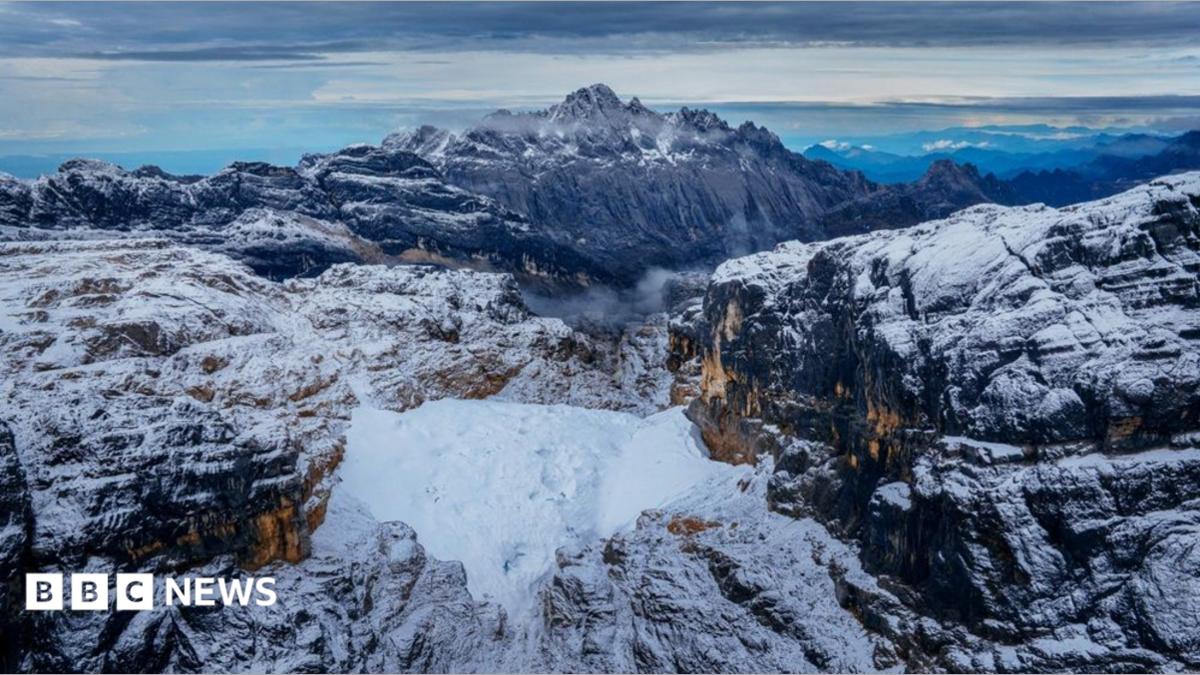
This is the Sudirman Range in Papua, Indonesia. The mountains sit about 450 kilometers south of the equator. For centuries, their tops held snow and permanent ice. A century ago, four main peaks carried glaciers. Today, only Puncak Jaya, also called Carstensz Pyramid, still has a little snow. Scientists expect it to disappear within a year or two.
The numbers are blunt. In the 19th century, glacier cover around the summit was about 1,900 hectares. Now it is about 16 hectares. From the early 2000s to 2025, the ice area shrank by 95 percent. Almost the entire glacier has vanished within a human lifetime.
The ice core
Marie Šabacká, a Czech glacier ecologist, traveled to Puncak Jaya in March 2025. She wanted to be among the last scientists to study Papua’s “eternal snow.” She says the tropical glaciers of Papua are unique because they are thousands of kilometers away from other glacier systems. They are the last remaining tropical ice between the Andes and the Himalayas.
Ice cores drilled from the slopes preserve records of the atmosphere, the tropical Pacific, and the Western Pacific Warm Pool. Scientists can use them to learn about rainfall, temperature, and atmospheric circulation. But the archive is disappearing before they can fully read it.
Šabacká says the cause is the same as elsewhere: atmospheric warming from burning coal, oil, and gas. As temperatures rise, the freezing point moves higher. More precipitation falls as rain instead of snow. El Niño can speed it up. Local factors like cloud cover, snowfall, and terrain shape the pace.
She says, “There is a deep unfairness in this.” The mountains are only 450 kilometers south of the equator. Permanent ice can survive only at very high altitudes and within a narrow range of climate conditions. A slight rise in temperature, a higher freezing point, or a shift from snow to rain can decide whether a glacier survives. The retreat is evidence of long-term warming. Its disappearance erases a habitat and a landscape the Amungme treat as sacred.
White arrow
At least five indigenous groups have deep spiritual ties to Puncak Jaya. The Moni call it Mbainggela and believe ancestors guard the mountain. For the Amungme, the range is Nemangkawi, the White Arrow.
Elfrida Natkime, a young Amungme woman, says, “Parents and grandparents pray for children to have hearts like the white arrow, never turning from the right path. It stands for honesty, purity, and moral integrity.” In Amungme belief, Nemangkawi shows how people should live.
Adolfina Kum, an Amungme environmental activist, asks, “If Mecca were destroyed, how would Muslims feel? If Rome or the Vatican were destroyed, how would Catholics feel? That is how the Amungme feel when Nemangkawi is destroyed.”
For many Papuans, the vanishing ice sits inside a longer history. The discovery of large copper and gold deposits changed the region in the 20th century. Mining projects reshaped parts of the land. Entire mountainsides were dug open. Roads, industrial infrastructure, and settlements changed the valleys.
Papuans say the development brought jobs, roads, education, and economic opportunities. It also brought environmental damage and decades of social conflict. As mining expanded, some lost access to ancestral land. The BBC contacted Freeport, which operates the Grasberg mine, for comment. The mine is one of the world’s largest gold and copper operations.
Elfrida says, “Whenever I see these mountains, I am amazed, but I am also sad… Since the company came, I have seen the mining. But the development has also given many people a living.”
Justinus, a Moni man, stands in front of the mountain. He wears a blue jacket and dark blue trousers. A red backpack hangs from his shoulder. He does not speak.
The last patch
Scientists and explorers are racing to record what remains. Klaus Thymann, a Danish researcher, and his team used drones and 3D mapping to build a detailed model of the existing glacier. He says, “There is almost no ice left. That is the fact.”
Thymann says glaciers are a strong indicator of climate change. “When people hear that something described as eternal is disappearing, they react.”
Adolfina Kum says when a sacred mountain, forest, or ancestral place is damaged, the community loses part of what holds it together. “I often describe it as pulling a tree out by its roots. Without roots, the tree loses its foundation.”
On the ridge, the last white patch is smaller than a football field. A drone hovers above it, mapping the edges. In the valley, a man with a red backpack looks up. He does not say anything.
In a year or two, the patch will be water. It will run down the rock, into the streams, into the warm air of the equator. The mountain will still be called Nemangkawi. Children will still be taught to have hearts like white arrows. But the arrow will be gone from the sky.
About the Creator
Jin
Writer of reamstories
https://reamstories.com/jin
Enjoyed the story? Support the Creator.
Subscribe for free to receive all their stories in your feed. You could also become a paid subscriber, letting them know you appreciate their work.
Comments
There are no comments for this story
Be the first to respond and start the conversation.