
The Green Tide: Plankton Blooms and a Changing Gulf of Thailand
A Striking Sight Off Ko Lan Nature’s Cycle, Amplified Rain, Runoff, and Rising Temperatures When the Bloom Fades, the Danger Lingers Tourism in the Balance Warning Signs for the Future

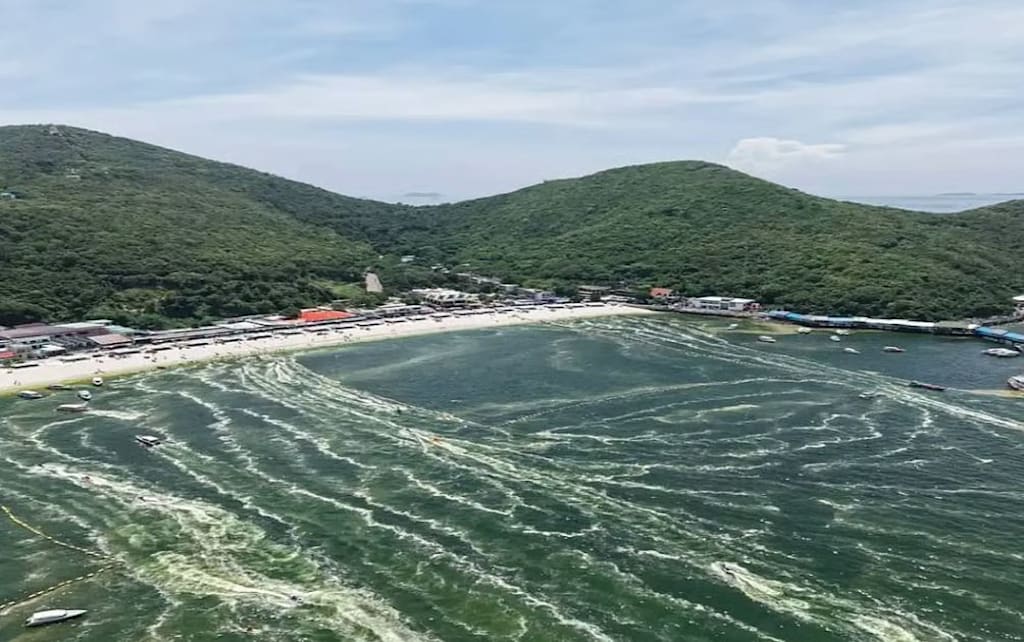
This week, the waters surrounding Thailand’s popular island destination of Ko Lan turned an unsettling, vivid shade of emerald green, keeping visitors on shore and sparking concern among scientists and locals alike. What swimmers saw was not pollution in the traditional sense, but a dense bloom of microscopic plankton a natural phenomenon whose increasing frequency and intensity across the Gulf of Thailand is sounding growing alarms about the health of regional seas.
A Striking Sight Off Ko Lan
The transformation was unmistakable. Patches of bright, pungent green stretched along sections of the island’s coastline, contrasting sharply with the usual blue waters of the northern Gulf, while other stretches remained entirely unaffected. Jet skis floated through discoloured waves, and tourists gathered at the shoreline, hesitant to enter. “I felt that it was unusually green compared to normal seawater, so I didn’t dare go in,” said Latipeya Thantibhapat, a 29‑year‑old visitor from Chiang Mai. “I was afraid I’d break out in a rash.” Food vendors reported thinner crowds, with some holidaymakers moving to clearer beaches elsewhere an immediate and tangible impact on the island’s livelihood.
Nature’s Cycle, Amplified
Researchers from Burapha University have identified the organism largely responsible: Noctiluca, a type of plankton whose sudden proliferation creates the dramatic hue. As Arvut Munhapon, head of marine environmental research at the university’s Institute of Marine Science, explained, “Plankton blooms are a natural, recurring phenomenon, but have worsened around the world as climate change has warmed seas.” His team has been on site collecting samples, measuring water quality, and building a database to better understand the patterns. The core tension is clear: this is not an entirely new event but it is happening more often, spreading more widely, and lasting longer than before.
Rain, Runoff, and Rising Temperatures
Several forces have converged to fuel this year’s bloom. Heavy monsoon rains and severe flooding across central Thailand and Bangkok have washed vast volumes of freshwater into the Gulf, carrying with it fertiliser residues, nutrient‑rich wastewater, and organic matter all of which act as fuel for rapid plankton growth. Compounding this, El Niño‑driven warming has raised sea surface temperatures; warmer water accelerates biological growth while simultaneously holding less dissolved oxygen, creating ideal conditions for blooms to explode and then collapse. It is a feedback loop driven both by local land use and global climate trends.
When the Bloom Fades, the Danger Lingers
The most serious concern emerges not while the water is green, but afterwards. Blooms typically persist for two to three days before dying off en masse. As the plankton decompose, they consume nearly all available oxygen in the water, creating hypoxic conditions so‑called “dead zones” where marine life cannot survive. Anukul Buranaprat, deputy director of the Institute of Marine Science, warns this threat is already deepening: “Hypoxia in the inner Gulf of Thailand has genuinely gotten more severe.” This year, he has observed an unusually extensive low‑oxygen zone forming across the seabed, endangering bottom‑dwelling creatures and disrupting the foundation of the local marine food web. The full extent of the link between El Niño and this deterioration is still being studied, but the trend is unambiguous.
Tourism in the Balance
Beyond ecology, these shifts carry economic weight. For Ko Lan and countless communities dependent on healthy seas, a discoloured coastline means lost visitors, empty beachfront stalls, and reputational damage that can linger long after the water clears. Tourist apprehension is understandable; while Noctiluca blooms are not always directly harmful to humans, their sudden appearance signals broader environmental stress that erodes confidence. The challenge for authorities will be balancing honest communication with long‑term action reassuring the public without ignoring the underlying causes.
Warning Signs for the Future
The bright green tide off Ko Lan is more than a temporary inconvenience. It is a visible marker of two intersecting pressures: the immediate nutrient load carried by every heavy rain, and the slow, steady warming of the oceans that makes such imbalances harder to reverse. Restoring the Gulf will require action at every level better wastewater management, reduced fertiliser runoff, sustainable flood control, and global progress on climate change. Until those take root, Ko Lan’s green waters will remain not just a curiosity, but a clear warning: the seas that sustain us are changing, and we ignore the signs at our peril.
About the Creator
Mark Lim
Hi I am mark an automotive student and a car, tech and food enthusiast ! Im gonna try and post daily & hope you enjoy what I write and do share my page with people you know. I would gladly appreciate it! Cheers
Enjoyed the story? Support the Creator.
Subscribe for free to receive all their stories in your feed.
Comments
There are no comments for this story
Be the first to respond and start the conversation.