
Ten Real Places on Earth That Look Like They Belong in Fantasy Novels
These landscapes feel like someone forgot to turn off the CGI.


The Door to Hell — Turkmenistan
The Darvaza gas crater, also known as the Door to Hell or Gates of Hell, officially the Shining of Karakum, is a burning natural gas field collapsed into a cavern near Darvaza, Turkmenistan. Hundreds of natural gas fires illuminate the floor and rim of the crater. The crater has been burning since 1971.

The Rainbow Mountains — China
Zhangye Danxia Landform Geological Park, located in Gansu Province in northwestern China. The vibrant stripes of red, orange, yellow, green, and blue were formed over 24 million to 135 million years through the deposition of sandstone and mineral layers, compressed by tectonic plates and shaped by wind and water erosion. Iron oxides (such as hematite) create the deep red hues, while other oxidized minerals produce yellows and browns.

The Glowworm Caves — New Zealand
New Zealand's most famous glowworm caves are located in Waitomo on the North Island and Te Anau on the South Island. Thousands of Arachnocampa luminosa (endemic New Zealand glowworms) create a natural blue-green bioluminescent light show inside these ancient limestone and rock chambers.

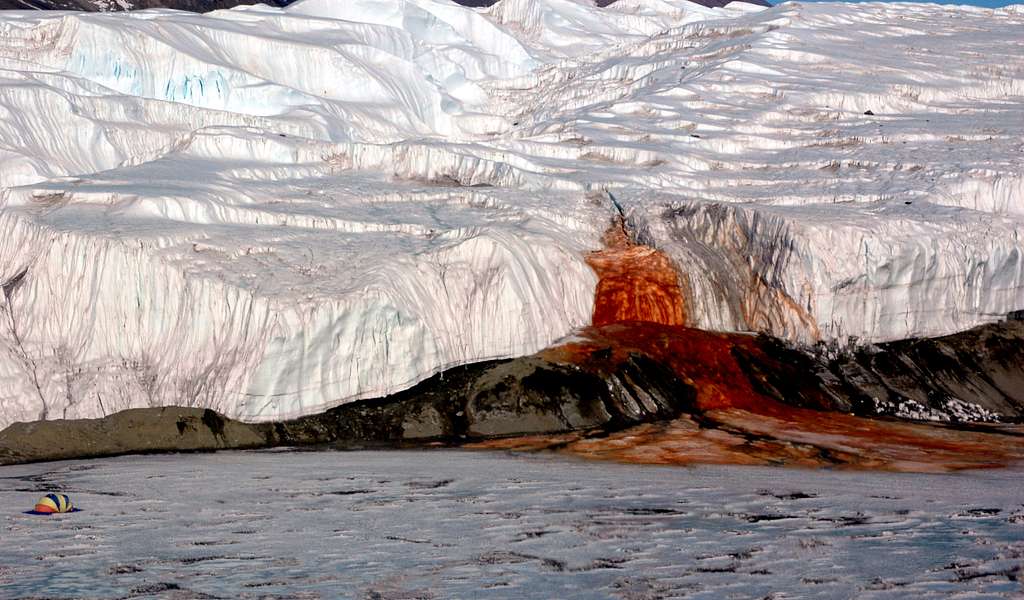
The Blood Falls — Antarctica
Blood Falls is a crimson-colored saltwater waterfall that flows from the tongue of Taylor Glacier into West Lake Bonney in the McMurdo Dry Valleys of East Antarctica. The water comes out clear from beneath the ice, but turns a deep blood-red hue when the iron-rich, hypersaline brine hits the oxygen in the air and oxidizes (rusts). The liquid comes from a subglacial pool buried roughly 400 meters (1,300 feet) deep and isolated for millions of years. The ancient, sunless water supports unique, surviving microscopic communities that live without photosynthesis. Research covered by Scientific American and Johns Hopkins University shows that tiny iron-rich nanospheres and ancient marine-derived organisms help explain how liquid water persists and moves beneath freezing glaciers.
The Crooked Forest — Poland
The Crooked Forest is a grove of oddly-shaped Scots pine trees located in the village of Nowe Czarnowo near the town of Gryfino, West Pomerania, in north-western Poland. It is a protected natural monument of Poland. This grove of 400 pines was planted in around 1930.

The Giant’s Causeway — Ireland
The Giant's Causeway is an area of approximately 40,000 interlocking basalt columns, the result of an ancient volcanic fissure eruption, part of the North Atlantic Igneous Province active in the region during the Paleogene period.

The Pink Lake — Australia
Australia is famous for its striking pink salt lakes, which get their vibrant colors from salt-loving algae (Dunaliella salina) and red carotenoid pigments. Swimming is generally not recommended or allowed in most pink lakes due to extremely high salt crusts, sharp crystals, and environmental protection guidelines. Colors are usually most vibrant on sunny days or right after seasonal rains trigger algal growth. Always check local road and park conditions before driving out.

The Underwater Waterfall — Mauritius
The underwater waterfall in Mauritius is a famous natural optical illusion located off the southwest coast of the island near the Le Morne Brabant peninsula. There is no real water plunging into a deep hole; water cannot fall underwater. Strong ocean currents push sand and silt off the edge of a shallow underwater shelf (about 150 meters deep) down into a massive 4,000-meter oceanic abyss. The movement of pale sand against the dark blue and turquoise water creates the convincing illusion of a cascading waterfall.

The Stone Forest — Madagascar
The Madagascar stone forest, officially known as the Tsingy de Bemaraha National Park and Strict Nature Reserve, is a dramatic landscape of razor-sharp limestone pinnacles located in the Melaky Region on the western coast of Madagascar.

The Bioluminescent Beaches — Maldives
The bioluminescent "Sea of Stars" in the Maldives is a natural phenomenon where microscopic marine phytoplankton (primarily dinoflagellates and Noctiluca scintillans) emit a bright neon-blue or blue-green light when disturbed by waves, footsteps, or swimming.

About the Creator
Kristen Barenthaler
Curious adventurer. Crazed reader. Librarian. Archery instructor. True crime addict.
Instagram: @kristenbarenthaler
Facebook: @kbarenthaler
Enjoyed the story? Support the Creator.
Subscribe for free to receive all their stories in your feed. You could also become a paid subscriber, letting them know you appreciate their work.
Comments
There are no comments for this story
Be the first to respond and start the conversation.