
Six Hours on the Floor: How Nagoya’s Airport Chaos Exposed the Asian Games Before They Began
Athletes went hungry, stretched on terminal tiles, and found their own way out while the host’s systems collapsed. The “frugal” Games had barely started—and the bill was already being paid by the people it was meant to serve.
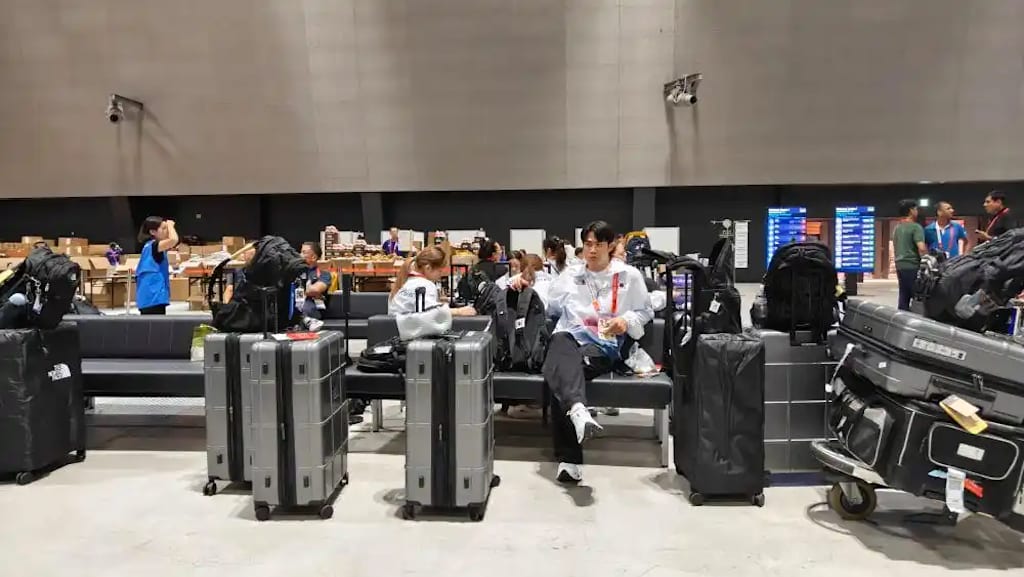
Six Hours: What the Nagoya Airport Chaos Revealed Before the Asian Games Even Began
The plane landed on time. The athletes did not leave.
At 12:15 p.m. local time on September 16, the Chinese sports delegation's headquarters and several teams landed at Nagoya's Chubu Centrair International Airport. The flight was on schedule. For a moment, everything looked normal.
The plan was simple. Teams arriving that day would board buses at the airport transport center and ride to their accommodations. The Asian Games were about to begin. Athletes needed to rest, eat, and prepare.
Instead, the next six hours became a test of patience, hunger, and organizational failure.
By 2 p.m., reporters at the airport transport center saw athletes from several countries and regions sitting on the floor, slumped over luggage, or leaning against walls. They looked exhausted. The Indian rowing team's coach said his group had landed around 10 a.m. and was still waiting more than four hours later. The Korean delegation sat in clusters. The Kazakh shooting team waited two hours, but no one told them why.
The Chinese gymnastics team had 21 people. The airport system could find only two of them.
That single detail explains much of what happened. The organizing committee's registration and transport dispatch system had failed. Without a match in the system, staff could not confirm identities, assign buses, or move teams forward. The system was the gate. When the gate broke, no one opened a manual door.
"Everyone was asking everyone else."
A volunteer, looking helpless, told a reporter: "We don't know the exact reason. Maybe one link didn't connect with the next." That phrase, one link didn't connect, became the quiet slogan of the afternoon.
No one could say when buses would come. No one could say which teams would leave first. No one could say what had gone wrong. Staff asked each other. Volunteers asked staff. Team officials asked volunteers. The entire operation turned into a circle of people shrugging at one another.
Meanwhile, the athletes did what athletes do. The Chinese gymnastics team found a relatively open patch of floor. They unrolled yoga mats. They took out foam rollers and resistance bands. They changed into training clothes and began stretching.
One young woman lay on her back, a foam roller under her shoulder blades, rolling slowly. Her face showed no anger, only concentration. A male teammate wrapped a resistance band around his ankles and did lateral steps across the cold tile floor as if he were in a training hall. Passersby took photos. The athletes ignored them.
Training is a habit. It does not wait for a bus.
But habit cannot replace food. The transport center offered drinking water. It did not offer food. A vending machine and a small convenience store were soon emptied. Athletes who had just finished long flights, some from Europe, some from other parts of Asia, went five, six hours without a proper meal.
One athlete said: "I haven't really eaten all day. From landing to now, more than five hours. I'm tired, sleepy, and hungry. And we still have training tomorrow."
Another smiled bitterly and said: "These things are harder than competition."
Competition is hard, but competition has rules. It has referees. It has a start and a finish. Waiting in an airport with no information, no food, and no clear end is a different kind of hard. It is the hardness of being powerless.
The badminton team found its own way out.
The Chinese badminton team did not wait forever. They first tried to buy tickets for the public airport bus. There were not enough seats. Some members left first. The rest stood outside the transport center, unsure what to do.
Then staff from the Chinese Consulate-General in Nagoya arrived. They had come to meet the team, heard about the situation, and immediately began making calls. The consulate contacted local Chinese residents, who helped arrange rental cars. By around 4:30 p.m., the remaining badminton players were finally on their way.
Other teams also found their own solutions. Some paid for taxis. Some called local contacts. The organizing committee's message was blunt: teams could arrange their own transport, but they would have to pay for it themselves. The announcement played politely over the airport speakers, as if this were a normal option instead of an admission of failure.
Around 5 p.m., parts of the Chinese table tennis, wushu, and rowing teams finally got buses. The gymnastics team did not leave until around 6 p.m. By then, the sky was dark. They had been at the airport for nearly six hours.
This was not just a system glitch.
A system failure can happen anywhere. No technology is perfect. The question is what happens after the failure. Someone needs to step in. A manual backup needs to exist. A human being needs to take responsibility.
In Nagoya, the answer was no.
Staff could not check names manually. They could not assign buses by hand. They could not provide regular updates. They could not even explain the problem. The organizing committee had built a system with no Plan B, and when the system broke, the people running it broke with it.
That is an organizational problem, not a technical one.
And it did not affect only China. Indian, Korean, Kazakh, and Sri Lankan athletes were also stuck. The failure was universal. It was incompetence on a schedule.
The deeper issue: saving money in the wrong places.
The airport chaos did not come out of nowhere. It was a symptom of a larger design choice.
Nagoya's Asian Games organizers decided to abandon the traditional Athletes' Village. Instead of a centralized village, they dispersed athletes across a cruise ship, temporary container-style housing, and hotels around the region. The cruise ship had about 1,500 cabins. The container units were built near the port. Other athletes were placed in hotels, some as far away as Tokyo.
The logic was clear: cut costs. The organizers promised a new model of "frugal" Games. But frugality has a limit. When you scatter athletes across a wide area, transport stops being a convenience. It becomes the lifeline of the entire event.
If the buses fail, the Games fail. If the airport dispatch system fails, everything downstream fails. The six-hour wait at Nagoya airport was not an isolated accident. It was the lifeline snapping at its weakest point.
The accommodation itself has also drawn complaints. Korean basketball players staying in container-style rooms posted videos of leaking sinks and water across the floor. One player wrote: "Please help us." The vice president of the Korean Basketball Association said the beds were too short for players over two meters tall. He called it, based on his experience, the worst arrangement he had seen.
The Indian delegation took an unusual step. They built two container-style mock-ups at home so their athletes could get used to the conditions before arriving in Japan. A national delegation preparing its athletes for the host's housing by simulating it at home is almost unheard of in international sport.
The organizing committee chair later admitted that they had "neither the manpower nor the budget" to accommodate extra participants. The budget was planned for 15,000 people. More than 17,000 registered.
When the budget fell short, the organizers did not cut ceremonial extras. They cut basic support. They cut food. They cut transport. They cut comfort. They shifted the cost of their own mismanagement onto the athletes.
The paradox of "saving money."
The most bitter irony is that this cost-cutting Games has become more expensive than planned. To cover the visual gaps left by a simplified opening ceremony, organizers had to buy more AR and VR equipment. After reducing volunteers, they had to develop more automated service systems. After complaints from multiple delegations, they had to add emergency funding for housing and transport.
Japanese media estimates put the Asian Games and Asian Para Games operating budget at around 298 billion yen, more than three times the original plan. Including infrastructure and promotion, the total could reach 370 billion yen.
Nothing important was saved. What was lost was the athletes' trust and preparation.
Real frugality means concentrating resources on the core: athlete services, event organization, safety, transport. It means cutting what does not matter. Nagoya did the opposite. It spent more overall while pinching pennies on the things athletes actually needed. A bed they could stretch out in. A meal after a long flight. A bus that arrives on time.
The Games had not even begun.
The Nagoya airport incident happened before the opening ceremony. Football and basketball had already started, but most athletes were still arriving. The chaos at the airport was the first impression many teams received of the host country's organization.
China's teams found their own way out. That shows their resourcefulness. The consulate and local Chinese residents helped. That shows the strength of community. But they should not have had to self-rescue in the first place.
Imagine your neighborhood loses power. You buy a generator. The lights come back on. That does not mean the power company did a good job. It means you solved a problem they created.
The athletes who waited six hours will remember it. They will not mention it in post-match interviews. Reporters will not ask. But their bodies will remember. The fatigue and hunger leave traces. They show up in a missed step, a slow reaction, a heavy leg.
And when an athlete says, "These things are harder than competition," she is not complaining. She is telling the truth.
Competition, at least, gives you a chance to fight. Waiting for a bus gives you nothing to fight except time.
About the Creator
Jin
Writer of reamstories
https://reamstories.com/jin
Enjoyed the story? Support the Creator.
Subscribe for free to receive all their stories in your feed. You could also become a paid subscriber, letting them know you appreciate their work.
Comments
There are no comments for this story
Be the first to respond and start the conversation.