
Shuffling Around Christchurch in Dorset
Medieval punishment, taphophobia, the Normans, 900 years and feral brats
Having left home quite early in the morning we knew we had to have some calorific input before we went for a shuffle around the Dorset town of Christchurch.
Fortified with calories, protein, carbohydrates and proteins we set off. Christchurch is about twenty minutes from where we live. As we know the town well it is highly unlikely we will find much new during these shuffles but that didn’t matter as we were both glad to be out for a walk before the extreme heat set in for the rest of the day.
The Christchurch of today is a thriving Dorset town on the edge of the New Forest. The main street is populated by very few national or multinational retailers which gives the place variety and the constant hope while Christmas shopping of finding something a little bit different for those recipients who have everything.
We managed to find that little something in a small Italian delicatessen near the Priory for our sister in law. whom We are building up a hamper of luxury and unusual food items from our travels for her. Yes, we know it is August but what harm is there in being prepared? As, she may well read this that is all I am going to say on this subject.
All of this is a far cry from what Daniel Defoe wrote about the place in his “A tour through the whole Island of Great Britain2 after passing through the area on the third leg of his tour. He describes Christ Church as “…a very inconsiderable poor place, scarce worth seeing, and less worth mentioning in this account”. He wrote about the wider area around the town as not having very much international sea trade “except it be what we call smuggling and rouging which I may say, is the reigning commerce of this part of the English coast”.
I think by now you will appreciate that both Heather and I love books and enjoy reading. The local hospice shop had a good selection which by the time we left the premises the stock had been reduced by four. Our bookshelves are already bulging and over stacked so logic would dictate that we shouldn’t buy anymore. That logic was quickly overruled by another logic that we would need some reading material for our forthcoming holiday. And so, I became burdened with four tomes.
Running parallel to the main street is the Mill Stream. On the town side of the brook, it is not possible to walk along the bank as it is built on with houses and private gardens marking its path through the town. It is still possible to get to the bank down a side street and past some stunning old properties. The side street, named “Ducking Stool Lane” ends at the brook where there is a ducking stool.
Ducking stools, not used in this country since 1809, were a barbaric form of punishment involving someone found to be guilty having to endure being ducked into and under the water as many times as the judge felt appropriate to fit the crime. They were used exclusively to punish women who were accused and found guilty of being scolds. This is a crime that also included the offences of verbal abuse, brawling or any other form of what we would call today, anti-social behaviour.
The punishment meted out was not intended to be capital but more of a means of ridiculing, embarrassing or humiliating the adjudged criminal. Contrary to popular belief, most likely generated from stories from America of how witches were identified prior to being placed on trial, There are no records in this country of ducking stools being used to identify witches.
If this punishment was still on the books some 217 years after the last recorded ducking any sentence would have had to have been deferred or suspended. The Mill Stream, on the day of our visit, was barely deep enough for the ducks to be able to paddle in its cool waters. That is how hot the summer of 2026 and will continue to be so well into September.
The first ducking stool on this location was installed in 1305. A little bit earlier than that was when the Norman Keep was built between 1180 and 1190. What is left of this structure is perched on top of a man made mound that enabled the residents, the de Redvers family who were lords of the manor for two hundred years, to keep an eye on things in their town.
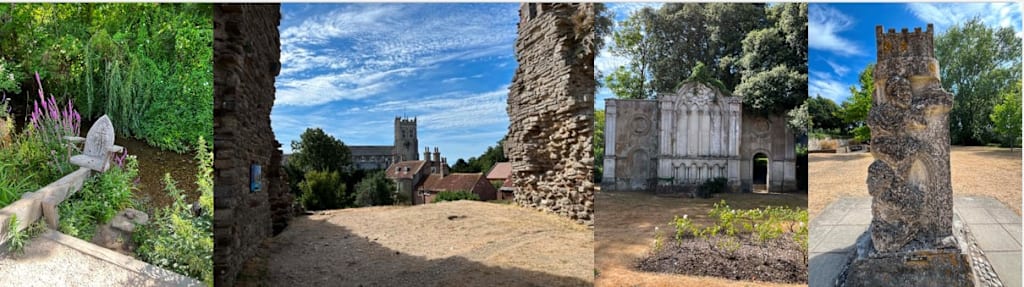
Although the family who took over the town after the de Redvers had nothing to do with the Civil War (1642 – 1651) the Parliamentarians destroyed the castle leaving just the two walls of the keep. The five metre climb to the summit of the mound is well rewarded with a view across and over the rooftops of Christchurch. Another view that makes this short climb worthwhile is the one of Christchurch Priory framed by the two remaining walls of the keep.
Our root back to the car took us through the grounds of the Priory.
Tucked away and sheltered from the brilliant sunshine was what could best be described as the remains of some sort of religious building. It is actually a mausoleum of a Mrs Perkins who died in 1783. She suffered from “taphophobia” which was not the cause of her death but her fear of what would follow. “Taphophobia” comes from the joining of the Greek words “taphos” meaning a grave or a tomb and “phobia” meaning a fear. Mrs Perkins was scared witless that when she was placed in a coffin and entombed she would wake up as if from a nightmare and couldn’t escape back to the world. Her instructions were that after her death that just in case she should come around was that her coffin, with an open lid should be left in the loft of a school in the grounds of the priory. This was so that if she should reawaken, the boys would hear her moving around above them and rescue her. This was while she was waiting for a mausoleum to be built, the remains of which still stand today without Mrs Perkins’ coffin.
In another part of the Priory’s grounds is an obelisk looking installation that on first glance looks like something from the Pacific Islands. It isn’t that old or from that far away. It is a sculpture by Jonathon Sells, a Dorset artist, who won a competition for a piece to commemorate the 900th anniversary of the Priory in 1994. He designed to reflect some of the humorous aspects during the Priory’s long history. There is a monk climbing on the shoulders of another to feed the birds in a nest, a wedding scene, a Norman soldier helping a cleric to reach the top of his crook and a caricature of the artist in modern glasses smiling permanently at passers by and those who stop to admire his work.
We sat on a bench overlooking an overgrown pond and in the shadow of the Priory our shuffle had been enjoyable. We had a look through the books we had bought at the start of our walk and renewed our vows to not read them until we were on holiday in September. We both saw a grey squirrel advance across the nearby lawn towards the obelisk.
Our arbour of peace, tranquillity and contemplation of books, life and the universe was broken when we heard the words from an adult male “Don’t go near the pond Seb and don’t let your little brother fall in either”.
The little tribe walked behind us invisibly but most definitely not silent. There was a male adult, presumably a Dad or irresponsible adult, and four little males. Three of them could be best described as feral. As for the fourth one it was strapped into a pushchair and thus suitably restrained from learning ferality from his siblings by nurture for the moment.
To our left the grey squirrel had found something to eat. It was contentedly munching away. Then as the tribe came into view over our left shoulders the Dad, aka irresponsible adult, called out again.
“Oh, look Seb, there’s a squirrel. Go on and see if you can catch him.”
At which Seb and another member, the names of Tarquin or Olly spring to mind, of the tribe set off after the squirrel screaming and shouting as they ran across the lawn. They were loud enough to wake Mrs Perkins from wherever she lay. Of course, the squirrel was too fast for them and scrambled up the nearest tree. The two boys got to the base and started shouting at the squirrel They even threw a couple of sticks up int the branches.
The two boys got bored and ran after the rest of the tribe that was heading through a gateway into another part of the Priory grounds. Peace returned but the squirrel had not by the time we walked on.
As they rejoined their tribe I heard the irresponsible adult male tell Seb that he wished he would look after the family barbecue as well as he looked after his little brother.
The quayside was quite crowded with people enjoying the summer’s morning. Pigeons, seagulls and some Canadian geese waddled around hopefully looking for some fallen crumbs or even the odd chip or two. That scene was soon disturbed when two boys, no more than eleven or twelve, dressed in trainers, shorts and life jackets rushed on to the quay and started running amongst the birds screaming and shouting. Of course, the birds are going to panic and take to the air which excited the brats even more. We couldn’t hear anyone from anywhere telling them that was not a nice thing to do.
What had started as a nice day sort of fizzled into a feeling of dismay and bewilderment that adults think in this day and age that it is ok for their offspring to chase birds and other wild animals for the sheer hell of it. Doesn’t give us much optimism for some of that generation growing up with caring, compassionate and empathetic attitudes towards other living things.
About the Creator
Alan Russell
When you read my words they may not be perfect but I hope they:
1. Engage you
2. Entertain you
3. At least make you smile (Omar's Diaries) or
4. Think about this crazy world we live in and
5. Never accept anything at face value
Enjoyed the story? Support the Creator.
Subscribe for free to receive all their stories in your feed.
Comments
There are no comments for this story
Be the first to respond and start the conversation.