
Scarborough in Yorkshire
On the coast of "God's own County"
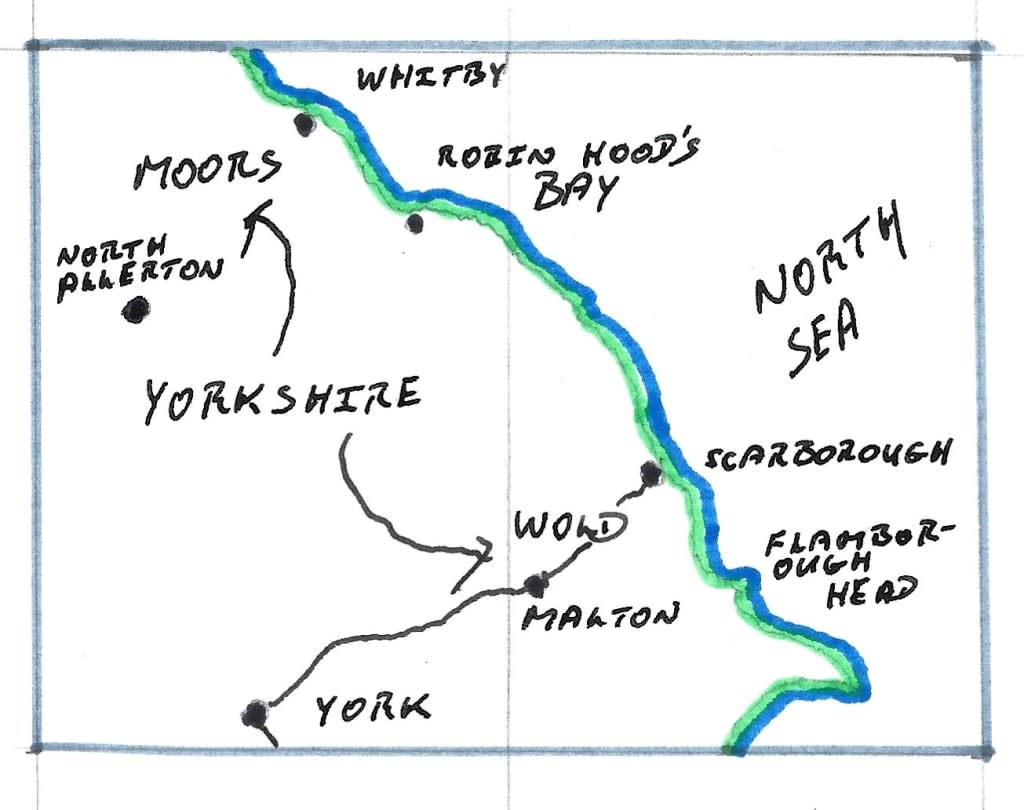
Scarborough is located on the eastern coast of Yorkshire which coincidentally is the county’s only coast.
To many Yorkshire people their allegiance to their home county takes precedence over their allegiance to their country. They even refer to their home county as “God’s own country”. This is one of those phrases that sounds like it has been around for a long time. So long, it has become embedded in the county’s identity and collective psyche as solidly and as old as the cretaceous rock formations that lie underneath Scarborough. It hasn’t. It was first mentioned as a headline for a special edition of Country Life published in 1995 by Nigel Farndale, a son of Yorkshire.
The town’s name is the result of the conflation of two words. The “Scar” part is a shortened version of the Anglo Saxon word “Scear” meaning a “rock”. The “borough” part is also rooted in the Anglo Saxon language and means a place that is fortified. Scarborough certainly has a big rock at the northern end of the South Bay overlooking the harbour. At the summit of this rock are the visible remains of an old castle whose ancient stones lie on top of fortifications dating back to 2000 BCE during the late bronze age. Archaeologists have also found evidence from 8000 BCE, the Neolithic era, of human habitation.
There could not have been very much going on here in 1086 as the town does not get a mention in the Domesday Book of that year. Or those collecting the data on behalf of William I got as far as Pickering, eighteen miles inland from Scarborough, and thought “Let’s call it a day on this lark and let William will think Pickering is on the coast”.
From the South Beach it is possible to see some of the remains of the fort that was built in the 12th century. It would be intact today if it hadn’t been used as target practice by the Royal Navy during World War I. In my own opinion the naval artillery should have been aiming about a mile to the south which would have preserved the fort and destroyed most of the town’s negative contribution to the British hospitality industry.
For several centuries Scarborough bumbled along as a fishing port, a trading harbour and a smuggling area. Then in 1626 a Mrs Farrar discovered a stream of acidic water containing iron that drained into the South Bay. “Taking the water” is something I only tried once at a spa resort in Canada’s Rockies. I couldn’t have been more than ten at the time and it was vile, so never again. Mrs Farrar saw a business opportunity and tapped into the demand for spa facilities that nearby Knaresborough had already developed. I wonder if Mrs Farrar took the waters herself or drank something else like ale.
Spring forward four hundred years and the sea water in Scarborough’s South Bay “…is not free of sewage” and the quality of the bathing water is “poor”. If Mrs Farrar was around today her business would be booming as an alternative for bathers to swim in.
The giant of travel writers, Daniel de Foe, was on one hand very polite about Scarborough in his travels in the early eighteenth century. He described it as “…well built, populous, pleasant and we found a great deal of good company.” On the other hand, he was a bit of a back stabber about the town when he visited Knaresborough fifty miles into the hinterland of the county.
“We were surprised to find a great deal of good company here drinking the water, and indeed more than we found afterwards at Scarborough.”
Oh well, even three hundred years ago it was difficult to trust the reliability of travellers’ reviews.
Scarborough holds the world record, set in 1988, for the largest recreation of a page of a comic. The record is based on the front page of the ‘Beano’ and was grafted into the sands just below The Grand Hotel. Sadly it, the comic not the hotel, was washed away by the incoming tide. These are the same sands where a picture of a very young Michael Parkinson, with cricket bat in hand, began to learn how to deal with leg breaks, googlies and full tosses bowled by his Dad in the 1940’s. In 1933 at the harbour a British record, still standing, was set for the largest tunny fish weighing in at eight hundred and fifty one pounds.
That catch marked the end of tuna fishing around the coast of Britain until fishing stocks had recovered sufficiently to attract this apex level predator back to our waters nearly a century later.
Possibly the person from Scarborough who is most deserving of a much wider fame than he already has is George Cayley (1773 – 1857). He is regarded by those within aeronautical circles as the founder of their science without which none of us would be able to jet off to anywhere in the world. He designed a fixed wing aircraft and recognised that for it to fly it had to come to terms with four forces; weight, lift, drag and thrust. He even identified the need for airplanes to have a cambered wing. In his work for aeronautic design and the need for lightness he invented the wire wheel made from steel and not copper which may or may not have been invented in Yorkshire.
Although not originally from Yorkshire William “Strata” Smith the man responsible for the first geological map of Britain in 1799 and thus the founder the science of geology lived and worked in Scarborough between 1824 and 1826. Overlooking the South Bay is the Rotunda Museum dedicated to the geology and coastal heritage of the area which was designed by him.
Yorkshire people have a stereotypical reputation for tightness with money. They have been described as ‘Scotsmen who have wandered south and on the journey have had all the generosity squeezed out of them’. That is the problem with stereotyping. It applies a broad brush stroke of generalisation to an entire group of people regardless of the reason for that group having a distinct identity. On our visits to the area we have always found a warmth and generosity that contradicts this sweeping generalisation except at one hotel.
About the Creator
Alan Russell
When you read my words they may not be perfect but I hope they:
1. Engage you
2. Entertain you
3. At least make you smile (Omar's Diaries) or
4. Think about this crazy world we live in and
5. Never accept anything at face value
Enjoyed the story? Support the Creator.
Subscribe for free to receive all their stories in your feed.
Comments
There are no comments for this story
Be the first to respond and start the conversation.