
Minus 4°C, a Closed Road, and 400 Calls: That Night Qilian County Opened Its Schools
A 50,000-person town. No hotel rooms. Snow on the mountain. Here is how 800 stranded travelers found a heated place to sleep.
Body
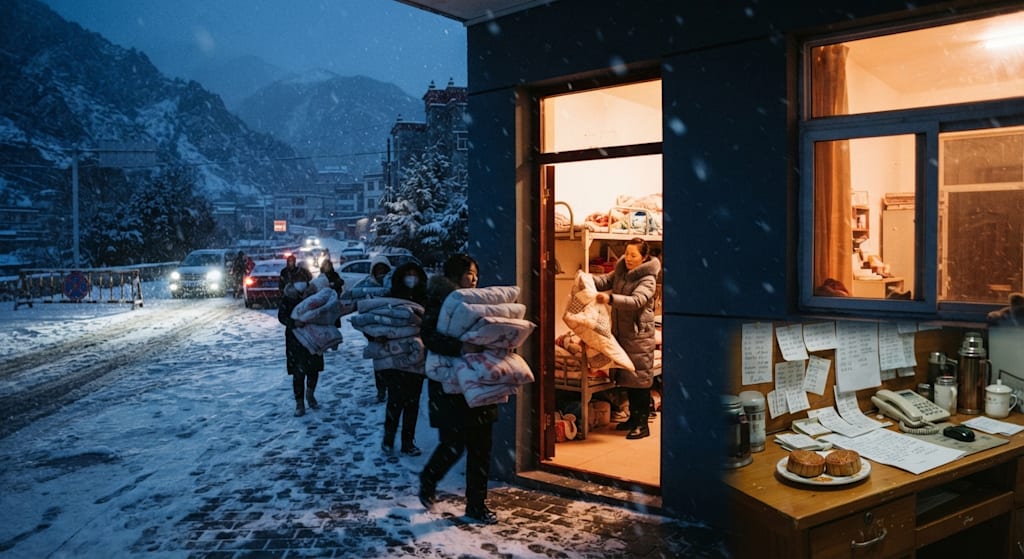
At 5:30 p.m. on October 3, the phones in the office of the Qilian County Culture, Sports, Tourism, Radio and Television Bureau began ringing. By midnight, more than 400 calls had come in. Mr. Chen and his colleagues wrote down phone numbers, number of people, and gender composition by hand, took photos, and sent them to the hotel group chat and the work group chat. The director ordered takeout for them. A hamburger took two hours, and it still was not finished.
That night the temperature was minus 4°C. Snow fell on the mountain tops. The Biandukou to Ebao section was closed for road construction, and traffic on the Gansu-Qinghai loop was rerouted to Qilian. People who had planned to go to Zhangye or Qinghai Lake were stuck in this county town of 50,000. They had not booked hotels because, according to plan, they were not staying overnight in Qilian.
If you only read the headline “A county town of 50,000 receives 100,000 tourists during National Day, hotels all full, culture and tourism bureau provides free student dorms,” readers would picture another scene: a crowd of people who did not do their homework flooding into a small town, and the government using student dorms to do someone a favor. Heavy snow and a road closure kept passers-through in town. The county opened student dorms to give people with nowhere to go a heated room on a minus 4°C night. The purpose was shelter.
Hotels were all full. More than 400 hotels and guesthouses, not a single vacant room. The culture and tourism bureau received 510 calls for accommodation help, involving more than 800 people. Emergency beds at the Ethnic Middle School and Haibei Prefecture No. 3 Senior High School housed 453 people. Other reception points and cancelled bookings housed 200. The rest found their own arrangements or went to nearby areas. The numbers are not shocking, but behind each number is a person calling in the cold wind.
Bureau director Feng Lingling laid out bedding and carried luggage in the dorms. Staff packed up the students’ belongings and brought in brand-new bedding. Tourists were told at check-in not to touch the children’s things. Some offered to pay and were surprised to hear it was free. When they left the next day, the beds were tidied. No reports of damaged or lost items were received.
A colleague moved things without eating and nearly fainted from low blood sugar. A tourist gave him two mooncakes, and he recovered. At 2:40 a.m., the staff went home. In the culture and tourism work group chat, messages were still being sent at three or four in the morning.
The actions were practical. People doing the work get tired, hungry, and hypoglycemic too. They were not doing image-building. Image-building does not have a bureau director making beds, and it does not make a hamburger last two hours.
Tourist Lin Bin came from Xi’an. He arrived in Qilian on October 3. From afternoon until dark, he could not find accommodation on the platforms. He came across the Qilian culture and tourism notice, called, and was arranged that night at the Ethnic Middle School. Four people to a room, brand-new bedding. It rained in Qilian on the 3rd, snowed on the mountain tops, and was minus 4°C at night. He said this “scored big points” for Qilian County.
Another netizen’s family searched for a hotel for three hours and could not find one. A local man suggested they call the culture and tourism bureau. The staff asked how many people, then told them to go straight to the school. When they arrived, many cars were parked at the gate. Registration was quick, men and women housed separately. In half an hour, they went from “homeless” to heated dorms. The next day, they tidied the beds before leaving.
There were also several people over 80. The line was long, so the bureau temporarily placed them in the room where staff were registering people. Registration went on late into the night. Staff worried about disturbing the elderly and prepared to move into the hallway. The elderly said it was too cold outside, no need to go out, stay in the room, we will not be noisy. In the end, the staff still went into the hallway.
These details are not grand. But emergency shelter is made of these details: phone calls, sticky notes, bedding, heating, hallway, mooncakes.
The requisition of student dorms needs discussion. Students pay accommodation fees; the beds are their space. Dorms involve privacy and belongings. Emergency requisition has a legal basis, but procedures could be more detailed: who decides to activate it? How are students informed? How are belongings kept? How are compensation, disinfection, and reassurance handled afterward? These cannot be backstopped by “tourists are well-behaved.” Nothing was lost this time. That was good luck, and also because most people followed the rules. Institutions cannot be built on luck.
But calling this “being generous with other people’s money” ignores the premise: minus 4°C, hotels full, people might freeze. Opening the doors first and fixing procedures later has its place in emergency logic. You can question the procedure, but you cannot deny that the doors needed to open.
Public opinion went off track because the reports put “sudden weather change, road closure, passing travelers stranded” later, and “50,000 population, 100,000 tourists, student dorms” earlier. Readers read it through the framework of tourism chaos, so naturally they scolded tourists for being blind and the government for putting on a show. Frontline workers did the work but got scolded in the comments. In news writing, the first paragraph decides how readers think.
If the first paragraph read: “On October 3, snow fell in Qilian, the temperature was minus 4°C, the Biandukou to Ebao section was closed, large numbers of passing vehicles were rerouted to Qilian, hotels were full, and the local government opened school dorms to shelter stranded people,” the comments would be different. When the premise changes, the judgment changes.
Qilian County’s tourism high season is usually July and August. This year Highway 9 became popular online, attracting large numbers of tourists during the National Day holiday. The local government expected traffic at most to match the high season, but it surged unexpectedly. Around 5 and 6 p.m. on the 2nd, they began receiving requests for help from people who could not find accommodation. The plan was activated, and the education bureau and schools opened dorms. The whole bureau was on duty. Some went to shelter points to deliver blankets, some answered phones in the office, some were still sending messages in the group chat at three or four in the morning.
From October 3 to 2:30 a.m. on October 4, there were 510 calls for help, involving more than 800 people. 453 people stayed in school dorms. 200 were housed through other channels. The remaining tourists found accommodation themselves or went to nearby areas. All related accommodation needs were properly resolved.
On the morning of the 4th, Qilian Culture and Tourism issued a notice: On October 3, traffic reached nearly 35,000 vehicles. All of the county’s more than 400 hotels and guesthouses were full. Public-service beds housed nearly 500 people. Because beds were limited, tourists having trouble finding accommodation were reminded to call the service numbers or adjust their itineraries.
That night in Qilian, the snow did not stop. The calls came one after another. Some made beds, some registered people, some carried bedding. The next day, the beds were folded, and the people left. Before the students returned, the dorms were disinfected. No elevation. That is just how it was.
About the Creator
Jin
Writer of reamstories
https://reamstories.com/jin
Enjoyed the story? Support the Creator.
Subscribe for free to receive all their stories in your feed. You could also become a paid subscriber, letting them know you appreciate their work.
Comments
There are no comments for this story
Be the first to respond and start the conversation.