
Japan’s Streets Are Spotless. So Why Can’t You Find a Trash Can?
The answer begins with a 1995 subway attack, runs through transparent bags and camera-monitored bins, and ends with you carrying an empty coffee cup across Tokyo.
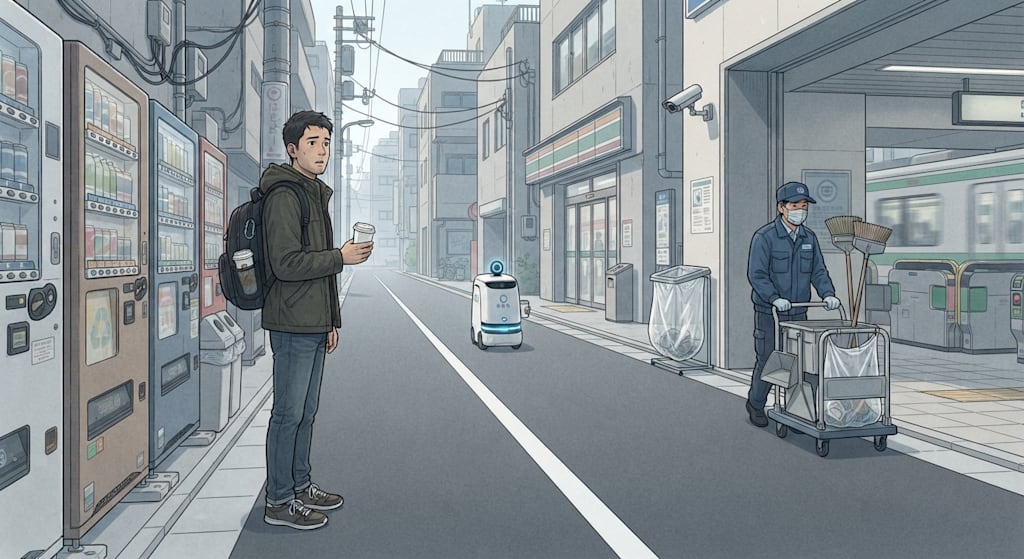
1. Shinjuku South Exit, 10 a.m.
A foreign visitor stands beside a row of vending machines. In his left hand is an empty paper cup. In his right hand is a convenience store plastic bag. Inside the bag: a receipt, the corner of an onigiri wrapper, half a pack of tissues.
Three vending machines stand side by side. The leftmost has two slots on its side. One says "アルミ缶." The other says "ペットボトル." The middle machine has only a bill slot and a coin slot. The rightmost has a small metal rack underneath, with a label reading "瓶・缶."
He lifts the paper cup toward the first slot. Stops. Pulls it back. The cup is paper. Not aluminum. Not PET. He crouches and looks under the machine. No other opening. He stands up and pushes the cup into the side pocket of his backpack. The zipper catches halfway. He stops. Turns the cup. Pushes it deeper. Then he walks into the underground passage. The side pocket bulges in a cylinder shape.
This happens in Tokyo many times a day. It is not news. No one takes a photo. A cleaner pushes a gray cart past him. On the cart: two brooms, a dustpan, three transparent trash bags. The cleaner looks around the vending machines. Nothing on the ground. He keeps pushing.
2. March 20, 1995
That day was a Monday. Morning rush. The Hibiya, Marunouchi, and Chiyoda subway lines. Members of Aum Shinrikyo released sarin gas in train cars and stations. Fourteen people died. Thousands were injured. Platforms closed. Trains stopped. Ambulance sirens ran from morning into afternoon.
Afterward, the National Police Agency asked subway stations to remove or seal trash cans. Transparent bags. Seals. Removal. Some stations took the cans away. Some removed the lids, left a hole, and covered it with wire mesh. Passengers put empty cans on the floor. Station staff bent down, picked them up, and dropped them into plastic bags.
That spring, Tokyo lost a batch of trash cans. Not all of them. Convenience store entrances still had them. Near ticket gates, some remained. But street-side cans, park entrance cans, and cans under overpasses were mostly gone.
Then came September 11, 2001. New York. Cities around the world looked again at street trash cans. London. Paris. Berlin. Japan too. Station cans became transparent. Transparent bags. Transparent bodies. You throw something away, and a camera is above you. Security staff watch from a monitor room. Not every station. Major stations: Shinjuku, Shibuya, Ikebukuro, Tokyo. Stickers read: combustible, non-combustible, PET, cans, bottles. Sometimes five bins stand side by side, but only one opening is available. Sometimes a single transparent bag hangs on a wall, zip-tied at the top.
Thirty years have passed. The sarin attack is a line in a chronology. The trash cans have not all come back.
3. Transparent Cans and Cameras
The station trash cans are still there. Their location has changed. They used to be mid-platform. Now they are near the ticket gates. They used to be metal. Now they are transparent bags. No one used to watch. Now cameras do.
You throw something away, and you see inside the bag: an onigiri wrapper, an empty can, a wet wipe, a mask. The transparency lets you see what other people threw away. It also lets you know that other people can see what you throw away.
Near the gates, a row of cans usually has four openings. The first says "可燃." The second says "PET." The third says "缶." The fourth says "瓶." A paper cup belongs in combustible. Many tourists push paper cups into the PET slot because the cup looks like a drink container. A station attendant pulls it out with tongs and drops it into the combustible bag. The tongs are stainless steel, long-handled, with rubber pads at the tips. He picks up the cup, shakes the ice into the combustible bag, crushes the cup, and throws it in. Five seconds. He does this hundreds of times a day.
At Shinjuku Station's east exit, a trash can robot has been on trial since September 2026. White body. About one meter tall. Wheels at the base. A ring of lights on top. It follows a pre-drawn route, avoids crowds, and stops beside a pillar. Someone drops an empty can into a slot on its side. It says, "ありがとうございます." Then it turns and continues.
The robot has cameras, lidar, and weight sensors. When it is full, it returns to its charging dock. The dock is behind the station office. At night, the lights go off. At 6 a.m., the lights come on, and it comes out.
The robot is not replacing every trash can. It fills a mobile gap. Fixed cans raise security concerns. Mobile ones can be controlled. Here today. Somewhere else tomorrow. If someone leaves a suspicious object, the robot can drive away. Or stop under a camera. Or return to the office. It is not science fiction. It is a trial.
4. Kyoto's Ledger
In the 2000s, some local governments began reducing street trash cans. Not nationwide. Each city did its own math. Kyoto did its math clearly. From 2011, the number of street trash cans was cut by more than half.
The reasons were written in reports. Maintenance costs rose. Household trash was dumped into street cans. Trash piled up around the cans. Crows tore open bags. Cats came. Rats came. Cleaning crews emptied the cans twice a day, sometimes three times. Weekends meant more. Golden Week meant more. Autumn leaf season meant more.
The cost of a street trash can is not just the can. It is daily emptying. Sorting. Transport. Incineration. Labor. Washing the ground around it. Summer smell. Complaint calls. Residents' meetings: why does my street have a can and the next neighborhood does not? Signs: tourists dumping guesthouse trash here. Stickers: please take your trash home. Stickers torn off. Stickers put back up.
Aya Yoshida works at the National Institute for Environmental Studies. She says that reducing cans was meant to encourage people to take their trash home. Not every place reduced them. Some station-front shopping streets pay for their own cans. Some convenience stores have them. Some vending machines have recycling slots. But street cans, ward office cans, and park cans were often reduced.
After Kyoto cut its street cans, litter did not visibly increase. Cleaning crews still swept every day. Volunteers still picked up trash every month. Elementary school students still cleaned riverbanks every semester. Shopping streets still handed out flyers for "beautification events." The flyer lists a date, a meeting place, and a note that gloves and tongs will be provided. After the cleanup, everyone gets a bottle of tea.
5. Not Causing Trouble
"Meiwaku o kakenai." Do not cause trouble for others. The phrase appears in schools, in workplaces, in train announcements. The announcement says, "Please refrain from phone calls in the car." Not forbidden. Please consider. You make a call, people look. You look. You put the phone away. You text. You call after you get off.
Trash works the same way. Leave it on a table, and staff clear it. Leave it on a park bench, and the next person who sits there clears it. Leave it at someone's door, and that household clears it. You do not want to be the person who makes someone else pick up your trash. So you put your trash in your bag. The bag has tissues, receipts, empty cans. You go home and sort it. Combustible. Non-combustible. Recyclable. Oversized. Each ward has a different schedule. You put the schedule on your fridge. You forget, and you wait until next week.
Eating while walking is not common in Japan. Not law. Habit. You buy a taiyaki and eat it at the shop entrance. The staff gives you a cup of tea. You finish, return the paper bag, and the staff says, "ありがとうございます." You leave. You do not eat on the train. You do not eat in the mall. You do not eat while walking. So you produce less trash. Most of the trash you do produce is thrown away at the shop.
But this does not mean Japanese people are born clean. Yoshida has said that clean streets are the result of policy, education, and investment in cleaning. Decades of it. Not genes. Not cultural essence. Elementary school lunch: students open milk cartons, wash them, dry them, tie them together. Neighborhood associations rotate street sweeping. Shopping streets pay cleaners. Littering is a crime under local ordinances. "Take your trash home" stickers. Cameras. Transparent bags. Cleaners who walk twenty thousand steps a day.
6. The Tourist's Backpack
A tourist's rhythm is different. A tourist walks many streets. Buys drinks. Buys convenience store snacks. Buys ice cream. Buys souvenirs. Eats on the street. Eats in a park. Eats in a station. A tourist produces more trash than a commuter.
A commuter goes from home to office, office to home. Does not buy on the way. If he buys, he eats inside the store. A tourist does not.
Junko Yokoo is a guide. She leads tours. Guests ask her: where is the trash can? She says: stations have them. Convenience stores have them. Next to vending machines, sometimes. But the streets have few. The guest says: then what? She says: put it in your bag. The guest says: in my bag? She says: yes. Throw it away at the hotel.
Guests complain at first. They cannot find a can. It is inconvenient. Why is it so clean but there are no cans? Yokoo listens. She does not explain. She takes them to the next spot.
Day two: the guest puts an empty bottle in his backpack. Day three: an onigiri wrapper goes into the backpack. Day four: the guest says, "I'm used to it."
An Australian tourist puts an empty bottle in his backpack. Three days later, he is back at the hotel. The front desk watches him take out three empty bottles, two onigiri wrappers, and one wet wipe. The front desk says, "ありがとうございます." Not praise. Procedure. The hotel has sorting bins. Combustible. PET. Cans. Bottles. He sorts. Goes upstairs. Showers. Sleeps.
The next day, his backpack is empty. He buys water. Drinks it. Holds the empty bottle. Sees a recycling slot next to a vending machine. Puts the bottle in. The machine says, "ありがとうございます." He walks on.
7. Robot Patrol
The Shinjuku Station robot is on trial. It does not go fast. It avoids people. It stops beside a pillar. It says, "ごみを回収します." One person puts an empty can into it. Another says, "すごい." A third takes a photo. A fourth takes a video and posts it. A man asks: does it sort? The station staff says: for now, only cans and bottles. A woman asks: what about paper cups? The staff says: take them home. She asks: why? The staff says: because paper cups are combustible. She asks: where is the combustible bin? The staff says: near the ticket gates. She walks away. The robot continues.
The robot has four openings. Two are open. Two are sealed. The open ones say "アルミ缶" and "ペットボトル." The sealed ones say "可燃" and "不燃." The staff says they may open later. For now, only two. When it is full, it returns to its dock. The dock is behind the station office. It enters by itself. It exits by itself. It does not take the elevator. It takes the ramp.
It avoids strollers and wheelchairs. It gives way to rushing commuters, people in kimono, suitcases. It steers around drunks, crouchers, sitters, bench-liers. Pigeons. Rain. Snow. Wind. Trash.
8. The End of the Empty Cup
The foreign visitor sits on the Yamanote line. The empty paper cup is still in his backpack's side pocket. He goes to Shibuya. Harajuku. Omotesando. He buys a crepe. Eats it at the shop entrance. Returns the wrapper to the staff. The staff says, "ありがとうございます." He goes to a convenience store. Buys a bottle of tea. Drinks it. Puts the empty bottle in the recycling bin at the store entrance. Returns to his inn. Takes the paper cup out of the backpack's side pocket. Throws it into the room's trash can. The can is small. Inside: a tea bag, a receipt, a rubber band. He crushes the cup. Puts the lid on.
The next day, he leaves. The backpack's side pocket is empty. He walks on the street. No trash on the ground. He sees a cleaner sweeping leaves. Three recycling machines sit beside a vending machine. A transparent trash can stands near the station gates. A robot turns from behind a pillar. He does not take a photo. He puts his hands in his pockets. He walks on.
About the Creator
Jin
Writer of reamstories
https://reamstories.com/jin
Enjoyed the story? Support the Creator.
Subscribe for free to receive all their stories in your feed. You could also become a paid subscriber, letting them know you appreciate their work.
Comments
There are no comments for this story
Be the first to respond and start the conversation.