
Choose Your Own Adventure
For Twenty Four Hours


You awake early. Outside, the foghorn keeps up its mournful lowing, the sound ebbing and flowing like the tide, warning sailors of the treacherous coast hidden in the mist. You slept well – it is peaceful here, the traffic noise dies at night and the skies are dark – and see that it is 8am already, and you decide to get up. You stretch, and open the curtains, peering out into the white beyond.
Guernsey is prone to fog, you know. 9 miles long and 5 miles wide, it’s little more than a rock in the sea, after all.
Well you think, I’m not going to let a bit of fog spoil my fun. You dress, and as you put on your shoes, you discuss what to do with your best friend, Robin.
“This day could stay foggy a while, but then, these sea mists can burn off quickly once the sun is up, and the forecast for the day is good.” You ponder your dilemma a moment, and then make your decision.
If you decide to gamble on the fog clearing early, go to paragraph 1. If you believe it might stick around a while, go to paragraph 2.
Paragraph 1
“Let’s grab the paddle boards and head down to Petit Bot” you tell Robin, and together you load up the car before driving the winding lanes across the island, dropping down through a shady valley to park beside a small café and a round brick tower at the mouth of a steep sided, pebbly bay. You’re feeling glad you decided to come, the mist is thinning and you can see that higher up the cliff, the sun is shining.
“We'll walk out to the lookout point first” you suggest, and the two of you set off up the steps, climbing sharply away from the little bay. As you walk, you tell Robin about the tower, one of 15 loophole towers built along the island’s coast in the late 18th century to protect vulnerable landing points against the possibility of French invasion onto British soil after France allied itself to America in the Revolutionary War.
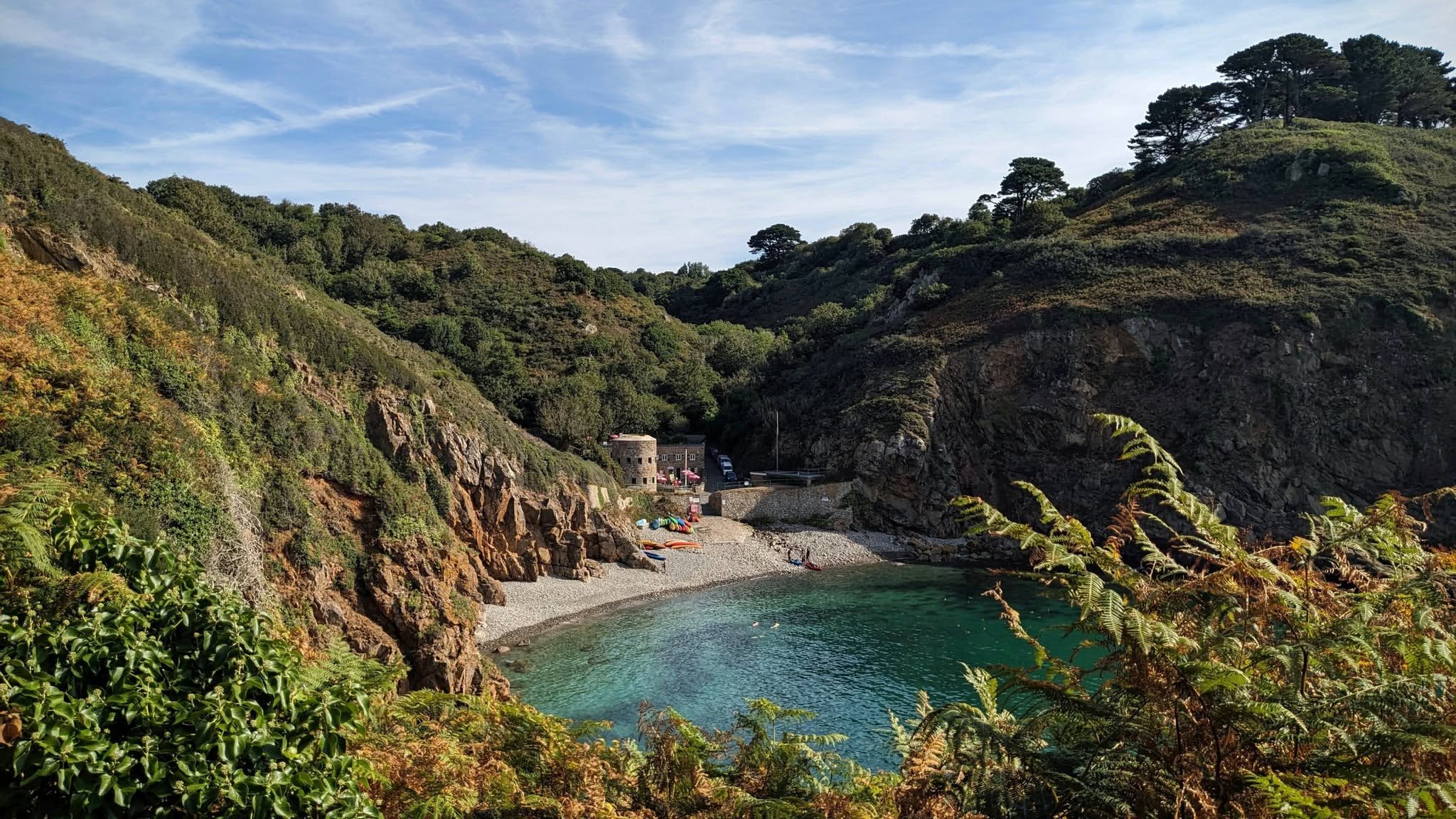
You are both breathless as you arrive at the top, but the views to the east and the west were worth every step, the jagged coastline stretching away, fringed by brilliant blue.
“Come on,” you say, “The mist has cleared now,” and the two of you head down to launch your paddle boards onto the smooth, clear water. It is peaceful and serene out on the sea, but the smell of bacon cooking back at the café brings you in for breakfast, and you sit on the wall, eating bacon rolls as the water on your feet dries.
“What’s next?” asks Robin, and you check your watch.
“Its high tide now, so six hours to low tide. Do you like history?”
“I do!” Says Robin.
“Ancient, middle ages, modern?”
If you decide Robin prefers Ancient history, go to Paragraph 2. If Robin is interested in the Middle Ages, go to paragraph 3, and if you think Robin would prefer modern history, go to paragraph 4.
Paragraph 2
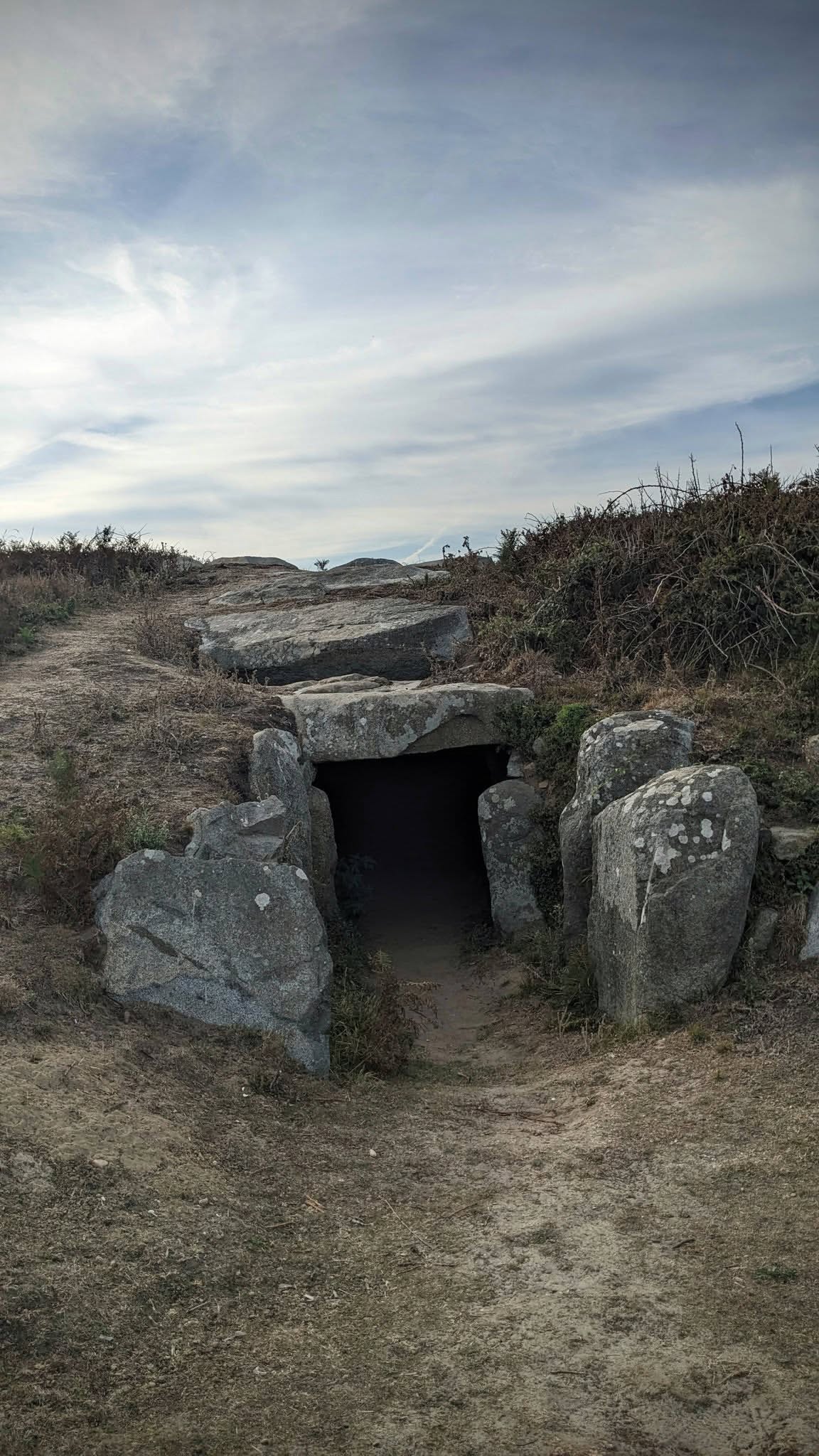
“Oh, I love this really old stuff” says Robin as you set out across L’Ancresse Common, hoping you remember the way. Here on the north of the island, the fog is still laying across the lands, shrouding the large upright stones that frame a dark opening in the low hill. “This is a megalithic burial mound, I would say. About 4000 years old, maybe even older. They would have found a lot of bones in here.”
Together, you stand inside the passage grave. With the wisps of white drifting around it, it is easy to imagine funeral rites taking place here, and a shiver passes down your spine.
“It’s incredible, isn’t it? To feel so close to people who lived so many thousands of years ago,” you say. “But look, the sky is definitely clearing now. Do you fancy a walk to work up an appetite for lunch?”
“That sounds perfect” says Robin.
“Did you bring your swimsuit?”
If Robin has a swimsuit, go to paragraph 5. If not, go to paragraph 4.
Paragraph 3
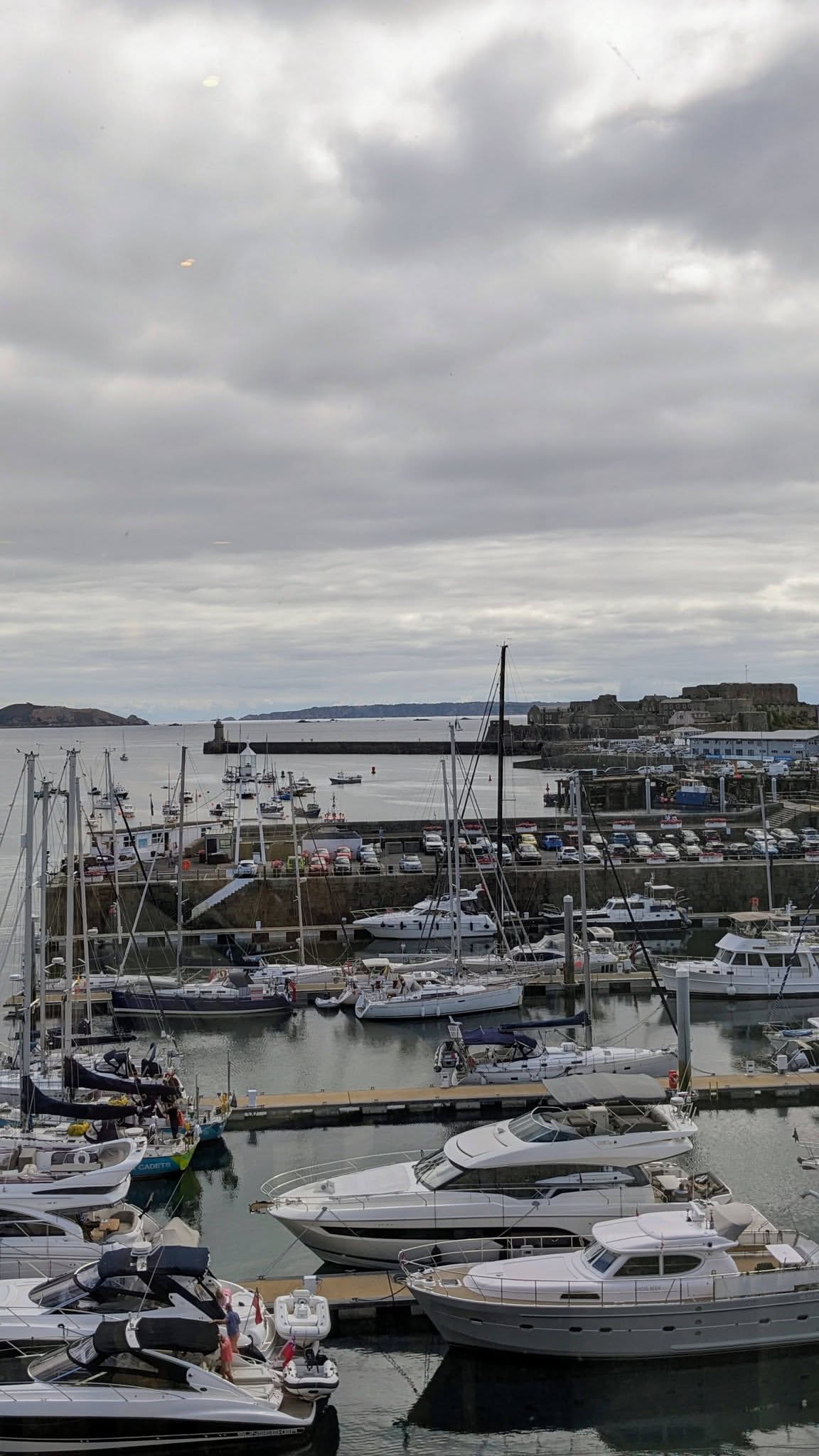
Driving through along the sea front at St Peter Port, you look past the rows of white sailing boats to see the castle dominating the mouth of the harbour, squat and sturdy, unbroken for 800 years. You park, and walk out along the thick sea wall, towards where fishermen have set up poles jutting over the water. There is only one person ahead of you in the queue at the ticket office when you arrive at Castle Cornet. You pay for two tickets, and enter under the big portcullis.
“I read it was built to keep Guernsey loyal to the English crown after King John lost Normandy to the French in the late 13th century” says Robin.
“That’s true,” you say, “but the Tudors expanded it of course!”
“And then there was the seven years the French held it during the hundred years war” answers Robin.
“Don’t let’s forget the Germans using it to defend their occupation of the island!”
You tour the museums and the garden, noting the layers of modifications made by successive occupiers, but you linger for longest on the ramparts where you look out across the sea. The day is clear now and you can see all of Guernsey’s major outlying islands. Alderney is little more than a hazy mass on the horizon, but the long sands of Herm look almost close enough to swim to, if you didn’t know better, and you tell Robin about the puffins you can see if you take a boat out to her little neighbour, Jethou, at the right time of year. Beyond, the green wedge of Sark rises from the starting blue sea.
“Maybe tomorrow we can take a boat out to Sark,” you suggest. “There are no cars on the island, only horses, bicycles and a few tractors, and at night, the sky is so dark you can see every star.”
“Perhaps,” says Robin, “but what shall we do now?”
“A walk before lunch?” you ask. “The tide is looking good if you fancy a swim? Or would you like some more history?”
If Robin has not had enough history yet, go to paragraph 4. If Robin is keen to take a dip, go to Paragraph 5.
Paragraph 4
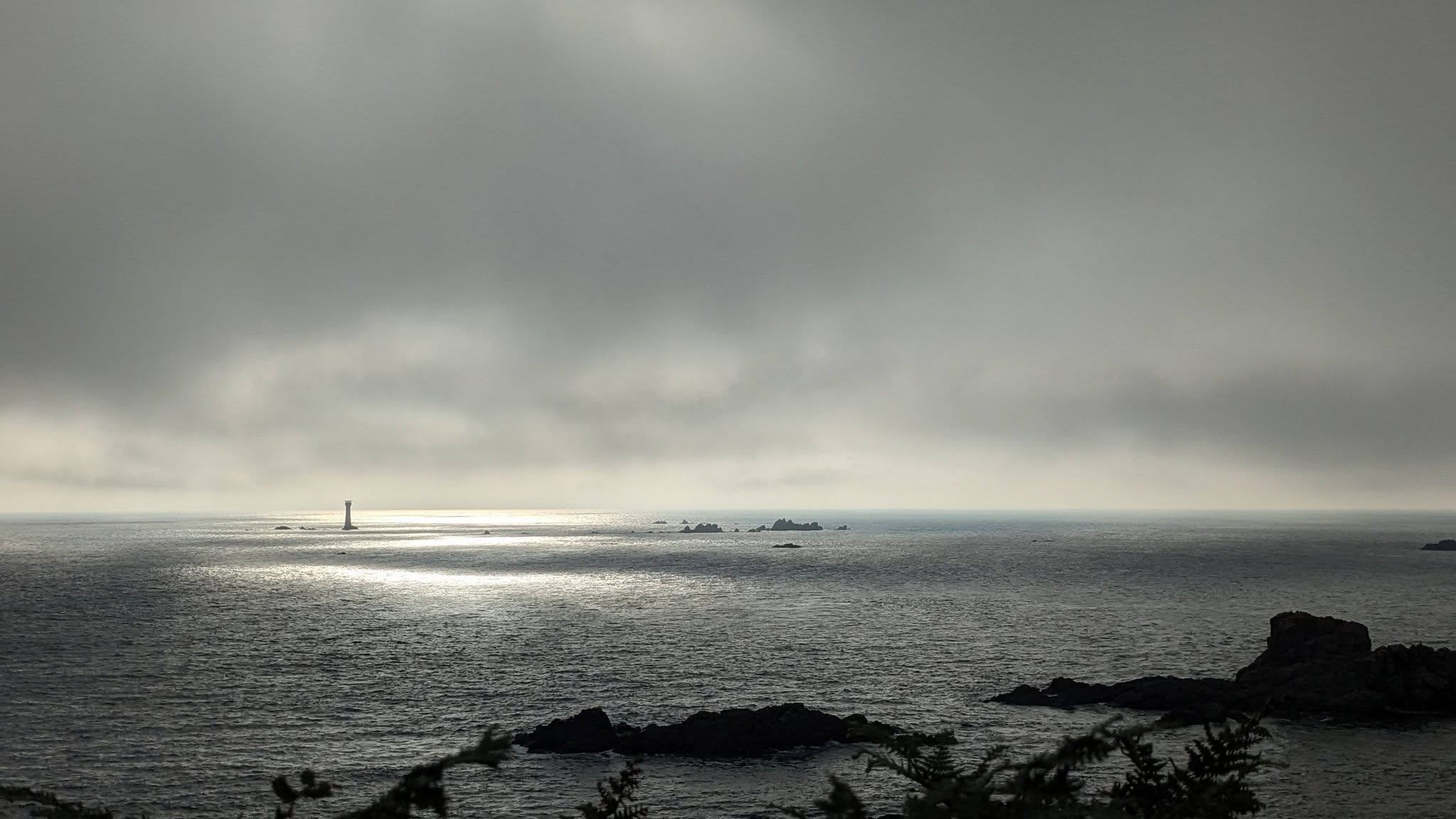
At the car park, you step out of the car, and onto the high cliff path that skirts the island for nearly forty miles, plunging in and out of the bays that punctuate the south coast cliffs, before smoothing out to skirt the wide, sweeping beaches of the west coast, rounding the top of the island and flowing on down the more populated eastern coast, with its views of the outlying islands and its two main towns, St Sampson and St Peter Port. On a clear day, from the east coast, you can see right to Jersey, and France beyond, but here at Pleinmont on the south west corner of the island, it is deep blue ocean as far as the eye can see, and as usual, not another soul in sight. To the right, away from the coast, a lighthouse stands on a rocky outcrop, reminding you of the danger these waters can pose to the unaware. To the left, a strange concrete structure appears to jut from the cliff, almost as if it belongs there, though it is definitely manmade. You follow the clear path towards it, admiring the swooping seabirds who wheel and circle in the inlets below you. This coast is densely wrinkled, and the path rarely runs straight for long, turning and dipping and rising and turning again.
“What is this?” asks Robin, when you arrive at the structure. It is made from concrete, and dug into the steepness of the land. Dropping down beside it, there is a doorway, and inside, a room, where several men could stand, and maybe even sleep, in another room behind. At the front of the structure, a long horizontal slit opens on three sides of what would, completed, be a hexagon.
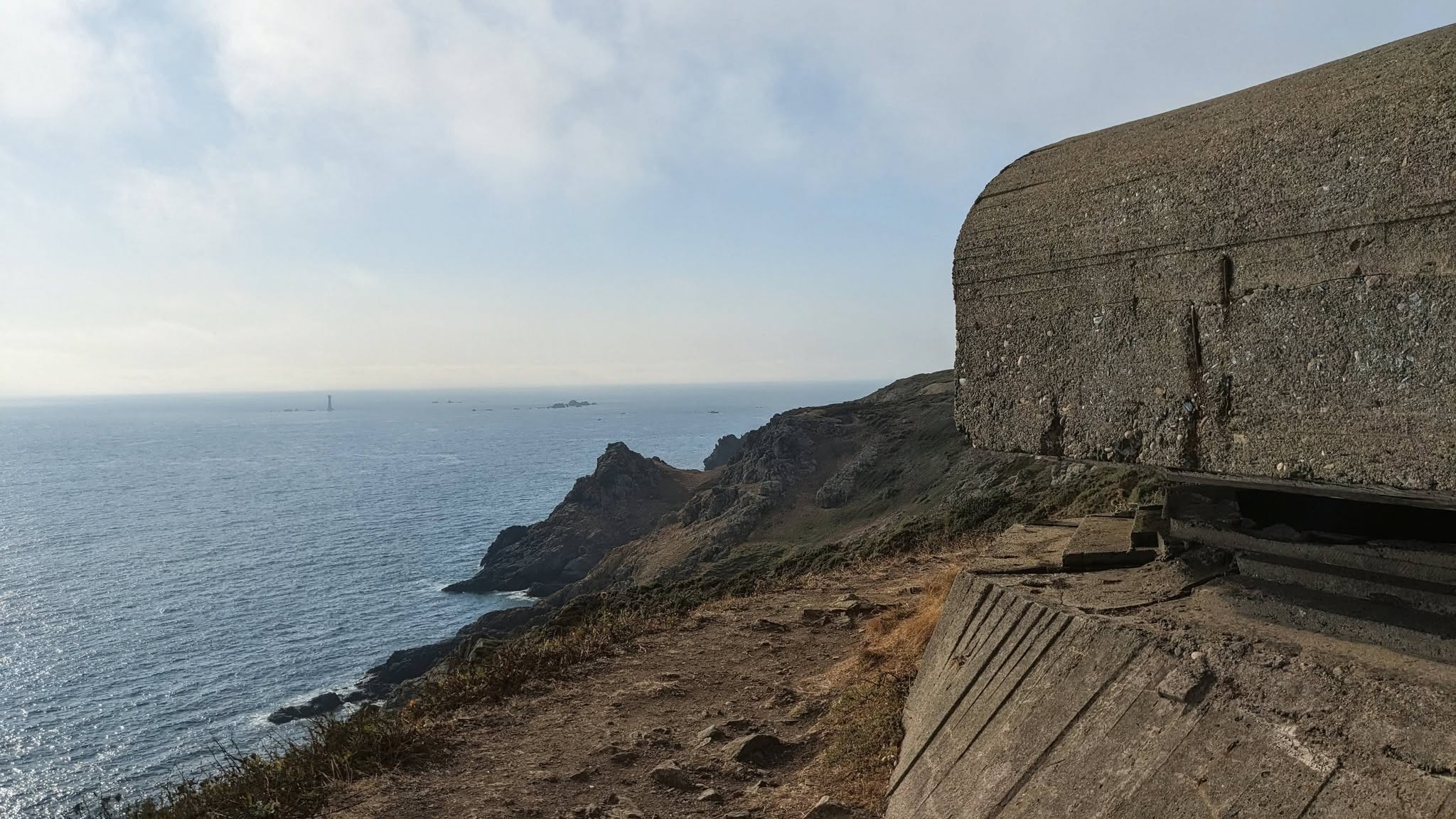
“The Germans built these all along the coast to defend the island in World War 2. Once they had a piece of land loyal to the British Crown, they didn’t want to give it up!”
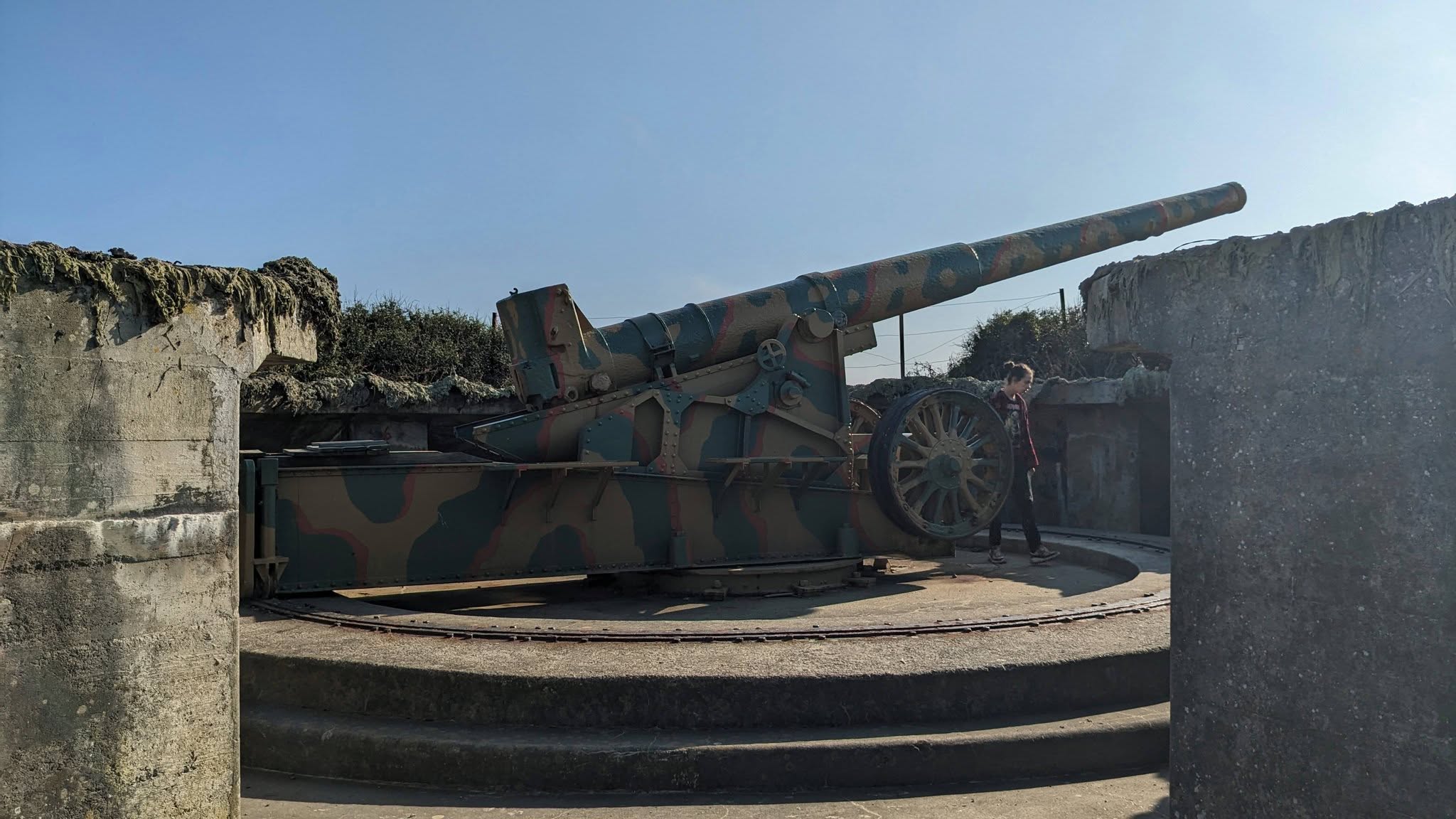
Walking on, you come to a series of trench like cuttings made in the flat of the land above the cliff, leading to an enormous gun mounted on a track, allowing it to turn to face the enemy.
It is sobering to remember how people suffered, are still suffering, in wartime, and you walk on in silence for a while, soaking up the coconut smell of the gorse bushes that dot the cliff top with their yellow flowers. After fifteen minutes, you round the south western tip of the island, and suddenly the west coast opens up before you.
“I’d love to go down there and look at some of those fortifications too” Robin sighs, “but I need some lunch!”
Choose Paragraph 6 if you would like seafood and a relaxed atmosphere, or Paragraph 7 if you would prefer a more metropolitan lunch.
Paragraph 5
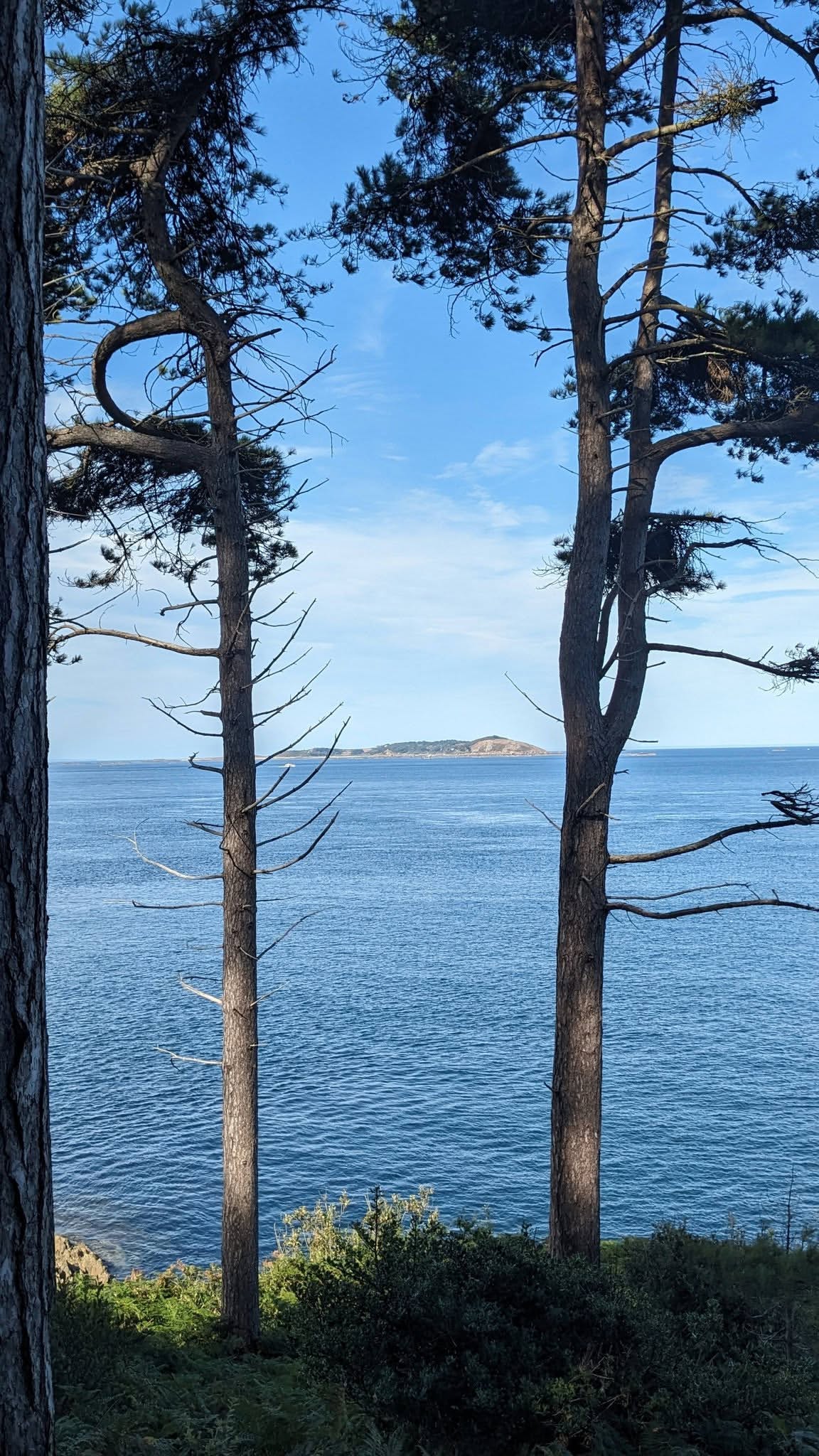
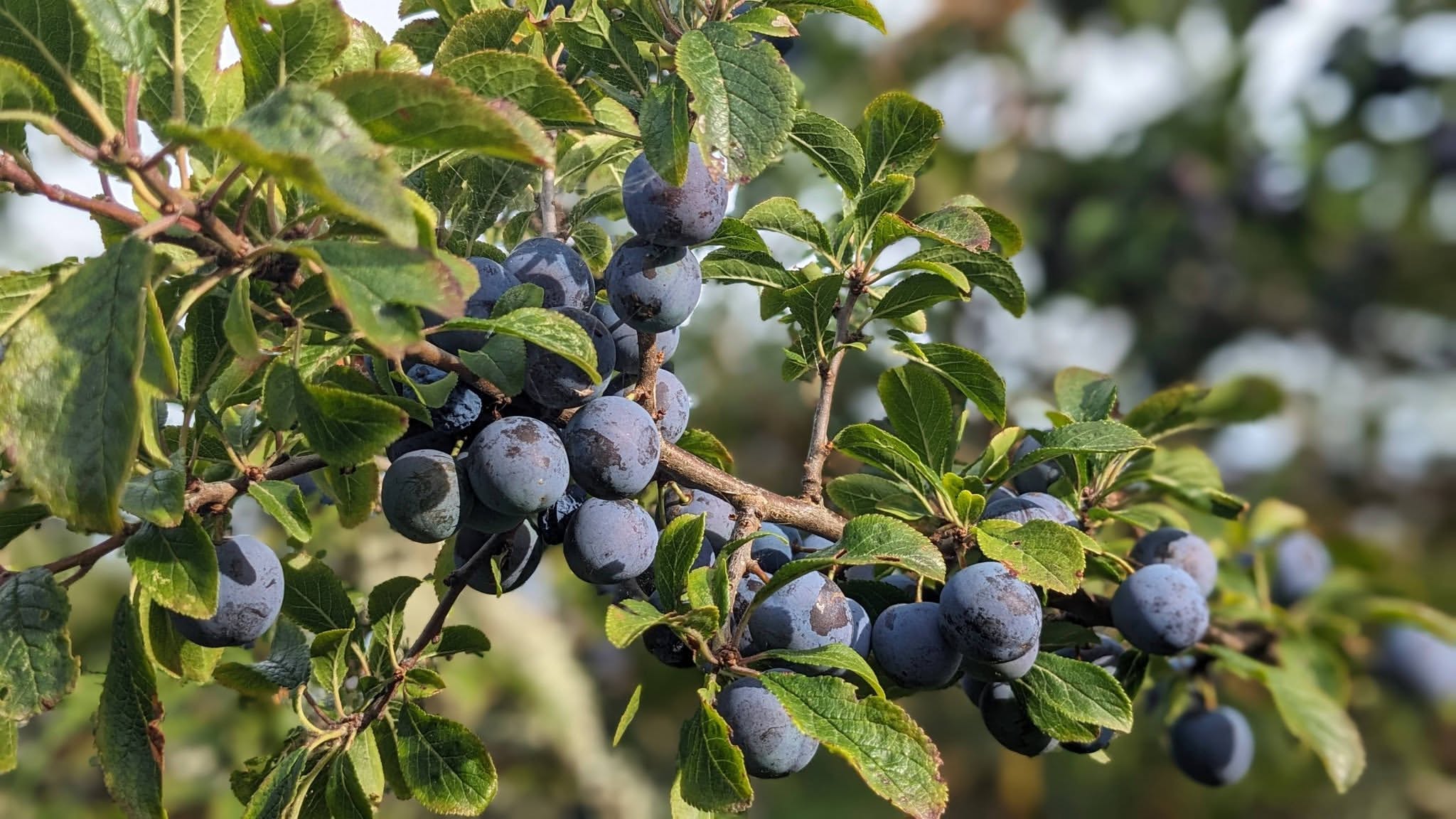
You set off from the car park, pausing to admire the monument at the top of the hill. The path drops steeply through the dappled light of woodland, and to your left you glimpse flashes of blue between the trees. Here and there, a larger gap in the greenery allows you to pause and look out to see the outlying islands to the east, Herm appearing green and gold in the sunshine, and Sark a grey-green mirage beyond. Deciduous woodland, pocked with purple foxgloves and elegant arched ferns, gives way to tall pines, and then to yellow flowered gorse that fills the air with the smell of coconut. Eventually, these two cede to low grass and pink tuffs of sea thrift. The path detours out to a small lighthouse, and then climbs again, between arching branches of blackthorn, heavy with dark purple sloes. Together, you and Robin pick some. You have always wanted to make Sloe gin.
At the top, you pause to admire the view. There is Alderney, hazy in the distance, then as you move south, Herm and Jethou, Sark, and further away, Jersey, with the long line of France behind.
“The day has cleared up nicely” you say, as you proceed along the south coast and towards views of the wide open sea. Alongside the path, you come across a concrete structure built into the cliff.
“There are lots of these along this coast” you tell Robin. “The occupying German forces built them to defend their position in World War Two.”
Together, you drop down beside the structure to enter at an open doorway. Inside there is a room big enough for several men, and on three side, a horizontal slit allows a watcher, as well as guns, to cover the east, south, and west approaches.
It feels good to get back into the sunshine and you as you continue to walk on this high cliff path, the southern coast extends in front of you, golden bay after bay after bay. Without a word, both of you pause to breath it in, stunned into a silence only pierce by the cries of the gulls riding the currents below you.
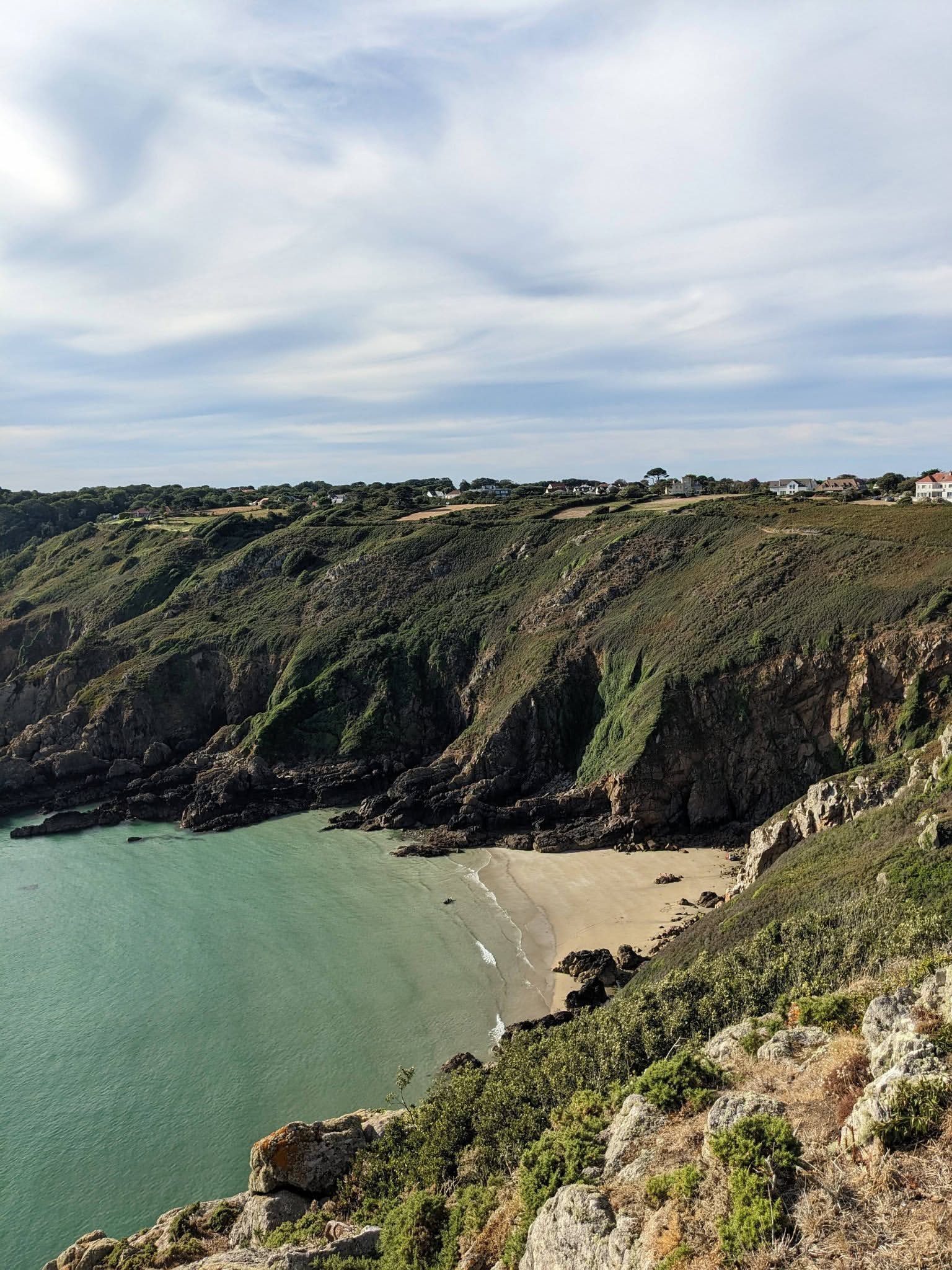
“You see that one?” you point at the nearest bay, a deep stretch of golden sand backed by tall green-cloaked cliffs. “That’s Petit Port. That’s where we’re headed.”
Robin stares. “But how? It’s all the way down there?”
“I know,” you say, “there are steps, but for years they were closed. You could still get down there though. It just meant you had the beach to yourself! Even since they repaired them, not many people go down. It’s hard work, and very steep, but its worth it, I promise.”
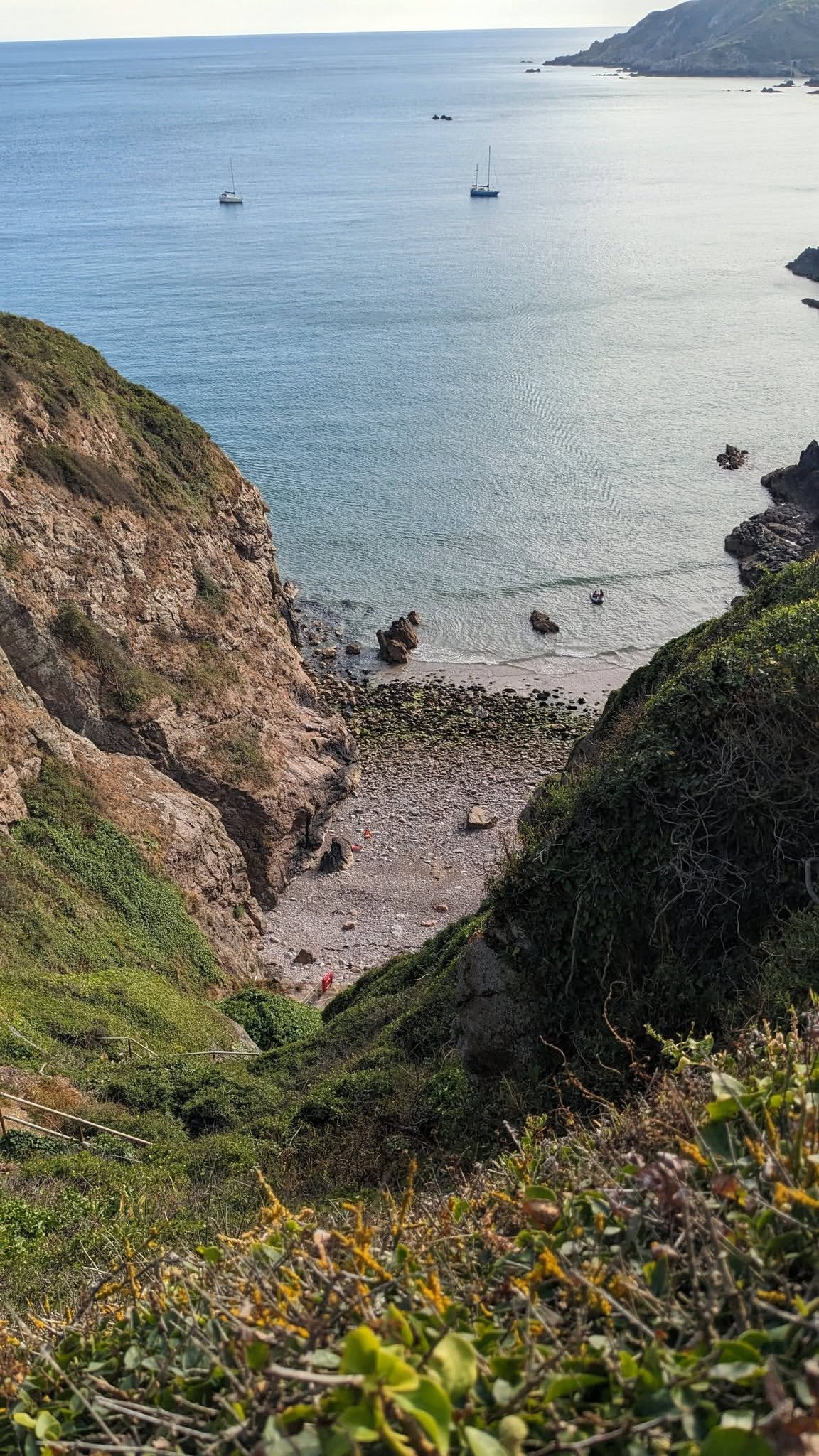
Later, as you pick your way across the rocks and onto the smooth sand, Robin agrees. “This is so worth it. But these rocks look so old. What do you know about them?”
“Not much,” you reply, regretting your lack of credentials. “It’s a type of metamorphic rock called Icart Gneiss. These are actually some of the oldest rock formations the British Isles.”
Geology is forgotten though, as the two of you run across the side and plunge into the cold water, swimming out to where you can see the next bay.
“Some of these bays, you can walk between at low tide.” You are breathless, treading water while you talk.
“That’s fantastic, but I have to tell you, I’m starving! When is it lunch time?”
Choose Paragraph 6 if you would like to explore another bay with lunch, or Paragraph 7 if it’s time to get back to civilisation.
Paragraph 6
“You have to try these crab sandwiches.” You hand Robin a sandwich, and listen to the grunts of pleasure as it disappears. “When you’ve finished, let’s just drop down to the Moulin Huet bay – if the tide is low enough we can walk round to the next bay, but either way, you can see the exact view Renoir painted when he was here.
“I guess that’s why this is the Renoir Tea Garden then!” Robin smiles and reaches for a serviette. “That was delicious. But honestly, I am so tired, show me the view, then let’s do something a bit less energetic!”
You look at the sky. Is that a raincloud approaching?
If you think it’s going to rain, go to paragraph 8. If you think it’s just a passing cloud, go to paragraph 9.
Paragraph 7
You walk down the winding cobbled main street and sit at an outdoor table in the bustling heart of St Peter Port and place your order. Outside the old market, the square hums with activity.
“There are so many good restaurants here, it’s hard to go wrong” you say, as Robin tucks in.
“You’re not wrong, this food is great. But where too next?”
You look up. Rain was forecast, but the sky looks clear.
If you think it is going to stay dry, go to paragraph 9. If you think rain is coming, go to paragraph 8.
Paragraph 8
“It’s actually kind of scary in here!” Robin stays close to you as you walk down the long, arched tunnel, dimly lit passages, some empty, their ceilings oozing blackened water, others filled with rows of metal bedframes, branch off to the side.
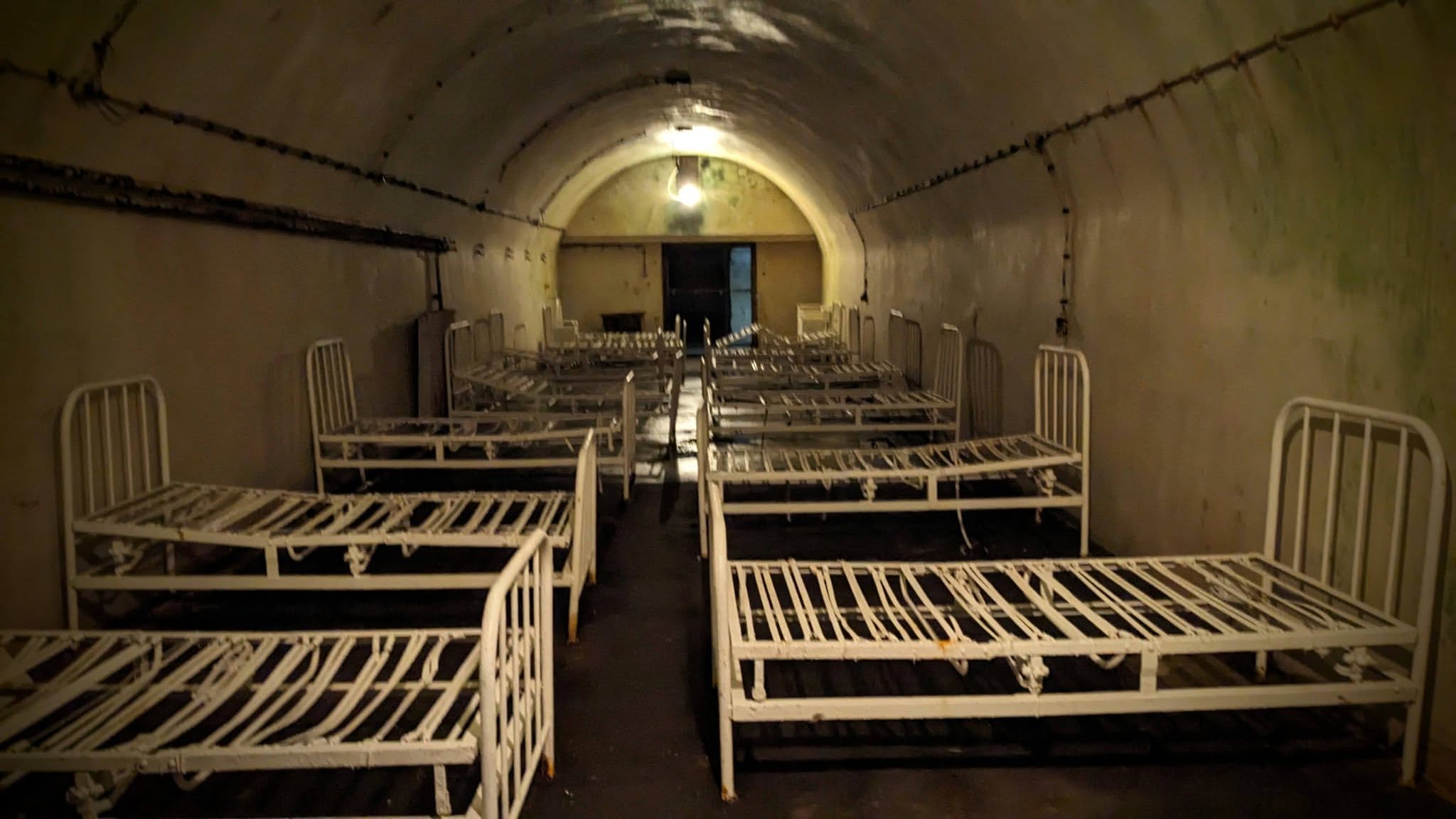
“I know,” you say. Imagine what it was like filled with patients! The Germans excavated all of this during world war two as a hospital and ammunition store.”
“I can’t imagine it feeling much more cheerful even full of people!” Robin says, and you listen to the words echoing into the distance, between the drip, drip, drip of water.
“Let’s go somewhere more cheerful!” you say.
Go to Paragraph 9
Paragraph 9
Before you, the tiny building glints in the sun. A brief rain shower has wetted the world, and now thousands of shards of ceramics in every colour and pattern you can imagine are gleaming brightly.
“Welcome to the Little Chapel” you say, leading the way up the stairs and into the tiny knave of the chapel. “Can you believe this was the work of one man? He wanted to create a grotto like the one at Lourdes. This, I believe, was his third attempt.”
“All these pieces of pottery must have taken years to put in place.” Robin is staring at a small saucer forming the centre piece on one wall. “And how many people could you get in here? Five?”
"I've never seen as many as five people here at once!" you laugh.
In the corner of the chapel, stairs lead down into one, and then another side chapel, each as elaborately decorated as the last, each fit for only one worshiper at a time.
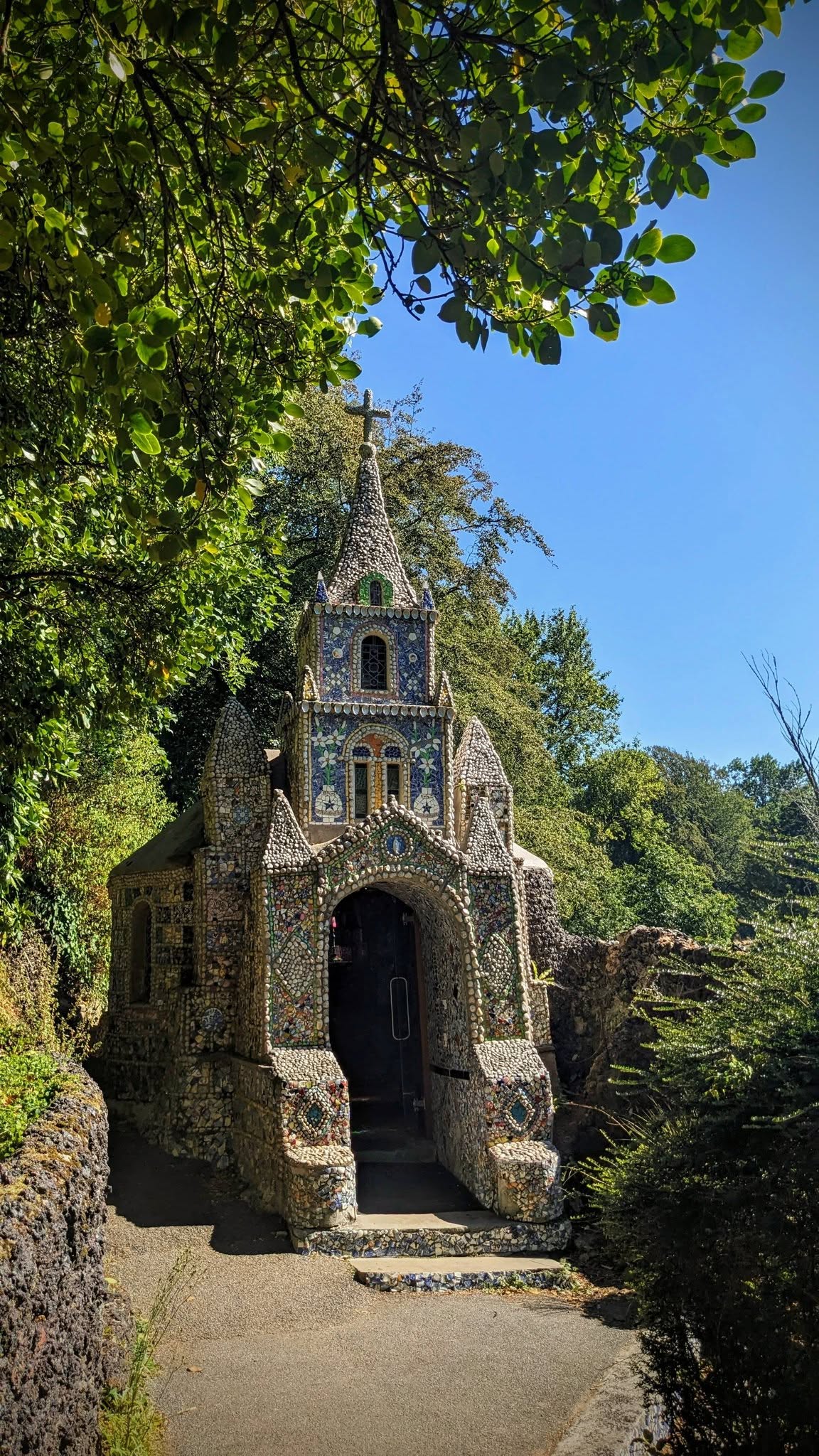
“Every wall is covered, inside and out!” Robin remarks, circling the tiny building again. “It’s wonderful!”
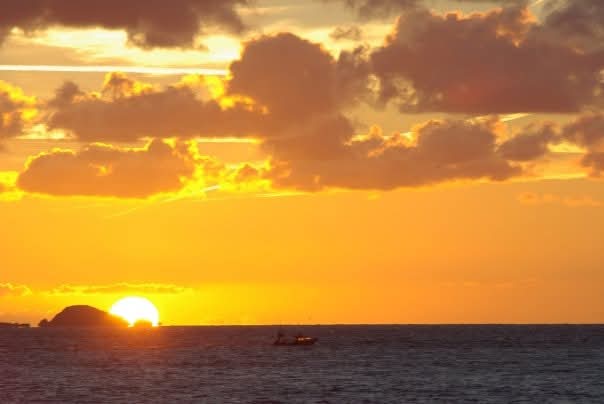
It’s been a long day, and both of you are tired. You agree to grab fish and chips, and drive over to Cobo beach on the west coast to eat on the sea wall. Side by side, with your legs dangling, you watch the tide make its second retreat of the day with the tang of vinegar on your tongues. A gentle wind has picked up, and low white crested waves begin to lap at the sand. Out to the west, the darkening sea seems to flow on forever, and ahead of you, the sun bends to kiss the horizon. The sky turns to orange, struck through with lines of red and purple, in a shifting song of colour. You draw in a breath, pulling the air deeply into your lungs, smelling the clean bite of salt.
"I knew someone who lived here for a while," you say.
"Then they were very lucky," Robin replies.
"They were. And they knew it, every day." You sit quietly together, and watch until beach goes on for miles, and the sea has slunk into the dark.
“Home?” you ask. “I feel like I am going to sleep well tonight.”
About the Creator
Enjoyed the story? Support the Creator.
Subscribe for free to receive all their stories in your feed. You could also become a paid subscriber, letting them know you appreciate their work.
Comments
There are no comments for this story
Be the first to respond and start the conversation.