
Camborne
Once the richest square mile in the world and now...
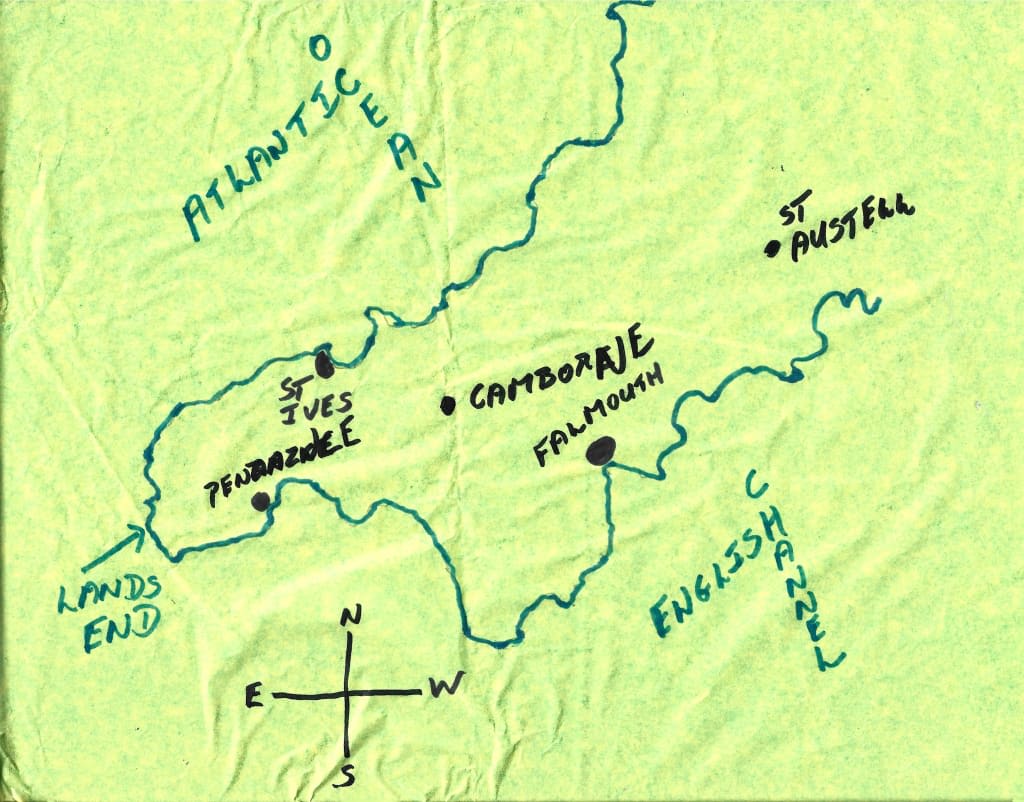
Camborne in Cornwall in the 18th century was described “…as the richest square mile in the whole world”.
Nearly three hundred years later it is described as one of the poorest and most deprived areas of the country. In one league table, ranking areas from those that are poorest to those that are the wealthiest Camborne languishes in 1255th place in a dataset of a dataset of twelve thousand areas analysed. In another analysis it is amongst the worst 2% of the poorest areas.
The root cause of that rise to wealth and prosperity and demise to poverty and deprivation is tin and copper ores.
Records show that both ores have been mined in the area as far back as 2000BC. In 2019 near the coast of Israel marine archaeologists discovered a shipwreck that they dated to 1300BC. Samples from its cargo of tin were analysed and revealed that the source of the tin was the Camborne area of Cornwall.
Globalised trade is not just a 20th and 21st century economic phenomenon.
As demand for both metals grew rapidly during the Industrial Revolution the technology and skills required to dig deeper mines and mine more efficiently grew as well. This knowledge enabled the area to claim the world record for the world’s deepest mine. At its deepest the Dolcoath Mine went down one thousand metres. It produced 80,000 tons of black tin and 350,000 tons of copper ore by the time it closed for good in 1920.
The production of tin and copper ore peaked in the 1840’s and then began an irreversible decline. This happened as a result of mines in Chile opening where both raw materials were easily found and extracted at a much lower cost than in Cornwall.
To show how dependent the community was on mining it revealed that from a population of four and a half thousand two thirds of them were employed either directly or indirectly because of the mining industry. It is no surprise then that once that decline in production started it triggered so much poverty in the community. Since that happened nearly two hundred and fifty years ago there has not been any new industry move into the area to take up the slack in the employment market.
By 2021 the population had reached 20,451.
Although the mining industry has gone from Camborne leaving behind pit head buildings and chimneys across the countryside the town is still important in the international mining industry. The Camborne School of Mining was founded in 1888. Instead of financial wealth the school has the type of wealth that has been accumulated over generations; knowledge and experience. It is now regarded as an international centre of excellence and attracts students from around the world to learn about mining.
The other grip tin from Cornwall still has on the world is that it was used in the process to make the bronze that was then made into the sixty five bronze medals awarded during the London 2012 Olympics.
The toponymy of the town’s name is a result of a union of the Cornish language and local geography. “Cam” refers to a crooked hill and the “borne” syllable has evolved from the Cornish word “bron” referring to a hill. Camborne is the place of the crooked hill.
Evidence of human habitation has been found from over ten thousand years ago. The Domesday Book was written in 1086 and doesn’t include any mention of the town or hamlet as it would have been back then even though there are records confirming that a church surrounded by dwellings on top of a hill had been built prior to the book. In 1582 a renowned mapmaker named Norden noted of Camborne that “There was a church standing among the dwellings”.
By the 1830’s, when the town’s wealth was till booming a local trade directory noted that within the town there were more pubs than shops. Another directory of the same era said that Camborne was changing “From being a very insignificant place, the town is fast into opulence and consequently importance”.
Little did the author of that comment know how economic disaster was going to hit at the very heart of the community within ten years.
We stayed at the town’s Travelodge once but didn’t like it at all. After that we stayed at the Sir John Bassett owned by the Wetherspoon group. It was built in 1866 and was known as “The Old Market House” where merchants and traders conducted their business.
The town’s main street is “Tallywarren Street” which was known as “one of the longest, straightest and finest trading streets in Cornwall”. I know it is still long and straight but as for being the finest, well I’m afraid those days have long gone. Nowadays the best shops are clustered near the hotel. The only representatives of main street trade that have a national footprint are a couple of banks, a renowned stationers, one health food shop and a couple of betting shops. The rest of the outlets are charity shops, gift shops and fast food places.
During one of my early evening shuffles around town, I was approached by someone asking me if I had any loose change. It happens everywhere we go. On the same walk a youngish man came out of a pub, leaned against the wall and lit up a cigarette. He was followed by lady whose every inch of bare flesh was covered in tattoos and did she start to harangue him about something. A few minutes later on my return walk to the hotel I could hear them both having a go at each other before I could see them. Most of Camborne probably heard them as well. What I heard before the police arrived was the lady going on about her daughter, which may have been his, being pregnant, the father had buggered off and how was she going to support them all.
No doubt a street scene played out countless times at the height of the mining boom when the town was wealthy.
I discretely crossed the road following my Mum’s instructions about “Don’t get involved Alan. There was no chance I would be involved yet her words still echoed in my head. Where I crossed the road to was an old bank building that was an arcade of gambling machines, I guess this was a case of same industry just a different branch.
On the wall was a plaque which explained that where I was standing was part of the route that Richard Trevithick’s Puffin Devil went along on the Christmas Eve of 1801.
That is another story.
About the Creator
Alan Russell
When you read my words they may not be perfect but I hope they:
1. Engage you
2. Entertain you
3. At least make you smile (Omar's Diaries) or
4. Think about this crazy world we live in and
5. Never accept anything at face value
Enjoyed the story? Support the Creator.
Subscribe for free to receive all their stories in your feed.
Comments
There are no comments for this story
Be the first to respond and start the conversation.