
Berkeley Square, London
No nightingales but there was definitely a green hare
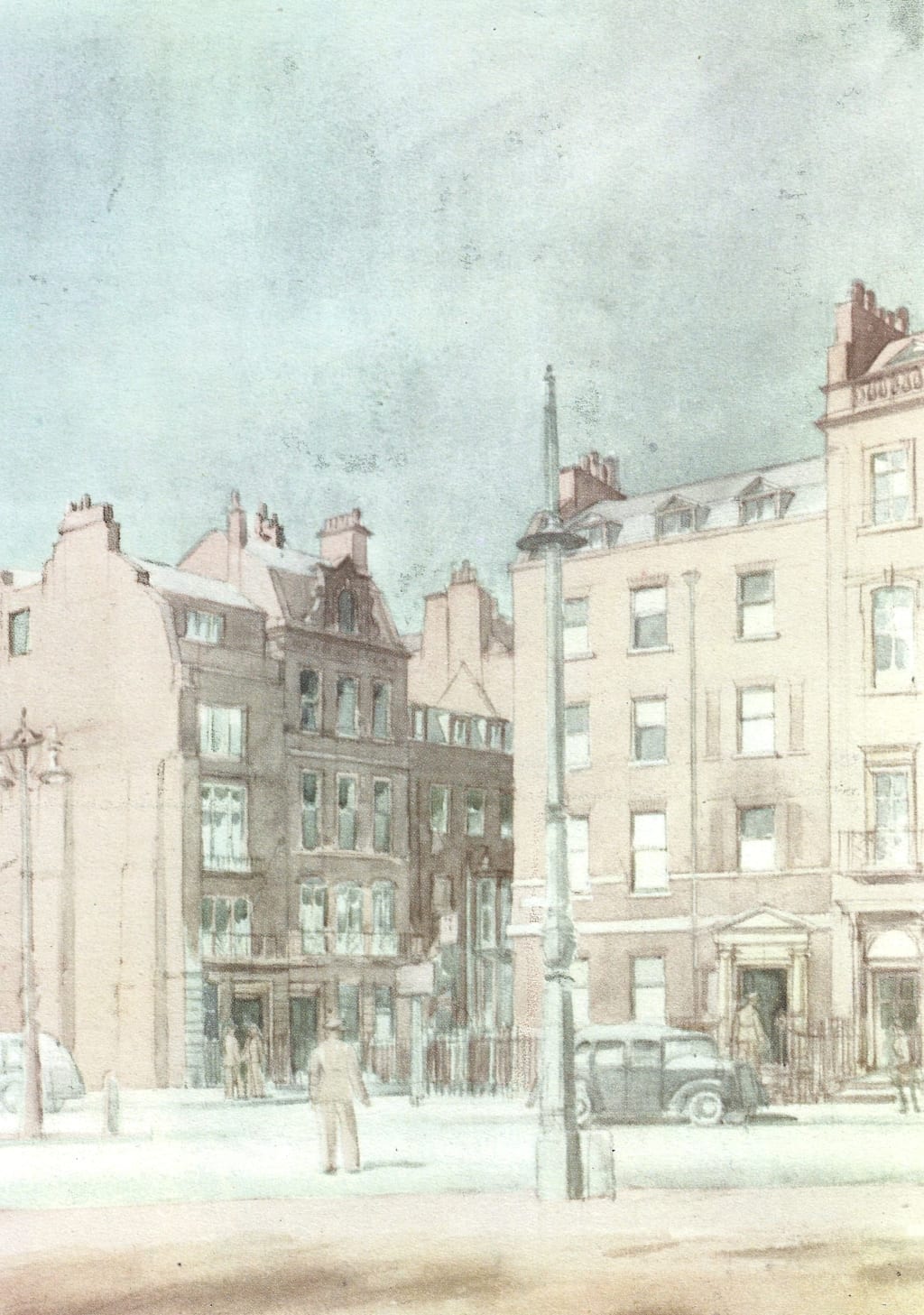
Berkeley Square in central London belies geometry and ornithology and is featured on pages forty and forty one of “Londoner’s England.
Despite its name it is not a square but a rectangle or an oblong whose length is approximately north to south and width east to west. Berkeley “Oblong” or Berkeley “Rectangle” just lack the elegance and romance that “square” conveys. And just imagine how the song “A Nightingale Sang in Berkeley Square” would sound if was based on real geometry. “A nightingale sang in Berkeley Oblong” or “A nightingale sang in Berkeley rectangle. It just wouldn’t have worked.
The romantic song about nightingales is based entirely on lyrical and ornithological licence. Over the 250 years since the square was originally laid out there have been no recorded sightings of nightingales taking up residence, passing through or even stopping off to do a gig for romantic couples.
As with all of London’s green spaces living and breathing nature in the form of birds and small mammals have taken up residence. Sparrows, pigeons, starlings and robins clean up crumbs and titbits from open air lunches while squirrels scuttle around frantically trying to find what the birds have missed. There are rabbits in the larger parks. I was not prepared to encounter a large hare and a green one at that, in Berkeley Square.
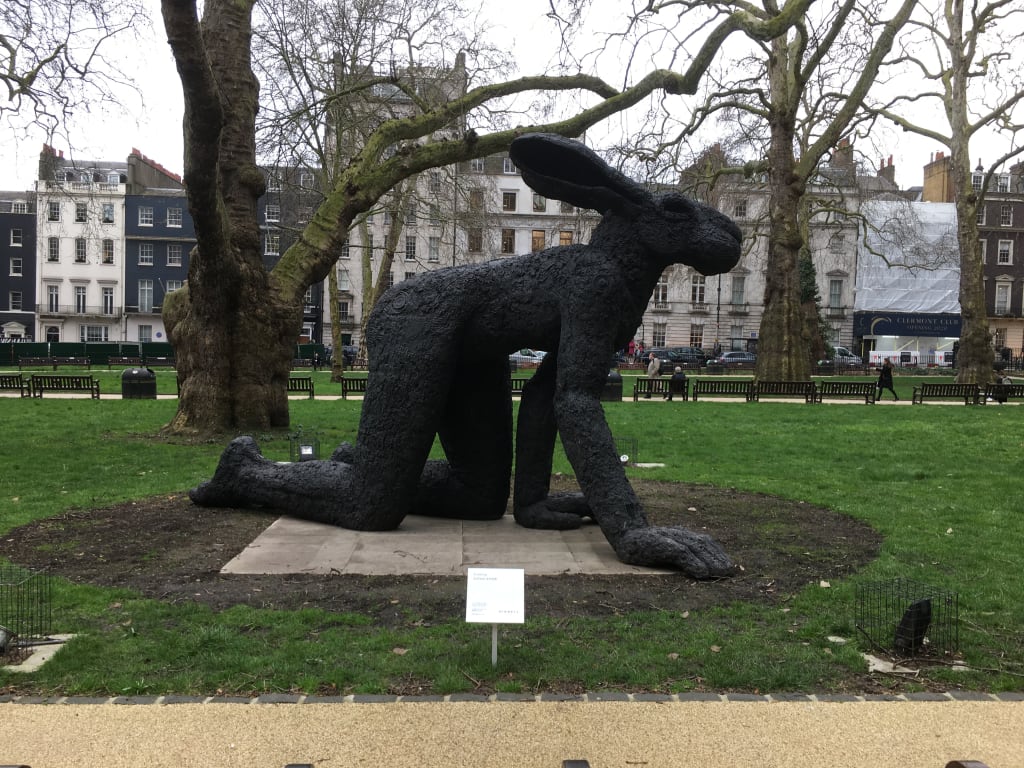
The time I spotted it was about mid-day so nothing unusual about that. Hares frequently come out during the day to box, eat and attract mates when they know it is safe. But only yards from bustling Piccadilly or Oxford Street in the heart of London’s West End? Such a sighting was incongruous to say the least. What was strange about this hare was it was crawling on all fours and those, through artistic licence rather than genetic mutation, were distinctly humanoid with a definite leaning towards the feminine. What made matters worse was its size.
It was cognitively challenging to look at in daylight but in the half in the half light of an early morning after emerging mole like from London’s most famous nightclub on the square? Would it be enough to put someone off the drink for the rest of their days?
To resolve my confusion and strong sense of discomfort I walked back and forth past the piece a couple of times. I still felt uncomfortable at what I was seeing. I kept wanting to see a conventional sculpture of a hare, but the feet and the hands would not allow me to. The more I looked at the head the more I thought there was stress and anxiety. I had to stop and think on a bench. From there I watched other people stop and look. Nobody stopped to look at the renaissance style fountain with a nymph at the centre of the square. It was this huge hare that was getting all of the lunchtime walkers’ attention.
Although this is not something I would have in our garden, even if space permitted, I did like it. It did it me stop to look as it did with other people passing it.
Challenge us. Make us slow down. Make us stop. Make us think. Make us change our perceptions. Make us take away something that we did not have previously. That is what art through any medium is meant to do
It wasn’t until I read the plaque near the piece that some of that initial discomfort subsided. Subsequent research led me to change my understanding. That is what this piece did for me. I came away with a desire to find out more and if what I thought matched that of the artist. It did not but that did not matter.
This installation is named “Crawling” and is by the artist Sophie Ryder. “Crawling” represents a lady hare who in the words of the artist:
“To me it encompasses so many emotions. The lady is strong and confident and she is moving along which makes me wonder where she is going?”
The artist created a maquette in 1999, liked it and decided to scale the piece up to create an outdoor installation. After working for two months on the project her first attempt collapsed causing her slight bruising. Scaling up was not that easy yet as she said,"It felt like two months’ work was wasted" but in that time she gained two years’ experience of making big pieces.
I had to bring closure to the distraction of “Crawling” as there was something else, I had set out to see in Berkeley Square. In the painting in the book there is a house at the south-west corner of the square where there is Charles Street. It was even more difficult than Shepherd Market and extremely dangerous to attempt a photograph due to the high volume of fast moving traffic so I didn’t try.
Note: This is a rewrite of an earlier version of this piece that will be included in "To Wander To Wonder To Write" in the section about London which will include Shepherd Market, A Walk in the Footsteps of Fleming and Bond, Tavistock Square and Whitechapel.
About the Creator
Alan Russell
When you read my words they may not be perfect but I hope they:
1. Engage you
2. Entertain you
3. At least make you smile (Omar's Diaries) or
4. Think about this crazy world we live in and
5. Never accept anything at face value
Enjoyed the story? Support the Creator.
Subscribe for free to receive all their stories in your feed.
Comments
There are no comments for this story
Be the first to respond and start the conversation.