
Will the United States Small Kitchen Appliances Market Reach US$ 7.54 Billion by 2034 as Smart Technology and Home Cooking Trends Transform Modern Kitchens?
Rising demand for convenience, growing adoption of smart appliances, premium home cooking experiences, and continuous product innovation are driving strong growth in the U.S. small kitchen appliances market.

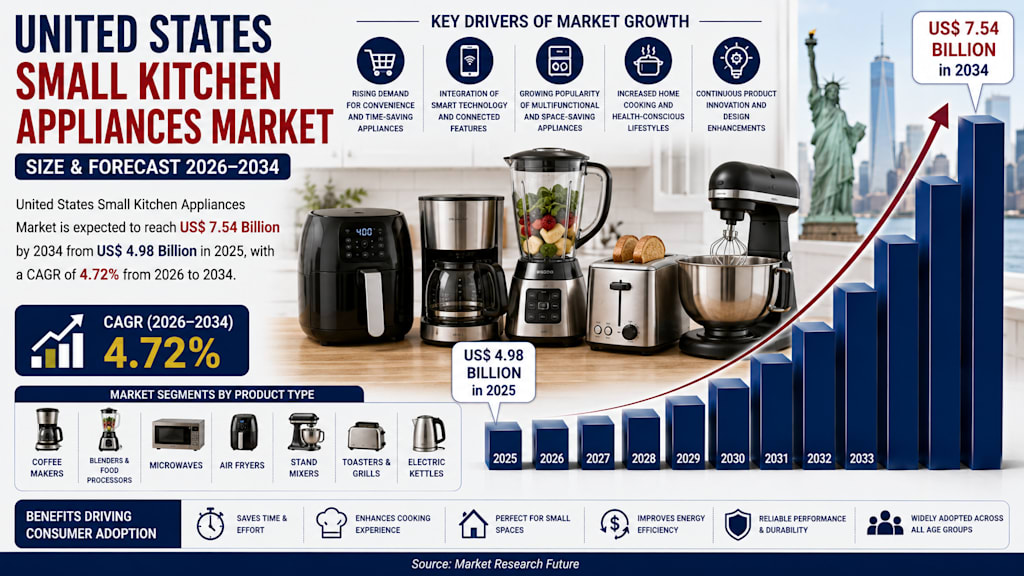
The modern American kitchen is undergoing a remarkable transformation. What was once a space dominated by basic cooking tools has evolved into a technology-driven environment filled with intelligent, multifunctional appliances designed to simplify daily life. From smart coffee makers and air fryers to advanced multi-cookers and connected food processors, small kitchen appliances are becoming indispensable tools for households seeking convenience, efficiency, and enhanced culinary experiences.
Changing lifestyles, increasing health awareness, and the growing popularity of home cooking have significantly influenced consumer purchasing behavior. Today's consumers are not only looking for appliances that save time but also products that provide greater versatility, automation, and customization. As a result, manufacturers are introducing increasingly sophisticated solutions that combine performance with smart technology.
The rise of remote work, expanding smart home ecosystems, and growing interest in gourmet cooking at home have further accelerated demand across the category. Consumers are willing to invest in appliances that improve food preparation, reduce manual effort, and deliver professional-quality results.
According to Renub Research, the United States Small Kitchen Appliances Market is projected to grow from US$ 4.98 billion in 2025 to US$ 7.54 billion by 2034, expanding at a CAGR of 4.72% during 2026–2034. Growing demand for convenience-oriented appliances, technological innovation, smart connectivity, and multifunctional kitchen solutions are expected to support sustained market growth throughout the forecast period.
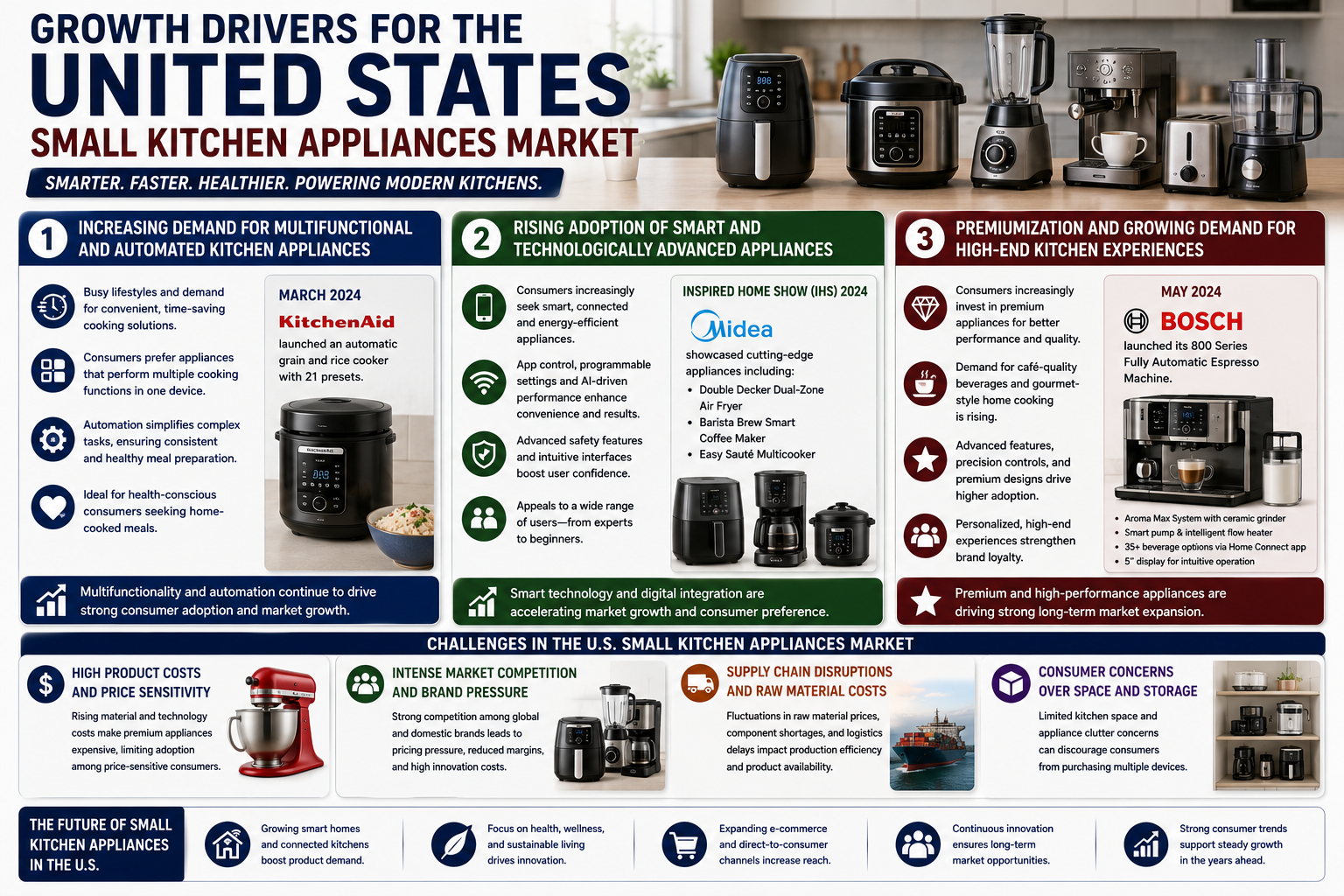
Small Kitchen Appliances Have Become Essential Household Tools
Small kitchen appliances are compact, electrically powered devices designed to simplify food preparation, cooking, and beverage-making tasks.
Unlike large kitchen appliances such as refrigerators or ovens, these products are portable, versatile, and often specialized for specific culinary functions.
Popular categories include coffee makers, air fryers, blenders, mixers, food processors, electric kettles, toasters, multi-cookers, grills, microwaves, and specialty beverage machines.
These appliances help consumers save time, improve cooking precision, and expand culinary possibilities while minimizing manual effort.
Advancements in design and technology have significantly increased functionality, making modern appliances more efficient and user-friendly than ever before.
As consumers continue prioritizing convenience and customization, small kitchen appliances have become central to contemporary household living.
Home Cooking Trends Continue Driving Demand
One of the most significant drivers of market growth is the increasing popularity of home cooking.
Consumers are spending more time preparing meals at home due to rising foodservice costs, growing health awareness, and greater interest in personalized nutrition.
Home cooking allows consumers to control ingredients, portion sizes, and nutritional quality while exploring new recipes and cuisines.
Small kitchen appliances support this trend by simplifying complex cooking tasks and reducing preparation time.
Products such as air fryers, food processors, and multi-cookers make it easier for consumers to prepare restaurant-quality meals from the comfort of their homes.
As home cooking continues gaining popularity, demand for efficient and innovative kitchen appliances is expected to remain strong.
Convenience Remains the Market’s Strongest Growth Catalyst
Modern consumers increasingly seek products that streamline daily routines and maximize efficiency.
Busy schedules, dual-income households, and fast-paced lifestyles have increased demand for appliances capable of reducing cooking time and simplifying meal preparation.
Small kitchen appliances provide practical solutions that eliminate repetitive tasks while improving consistency and convenience.
Automated cooking programs, preset functions, and programmable controls allow users to prepare meals with minimal supervision.
Consumers appreciate appliances that save time without sacrificing quality, making convenience one of the most influential purchasing factors within the market.
The ongoing emphasis on efficiency is expected to continue driving strong consumer adoption.
Multifunctional Appliances Gain Popularity
The growing demand for multifunctional appliances represents another important market trend.
Consumers increasingly prefer products capable of performing multiple cooking functions within a single device.
This preference is particularly strong among urban residents and households with limited kitchen space.
Multifunctional appliances reduce countertop clutter while providing greater versatility.
A notable example occurred in March 2024 when KitchenAid introduced an automatic grain and rice cooker featuring 21 presets for various grains and beans.
The appliance automatically dispenses the correct amount of water, simplifying meal preparation and improving cooking consistency.
Such innovations demonstrate how manufacturers are responding to consumer demand for all-in-one kitchen solutions.
Smart Technology Is Transforming Kitchen Experiences
Smart technology has become one of the most influential developments within the small kitchen appliances market.
Consumers increasingly expect appliances to integrate seamlessly with connected home ecosystems and mobile devices.
Manufacturers are incorporating Wi-Fi connectivity, smartphone controls, voice-assistant compatibility, remote monitoring, and programmable automation features into their products.
These capabilities provide greater convenience while enabling personalized cooking experiences.
Smart appliances can offer cooking recommendations, monitor performance, and automatically adjust settings to optimize results.
As connected homes become increasingly common, smart kitchen technologies are expected to play an even larger role in future market growth.
Artificial Intelligence Enhances Appliance Performance
Artificial intelligence is beginning to reshape how consumers interact with kitchen appliances.
AI-powered systems can analyze cooking conditions, recognize ingredients, recommend settings, and optimize performance automatically.
Manufacturers are leveraging AI to improve convenience and reduce the learning curve associated with advanced cooking techniques.
These technologies help users achieve consistent results while minimizing errors.
The integration of AI reflects broader consumer interest in intelligent home solutions that simplify everyday activities.
As AI capabilities continue advancing, they are expected to become increasingly important differentiators within the market.
Connected Home Ecosystems Support Growth
The expansion of smart home ecosystems continues driving appliance adoption.
Consumers increasingly seek devices that communicate with one another and integrate into broader connected environments.
Smart kitchen appliances can now interact with smartphones, tablets, voice assistants, and home automation platforms.
These integrations allow users to remotely control appliances, receive notifications, and access personalized settings.
The growing popularity of connected living is creating new opportunities for appliance manufacturers focused on digital innovation.
Innovation Remains a Key Competitive Advantage
Continuous innovation has become essential for success within the highly competitive small kitchen appliances market.
Manufacturers regularly introduce new features, enhanced functionality, and improved user experiences to attract consumers.
Companies are investing heavily in research and development to differentiate products and maintain relevance in rapidly evolving markets.
Innovations often focus on automation, energy efficiency, user-friendly interfaces, and multifunctionality.
Consumers increasingly reward brands that provide meaningful technological improvements and superior performance.
As competition intensifies, innovation is expected to remain a central growth driver.
Midea Showcases Next-Generation Kitchen Solutions
Industry innovation was clearly demonstrated during the Inspired Home Show 2024 in Chicago.
Midea introduced several technologically advanced products, including the Double Decker Dual-Zone Air Fryer, Barista Brew Smart Coffee Maker, and Easy Sauté Multicooker.
These products reflect growing consumer demand for intelligent appliances that combine convenience, efficiency, and enhanced functionality.
The company's emphasis on smart features highlights broader industry trends toward digital integration and automation.
Such product launches continue shaping consumer expectations and driving category expansion.
Premiumization Is Elevating Consumer Expectations
Premiumization has become a major force within the small kitchen appliances industry.
Consumers increasingly seek appliances that deliver professional-quality results and elevated culinary experiences.
This trend is particularly evident in coffee preparation, precision cooking, and specialty food categories.
Manufacturers are responding with high-performance products featuring advanced controls, premium materials, and sophisticated brewing or cooking technologies.
Consumers are often willing to pay higher prices for products that enhance convenience, improve results, and support personalized experiences.
The premium segment continues generating significant growth opportunities across multiple categories.
Coffee Appliances Benefit from Specialty Beverage Culture
The coffee appliance category remains one of the strongest performers within the market.
Consumers increasingly seek café-quality beverages at home, driving demand for premium coffee machines and specialty brewing systems.
In May 2024, Bosch introduced its 800 Series Fully Automatic Espresso Machine featuring the Aroma Max System, intelligent brewing technology, and access to more than 35 beverage options through the Home Connect platform.
Such innovations reflect growing consumer interest in customized beverage experiences.
As specialty coffee culture continues expanding, demand for advanced brewing equipment is expected to remain strong.
Air Fryers Continue Reshaping Home Cooking
Air fryers have become one of the most successful appliance categories in recent years.
Consumers appreciate their ability to prepare crispy foods using significantly less oil than traditional frying methods.
The appliances align closely with health-conscious cooking trends while offering speed and convenience.
Manufacturers continue expanding functionality by incorporating multiple cooking modes such as roasting, baking, dehydrating, and reheating.
The popularity of air fryers demonstrates how health and convenience can combine to drive widespread product adoption.
Multi-Cookers Appeal to Busy Households
Multi-cookers have gained popularity because they combine several cooking functions within a single appliance.
Pressure cooking, slow cooking, steaming, sautéing, rice cooking, and warming capabilities can often be found within one device.
These appliances help consumers save time and reduce the need for multiple kitchen tools.
Their versatility makes them particularly attractive for families and busy professionals seeking efficient meal preparation solutions.
Demand for multifunctional cooking systems is expected to remain robust throughout the forecast period.
Online Retail Continues Expanding Market Access
E-commerce has become one of the most important sales channels for small kitchen appliances.
Consumers benefit from extensive product selection, competitive pricing, detailed reviews, and convenient home delivery.
Manufacturers increasingly rely on online platforms to launch new products and engage directly with consumers.
Digital marketing campaigns, influencer partnerships, and online promotions further strengthen category visibility.
The continued growth of online retail is expected to support long-term market expansion.
California Leads Appliance Adoption
California remains one of the most influential markets for small kitchen appliances in the United States.
The state's technology-oriented consumers readily embrace smart home innovations and premium appliances.
Strong interest in health-conscious lifestyles also drives demand for air fryers, blenders, juicers, and specialty cooking devices.
California's diverse population and innovation-focused culture continue making it a leading market for early adoption and product experimentation.
Florida Benefits from Lifestyle-Driven Demand
Florida represents another important growth market.
Population growth, rising home ownership, and strong retail infrastructure support demand for modern kitchen appliances.
Consumers frequently purchase products that emphasize convenience, ease of use, and healthy meal preparation.
The state's warm climate also supports demand for beverage-focused appliances such as blenders and iced-drink makers.
New York Drives Compact Appliance Innovation
New York's urban environment creates strong demand for compact and multifunctional appliances.
Limited kitchen space encourages consumers to prioritize products that maximize functionality while minimizing footprint.
Coffee machines, portable blenders, smart ovens, and multi-cookers are particularly popular among urban residents.
The state's diverse culinary culture further supports demand for specialized cooking equipment.
Texas Emerges as a Fast-Growing Market
Texas continues experiencing strong growth in small kitchen appliance adoption.
Expanding populations, rising disposable incomes, and growing smart-home adoption contribute to market expansion.
Major metropolitan areas such as Houston, Dallas, and Austin demonstrate strong demand for connected appliances and convenience-oriented cooking solutions.
The state's strong economic performance supports consumer spending across both mid-range and premium appliance categories.
Market Saturation Creates Competitive Pressure
Despite strong growth prospects, the industry faces challenges related to intense competition and product saturation.
Numerous manufacturers compete across categories such as coffee makers, air fryers, and blenders, making differentiation increasingly difficult.
Price competition can reduce profit margins while requiring significant investments in innovation and marketing.
Manufacturers must continuously introduce meaningful improvements to maintain consumer interest and brand loyalty.
Supply Chain and Cost Pressures Persist
Rising production costs represent another important challenge.
Manufacturers face increasing expenses related to electronic components, motors, heating elements, transportation, and logistics.
Global supply-chain disruptions have further complicated sourcing and inventory management.
Balancing affordability with innovation remains a critical priority for industry participants.
Companies are increasingly investing in supply-chain resilience and diversified sourcing strategies to address these challenges.
Recent Industry Developments Highlight Strong Momentum
The market continues demonstrating strong innovation and financial performance.
In March 2025, Panasonic introduced the HomeCHEF Connect 4-in-1 Countertop Multi-Oven, combining microwave, air-fry, convection bake, and broil functions while incorporating AI-enabled cookware recognition.
SharkNinja reported fourth-quarter 2024 net sales of US$ 1.79 billion, representing a 29.7% increase and highlighting strong consumer demand for innovative home appliances.
Meanwhile, KitchenAid unveiled new Juniper and Black Ore finishes with customizable hardware options during KBIS 2025, reflecting the growing importance of appliance aesthetics and personalization.
Final Thoughts
The United States small kitchen appliances market is evolving rapidly as consumers increasingly prioritize convenience, smart technology, health-conscious cooking, and premium home experiences.
From connected coffee machines and AI-powered ovens to multifunctional cookers and advanced air fryers, innovation continues reshaping the modern kitchen.
While competition and supply-chain challenges remain important considerations, strong consumer demand for efficiency, customization, and intelligent functionality provides a solid foundation for future growth.
With the market projected to grow from US$ 4.98 billion in 2025 to US$ 7.54 billion by 2034, the U.S. small kitchen appliances industry is well positioned to remain a key driver of innovation within the broader home appliance sector.
About the Creator
Enjoyed the story? Support the Creator.
Subscribe for free to receive all their stories in your feed.
Comments
There are no comments for this story
Be the first to respond and start the conversation.