
Will the United States Household Appliances Market Reach US$ 147.01 Billion by 2034 as Smart Homes, Energy Efficiency, and Connected Living Reshape Consumer Demand?
Growing adoption of smart appliances, rising demand for energy-efficient technologies, increasing home renovation activities, and consumers’ preference for connected devices are driving strong growth in the U.S. household appliances market.

The American household is becoming increasingly connected, automated, and energy conscious. As technology continues to transform everyday living, household appliances are evolving far beyond their traditional functions. Modern refrigerators can monitor food inventory, washing machines can be controlled remotely through smartphones, and dishwashers are designed to optimize water and energy usage automatically.
This technological evolution is fundamentally changing how consumers interact with their homes. Today's appliances are no longer viewed simply as functional necessities. Instead, they are becoming integral components of connected living environments that prioritize convenience, efficiency, sustainability, and personalization.
The growing popularity of smart homes, rising disposable incomes, and increasing interest in energy-efficient solutions have significantly strengthened demand for advanced household appliances across the United States. Consumers are increasingly willing to invest in products that reduce manual effort, lower utility costs, and integrate seamlessly into digital lifestyles.
At the same time, strong residential construction activity, home renovation projects, and replacement demand continue supporting market expansion. As households seek to modernize their living spaces, appliance manufacturers are responding with innovative products designed to meet evolving consumer expectations.
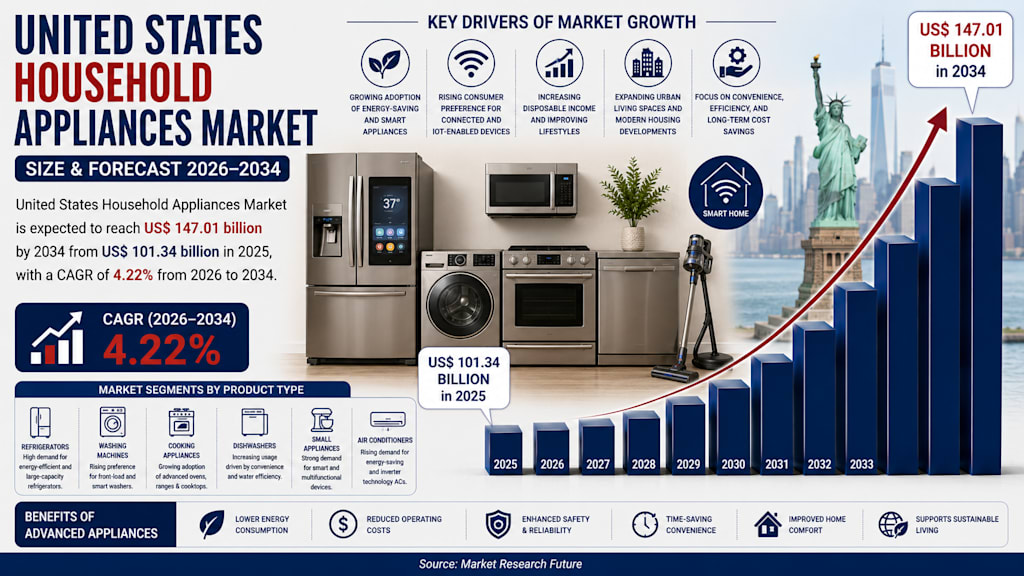
According to Renub Research, the United States Household Appliances Market is projected to grow from US$ 101.34 billion in 2025 to US$ 147.01 billion by 2034, registering a CAGR of 4.22% during 2026–2034. Growing adoption of smart appliances, increasing demand for energy-efficient technologies, and rising consumer preference for connected home ecosystems are expected to drive long-term market growth.
Household Appliances Continue Evolving Beyond Traditional Functions
Household appliances encompass a broad range of devices designed to simplify domestic activities and improve daily living.
The market includes major appliances such as refrigerators, washing machines, dryers, dishwashers, ovens, cooktops, air conditioners, and water heaters, along with small appliances including coffee makers, blenders, vacuum cleaners, air purifiers, and food processors.
Historically, consumers focused primarily on durability and functionality when purchasing appliances.
Today, purchasing decisions increasingly consider connectivity, automation, energy efficiency, aesthetics, and integration with broader smart home systems.
This evolution reflects changing consumer expectations and the growing role of technology within everyday life.
As homes become increasingly digital, household appliances are emerging as key components of modern living environments.
Smart Home Adoption Is Transforming the Market
One of the most important growth drivers within the household appliances industry is the rapid adoption of smart home technologies.
Consumers increasingly seek appliances capable of communicating with smartphones, voice assistants, and other connected devices.
Smart refrigerators can track inventory and suggest recipes.
Connected washing machines can be monitored remotely.
Intelligent dishwashers automatically optimize water and detergent usage.
These capabilities provide greater convenience while improving operational efficiency.
As consumers become more familiar with connected living, demand for smart appliances continues rising across virtually every product category.
The integration of artificial intelligence and automation is expected to further accelerate market growth during the coming decade.
IoT-Enabled Appliances Become Mainstream
The Internet of Things (IoT) is playing a critical role in the evolution of household appliances.
Connected appliances are increasingly serving as central components within broader home automation ecosystems.
Manufacturers are integrating sensors, cloud connectivity, predictive maintenance features, and remote monitoring capabilities into products.
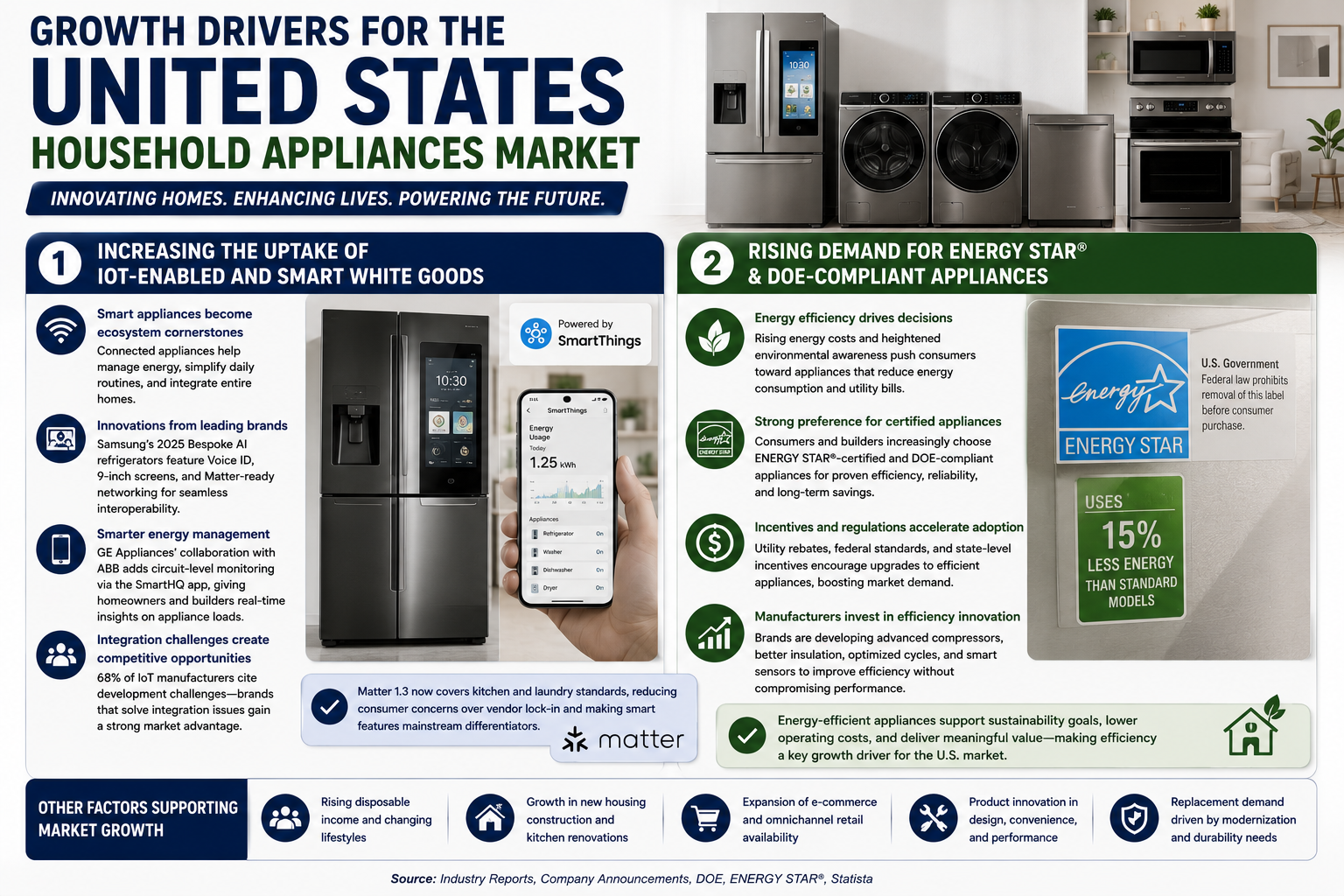
Samsung's 2025 Bespoke AI refrigerators demonstrate this trend by incorporating voice identification technology, advanced touchscreens, and Matter-compatible networking systems that improve interoperability with other smart devices.
As interoperability standards continue improving, consumers are becoming more comfortable investing in connected appliances that integrate seamlessly across different platforms.
The growing acceptance of IoT technology remains a major catalyst for market expansion.
Energy Efficiency Drives Consumer Purchasing Decisions
Energy efficiency has become one of the most influential factors affecting appliance purchases.
Consumers are increasingly aware of rising utility costs and environmental sustainability concerns.
As a result, demand for ENERGY STAR-certified and energy-efficient appliances continues increasing across the United States.
Modern appliances utilize advanced compressors, inverter technologies, sensors, and energy-management systems designed to reduce electricity and water consumption.
These innovations not only lower operating costs but also help consumers reduce their environmental footprint.
Government initiatives promoting energy conservation have further accelerated adoption of efficient appliances.
The emphasis on sustainability is expected to remain a powerful driver of market growth throughout the forecast period.
Government Standards Encourage Market Modernization
Federal and state-level regulations continue encouraging consumers to replace older appliances with more efficient alternatives.
Energy-efficiency standards established by government agencies create incentives for manufacturers to innovate while helping consumers reduce long-term utility expenses.
These policies have accelerated the development of products that balance performance with environmental responsibility.
As regulatory requirements continue evolving, manufacturers are expected to invest heavily in next-generation efficiency technologies.
Rising Disposable Income Supports Premium Appliance Demand
Economic growth and rising household incomes have increased consumer willingness to invest in premium appliances.
Many households now view appliances as long-term investments that contribute to convenience, lifestyle enhancement, and home value.
Premium products often offer superior performance, enhanced durability, smart connectivity, and advanced customization features.
Consumers increasingly prioritize quality and user experience over simply purchasing the lowest-priced option.
This shift toward premiumization is creating substantial opportunities for manufacturers offering technologically advanced products.
Home Renovation Activity Fuels Appliance Sales
The U.S. home improvement sector continues providing significant support to the household appliances market.
Kitchen and laundry room renovations frequently involve replacing older appliances with modern alternatives.
Consumers often upgrade appliances during remodeling projects to improve aesthetics, functionality, and energy efficiency.
Strong residential construction activity also contributes to demand, particularly in rapidly growing metropolitan areas.
New housing developments create opportunities for both major and small appliance sales.
As homeowners continue investing in property improvements, appliance replacement and upgrade cycles are expected to remain strong.
Social Media Influences Appliance Purchasing Behavior
Social media platforms have become increasingly important in shaping consumer preferences.
Platforms such as Instagram, TikTok, YouTube, and Pinterest expose consumers to new products, cooking trends, and home design concepts.
Appliances frequently appear in influencer content, cooking demonstrations, and lifestyle videos.
This visibility has accelerated demand for aesthetically appealing and feature-rich products.
Manufacturers are increasingly collaborating with content creators to showcase product capabilities and strengthen brand awareness.
The growing influence of social media continues reshaping appliance marketing strategies.
Air Fryers Illustrate the Power of Digital Trends
The rapid success of air fryers demonstrates how consumer trends and digital content can influence purchasing behavior.
By 2023, approximately 60% of U.S. households reportedly owned an air fryer, highlighting the category's remarkable growth.
Social media recipes, cooking tutorials, and wellness-focused content helped popularize air frying as a healthier cooking method.
Manufacturers continue expanding product functionality to meet evolving consumer expectations.
The success of air fryers illustrates the growing connection between digital influence and household appliance demand.
Major Appliances Continue Dominating Market Revenue
Major appliances account for a substantial share of total market revenues.
Products such as refrigerators, washing machines, dishwashers, ovens, cooktops, dryers, and air conditioners remain essential household purchases.
Replacement demand plays a particularly important role within this segment because consumers regularly upgrade aging appliances.
Technological advancements continue improving performance, energy efficiency, and user convenience.
Smart connectivity features are becoming increasingly common across major appliance categories, further strengthening consumer interest.
Refrigerators Lead Smart Appliance Adoption
Among major appliances, refrigerators have become leading examples of smart-home innovation.
Modern models feature touchscreens, inventory tracking systems, voice controls, remote diagnostics, and energy-management capabilities.
Consumers increasingly view refrigerators as central hubs within connected kitchen environments.
The growing integration of AI and IoT technologies is expected to further expand functionality in coming years.
Laundry Appliances Continue Advancing
Washing machines and dryers have undergone significant technological improvements.
Smart laundry appliances can automatically adjust cycles based on fabric types, monitor detergent usage, and provide maintenance alerts.
Energy-efficient models help consumers reduce water and electricity consumption while improving cleaning performance.
These advancements continue driving replacement demand across residential markets.
Small Appliances Experience Strong Growth
Small appliances remain one of the fastest-growing segments within the broader market.
Products such as coffee makers, air fryers, blenders, food processors, air purifiers, and vacuum cleaners benefit from shorter replacement cycles and frequent innovation.
Consumers often purchase these products to support specific lifestyle goals such as healthy eating, convenience, or premium beverage preparation.
The growing popularity of specialty coffee, home cooking, and wellness-focused living continues driving demand.
Online Retail Strengthens Market Accessibility
E-commerce has become a critical distribution channel for household appliances.
Consumers increasingly appreciate the convenience of online shopping, product comparisons, customer reviews, and home delivery services.
Manufacturers benefit from direct-to-consumer sales opportunities and improved customer engagement.
Digital platforms also facilitate product education and personalized recommendations.
The continued growth of online retail is expected to support future market expansion.
California Leads Appliance Innovation
California remains one of the most influential appliance markets in the country.
Strong environmental regulations, high consumer purchasing power, and widespread smart-home adoption create ideal conditions for advanced appliance sales.
Consumers actively seek energy-efficient refrigerators, washing machines, HVAC systems, and connected appliances.
The state's sustainability-focused culture continues supporting demand for premium products.
Texas Benefits from Population Growth
Texas represents one of the fastest-growing appliance markets in the United States.
Rapid population expansion, strong residential construction activity, and rising household formation support substantial appliance demand.
The state's hot climate drives particularly strong demand for air conditioning systems and cooling technologies.
Texas continues serving as a major growth engine for both major and small appliance categories.
New York Prioritizes Space Efficiency
New York consumers often prioritize compact and multifunctional appliances due to urban living conditions.
Space-saving refrigerators, combination washer-dryers, and compact kitchen appliances perform particularly well in dense metropolitan environments.
High utility costs also encourage adoption of energy-efficient technologies.
The state's strong renovation market further contributes to replacement demand.
Florida Supports Consistent Market Growth
Florida benefits from strong population growth, active housing markets, and recurring demand from vacation properties and rental units.
Consumers frequently purchase cooling systems, dehumidifiers, refrigerators, and laundry appliances.
The state's climate and demographic characteristics create unique opportunities across multiple appliance categories.
High Costs Challenge Consumer Adoption
Despite strong growth prospects, high upfront costs remain a significant challenge.
Smart appliances and premium models often carry substantially higher price tags than conventional alternatives.
Economic uncertainty, inflationary pressures, and interest-rate fluctuations can discourage discretionary spending.
Price-sensitive consumers may postpone upgrades or choose lower-cost alternatives.
Balancing innovation with affordability remains a key challenge for manufacturers.
Supply Chain Disruptions Continue Affecting Production
Supply chain instability remains another major concern.
Manufacturers rely heavily on semiconductors, electronic components, steel, plastics, and global logistics networks.
Shortages and transportation disruptions can increase production costs and extend delivery timelines.
These challenges create operational complexities while potentially impacting consumer satisfaction.
Although companies are investing in supply-chain diversification and localized manufacturing, uncertainties remain.
Industry Innovation Continues Accelerating
Manufacturers continue investing heavily in product development and sustainability initiatives.
In March 2024, Miele introduced enhanced features for its G7000 Dishwasher line, including improved AutoDos technology, quieter operation, and redesigned basket layouts optimized for reusable household items.
LG Electronics launched its 14-place LG Dios Objet Collection Dishwasher in February 2024, offering flexible installation options and improved space utilization.
Meanwhile, Whirlpool announced a partnership with One Energy to expand renewable-energy projects at manufacturing facilities in Ohio, highlighting growing industry commitment to sustainability.
These developments demonstrate how innovation continues shaping the future of the household appliances industry.
Final Thoughts
The United States household appliances market is experiencing sustained growth as consumers increasingly embrace smart technologies, energy-efficient solutions, and connected living environments.
From intelligent refrigerators and automated laundry systems to advanced dishwashers and premium small appliances, innovation continues redefining modern households.
While challenges related to affordability and supply-chain disruptions remain important considerations, strong consumer demand for convenience, sustainability, and technological advancement provides a solid foundation for future expansion.
With the market expected to grow from US$ 101.34 billion in 2025 to US$ 147.01 billion by 2034, the U.S. household appliances industry is well positioned to remain one of the most dynamic segments within the broader consumer technology and home improvement sectors.
About the Creator
Enjoyed the story? Support the Creator.
Subscribe for free to receive all their stories in your feed.
Comments
There are no comments for this story
Be the first to respond and start the conversation.