
Will the United Kingdom Feed Additives Market Reach US$ 3.28 Billion by 2034 as Sustainable Livestock Farming and Antibiotic-Free Production Transform Animal Nutrition?
Rising demand for premium livestock products, stricter animal welfare regulations, expanding poultry and aquaculture sectors, and increasing adoption of sustainable farming practices are accelerating growth in the UK feed additives market.

The United Kingdom’s livestock sector is entering a new era of efficiency, sustainability, and innovation. As consumer expectations evolve and regulatory standards become more stringent, farmers and feed manufacturers are increasingly turning to advanced nutritional solutions to enhance animal health, improve productivity, and reduce environmental impact.
At the center of this transformation is the feed additives industry. Once considered supplementary ingredients, feed additives have become indispensable tools in modern animal agriculture. They help optimize feed conversion, strengthen immunity, improve digestive performance, support disease prevention, and contribute to more sustainable livestock production systems.
Growing demand for high-quality meat, dairy, poultry, and aquaculture products is encouraging producers to adopt innovative feed technologies that improve both animal welfare and farm profitability. At the same time, the UK's commitment to reducing antibiotic usage and lowering agricultural emissions is creating strong momentum for next-generation feed additives.
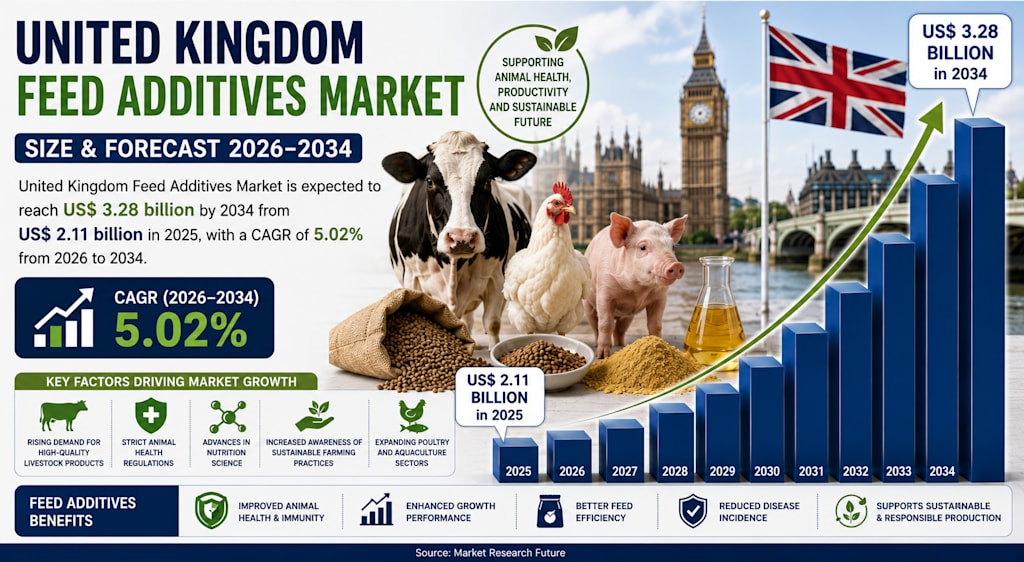
According to Renub Research, the United Kingdom Feed Additives Market is projected to grow from US$ 2.11 billion in 2025 to US$ 3.28 billion by 2034, expanding at a CAGR of 5.02% during 2026–2034. Rising demand for premium livestock products, advances in nutrition science, strict animal health regulations, and increasing focus on sustainability are expected to fuel long-term market growth.

Feed Additives Have Become Essential Components of Modern Animal Agriculture
Feed additives are specialized nutritional and functional ingredients incorporated into animal feed to improve health, growth performance, feed efficiency, and productivity.
These additives include vitamins, minerals, enzymes, amino acids, probiotics, prebiotics, antioxidants, binders, and various specialty ingredients designed to enhance digestion, nutrient absorption, immunity, and reproductive performance.
In modern livestock production, feed additives play a critical role in helping farmers maintain healthy animals while improving operational efficiency.
By maximizing nutrient utilization and minimizing waste, additives help producers reduce feed costs and improve profitability.
As global food demand rises and agricultural systems face increasing pressure to operate sustainably, feed additives are becoming increasingly important tools for maintaining productivity while minimizing environmental impact.
Rising Demand for Premium Livestock Products Drives Growth
Consumer preferences are changing rapidly across the United Kingdom.
Shoppers increasingly seek high-quality meat, dairy products, eggs, and seafood that meet strict standards for animal welfare, food safety, and sustainability.
To meet these expectations, livestock producers are investing heavily in nutrition programs that support animal health and optimize production outcomes.
Feed additives help improve growth rates, feed conversion efficiency, reproductive performance, and overall livestock productivity.
Healthier animals generally produce higher-quality products, which allows farmers to meet consumer demands while maintaining profitability.
As premium food consumption continues growing, the need for advanced feed solutions is expected to increase significantly.
Antibiotic-Free Livestock Production Is Reshaping the Industry
One of the most influential trends driving the UK feed additives market is the transition toward antibiotic-free livestock production.
For decades, antibiotics were widely used to support animal growth and disease prevention.
However, increasing concerns regarding antimicrobial resistance have led regulators, retailers, and consumers to push for reduced antibiotic use throughout the food supply chain.
This shift has created substantial demand for natural alternatives capable of maintaining animal health without relying on antibiotics.
Probiotics, prebiotics, organic acids, enzymes, phytogenic compounds, and yeast cultures are becoming increasingly important components of livestock nutrition programs.
These additives help strengthen gut health, improve immunity, and support efficient digestion while reducing disease risks.
As producers continue moving toward antibiotic-free systems, demand for innovative feed additives is expected to remain strong.
Consumer Demand for Transparency Is Influencing Feed Strategies
Modern consumers are paying closer attention to how their food is produced.
Questions regarding animal welfare, antibiotic use, sustainability, and supply chain transparency have become increasingly important.
Retailers and food manufacturers are responding by implementing stricter sourcing requirements and demanding greater accountability from suppliers.
Livestock producers must demonstrate responsible farming practices while maintaining competitive production levels.
Feed additives play an important role in helping producers achieve these objectives by supporting healthier animals and more sustainable production systems.
This growing emphasis on transparency is expected to further strengthen market demand.
Poultry Industry Remains a Major Growth Engine
The poultry sector is one of the most significant contributors to feed additive demand in the United Kingdom.
Poultry remains the country's most widely consumed source of animal protein, creating ongoing pressure to improve production efficiency and maintain high standards of animal health.
Feed additives such as amino acids, enzymes, antioxidants, vitamins, and mineral supplements are widely used throughout poultry production systems.
These ingredients help improve feed utilization, support rapid growth, and strengthen immune function in intensive farming environments.
As poultry consumption continues increasing, demand for performance-enhancing nutritional solutions is expected to grow accordingly.
Aquaculture Expansion Creates New Opportunities
Aquaculture has become one of the fastest-growing segments of the UK agricultural industry.
Salmon and trout farming, in particular, continue expanding as demand for sustainable seafood rises.
Unlike traditional livestock production, aquaculture requires highly specialized nutritional strategies.
Feed additives used in fish farming include pigments, immune-support compounds, digestive enzymes, antioxidants, and specialized nutrient blends.
These products help improve fish health, reduce mortality rates, enhance feed conversion ratios, and maintain product quality.
As seafood consumption continues growing, aquaculture is expected to become an increasingly important source of demand for feed additives.
Sustainability Has Become a Central Industry Priority
Environmental sustainability is now one of the most important considerations shaping the future of agriculture.
Farmers and feed manufacturers face increasing pressure to reduce greenhouse gas emissions, improve nutrient management, and minimize environmental impact.
Feed additives are helping producers address these challenges in several ways.
Enzymes improve nutrient digestibility, reducing waste output and lowering feed consumption.
Enhanced mineral formulations help reduce nutrient excretion while supporting animal performance.
Methane-reducing additives are also attracting attention as livestock producers seek solutions that contribute to climate goals.
As agriculture moves toward more sustainable production models, feed additives will play an increasingly important role in environmental management.
Environmental Compliance Encourages Adoption
Regulatory compliance is becoming increasingly complex for UK livestock producers.
Farmers must meet strict requirements related to emissions, nutrient management, and responsible resource utilization.
Feed additives offer practical solutions that help producers comply with environmental standards while maintaining productivity.
Improved feed conversion efficiency reduces resource consumption and lowers the environmental footprint of livestock operations.
As sustainability regulations continue evolving, demand for environmentally beneficial additives is expected to increase substantially.
Precision Farming Supports Nutritional Innovation
Technological advancements in agriculture are accelerating feed additive adoption.
Precision farming technologies allow producers to monitor animal performance, health status, and nutritional requirements more accurately than ever before.
These insights enable farmers to implement targeted feeding programs that maximize productivity and minimize waste.
Feed additives complement precision farming strategies by providing customized nutritional solutions tailored to specific species, growth stages, and production goals.
As data-driven agriculture becomes increasingly widespread, demand for advanced nutritional technologies is expected to grow.
Vitamins Continue Supporting Animal Health
Vitamins remain among the most widely used feed additives across livestock sectors.
They play essential roles in metabolism, immune function, growth, reproduction, and overall health.
Deficiencies can negatively affect animal performance, productivity, and welfare.
As livestock producers increasingly focus on preventative health management, vitamin supplementation continues to represent a critical component of modern feed programs.
The segment is expected to remain an important contributor to overall market revenues.
Amino Acids Improve Feed Efficiency
Amino acids are another vital category within the feed additives market.
These nutrients support muscle growth, protein synthesis, and efficient feed utilization.
Supplementing animal diets with amino acids allows producers to optimize feed formulations while reducing reliance on expensive protein sources.
Improved amino acid balance contributes to better feed conversion ratios and lower production costs.
As feed efficiency becomes increasingly important, amino acid demand is expected to remain strong across poultry, swine, and aquaculture sectors.
Enzymes Are Transforming Animal Nutrition
Enzymes have become some of the most valuable additives used in modern livestock production.
These compounds improve digestion by helping animals break down feed ingredients more effectively.
Improved nutrient absorption enhances growth performance while reducing feed waste.
Enzymes are particularly important in poultry and swine production where feed costs represent a significant portion of overall expenses.
The continued emphasis on efficiency and sustainability is expected to support long-term growth within the enzyme segment.
Probiotics and Prebiotics Gain Widespread Adoption
Probiotics and prebiotics have emerged as leading alternatives to antibiotic growth promoters.
These additives support healthy gut microbiota, strengthen immune responses, and improve digestive performance.
Consumers increasingly favor products derived from animals raised using natural health management practices.
Retailers and food manufacturers are also encouraging adoption of microbiome-support solutions as part of broader sustainability and animal welfare initiatives.
As antibiotic-free production continues expanding, demand for probiotics and prebiotics is expected to accelerate.
Ruminant Sector Benefits from Nutritional Innovation
The ruminant sector, including dairy and beef cattle production, continues to adopt advanced feed additive technologies.
Farmers use additives to improve rumen function, enhance nutrient utilization, support milk production, and strengthen reproductive performance.
Methane-reduction strategies are also becoming increasingly important within the sector.
As environmental regulations become stricter, demand for additives that improve sustainability while maintaining productivity is expected to grow.
Swine Producers Focus on Health and Efficiency
The swine industry remains another important market for feed additives.
Producers face ongoing challenges related to disease management, feed costs, and productivity optimization.
Feed additives help improve growth performance, strengthen immunity, and support digestive health throughout the production cycle.
As swine producers continue seeking efficiency improvements, nutritional innovation will remain a key priority.
London Serves as a Strategic Industry Hub
Although London is not a major livestock production center, it plays a crucial role in shaping the UK feed additives market.
The city hosts regulatory agencies, corporate headquarters, financial institutions, research organizations, and biotechnology companies that influence industry development.
Many international feed additive manufacturers coordinate UK operations through London-based offices.
Its role in policy development and scientific research continues supporting innovation throughout the sector.
Manchester Strengthens Logistics and Distribution
Manchester serves as an important commercial and logistics hub for the feed additives industry.
Its proximity to livestock-producing regions in northern England allows efficient distribution of feed ingredients and nutritional products.
The city's academic institutions contribute to research in biotechnology, animal nutrition, and sustainable farming practices.
As northern agriculture continues modernizing, Manchester remains a critical center for market development.
Birmingham Benefits from Strategic Location
Birmingham's central position within the UK makes it a vital distribution center for feed additives.
The city supports livestock operations throughout the Midlands through strong transportation networks and commercial infrastructure.
Its research institutions also contribute to advancements in enzymes, probiotics, and sustainable nutrition technologies.
Birmingham's importance within national agricultural supply chains continues growing.
Leeds Supports Northern Agricultural Growth
Leeds plays a strategic role within the feed additives market due to its proximity to Yorkshire's livestock industry.
Dairy, beef, and poultry farming activities create consistent demand for advanced nutritional solutions.
Research institutions, agricultural cooperatives, and veterinary services support ongoing innovation and adoption.
Leeds continues contributing to the expansion of sustainable livestock production across northern England.
High Costs Remain a Significant Challenge
Despite strong market prospects, cost remains a major obstacle.
Premium additives such as probiotics, enzymes, and organic minerals often require sophisticated manufacturing processes that increase prices.
Farmers already face pressure from rising energy costs, fluctuating commodity prices, and competitive livestock markets.
Smaller farming operations may struggle to justify investments in advanced nutrition programs without clear financial returns.
Addressing affordability concerns will remain critical for broader market adoption.
Regulatory Complexity Creates Additional Pressure
The feed additives industry operates within a highly regulated environment.
Manufacturers must comply with extensive safety requirements, documentation standards, and approval procedures.
Post-Brexit regulatory developments have added further complexity regarding imports, labeling, and compliance requirements.
These factors increase operational costs and may slow the introduction of innovative products.
Navigating the regulatory landscape remains a key challenge for both domestic producers and international suppliers.
Innovation Continues Shaping the Future
Industry innovation remains strong as companies invest in next-generation solutions.
In February 2023, Evonik launched PhytriCare IM, its first plant-based feed additive formulated from flavonoid-rich plant extracts known for anti-inflammatory benefits.
In March 2024, Devenish Nutrition Group completed the sale of its North American subsidiary, enabling the company to strengthen its focus on European and international growth opportunities.
Such developments demonstrate the industry's commitment to sustainability, efficiency, and technological advancement.
Final Thoughts
The United Kingdom feed additives market is entering a period of sustained expansion driven by changing consumer expectations, antibiotic-free livestock production, sustainability objectives, and advances in nutrition science.
Feed additives have become essential tools that help producers improve animal health, increase efficiency, reduce environmental impact, and meet evolving regulatory requirements.
While challenges related to cost pressures and compliance complexity remain significant, ongoing innovation and growing demand for sustainable food production continue creating substantial opportunities.
With the market expected to grow from US$ 2.11 billion in 2025 to US$ 3.28 billion by 2034, the UK feed additives industry is well positioned to play a central role in the future of efficient, responsible, and sustainable livestock farming.
About the Creator
Enjoyed the story? Support the Creator.
Subscribe for free to receive all their stories in your feed.
Comments
There are no comments for this story
Be the first to respond and start the conversation.