
Will the Smart Camera Market Reach US$ 15.74 Billion by 2034 as AI-Powered Surveillance and Smart Homes Drive Global Adoption?
Rising security concerns, artificial intelligence integration, smart city investments, and expanding connected home ecosystems are accelerating growth in the global smart camera market.

The global smart camera industry is entering a transformative era as artificial intelligence, machine learning, edge computing, and Internet of Things (IoT) technologies reshape the way visual data is captured, processed, and utilized. Unlike traditional cameras that merely record images and videos, smart cameras are capable of analyzing data in real time, identifying objects, recognizing faces, detecting unusual activities, and making intelligent decisions without requiring external processing systems.
The growing importance of security, operational efficiency, automation, and digital transformation has significantly expanded the use of smart cameras across residential, commercial, industrial, military, and public sector applications. Businesses, governments, and consumers are increasingly relying on intelligent visual systems to improve safety, monitor operations, and generate actionable insights.
As urbanization accelerates and connected ecosystems become more sophisticated, smart cameras are emerging as a foundational technology supporting smart cities, intelligent transportation systems, industrial automation, and next-generation home security solutions.
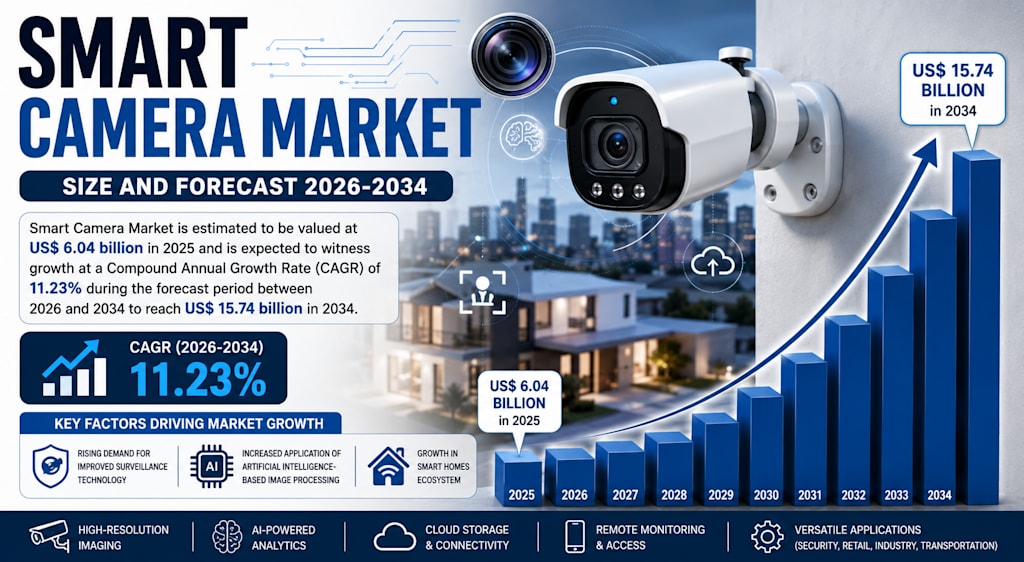
According to Renub Research, the Smart Camera Market is expected to grow from US$ 6.04 billion in 2025 to US$ 15.74 billion by 2034, registering a CAGR of 11.23% during 2026–2034. Rising demand for advanced surveillance systems, AI-powered image processing, and growing adoption of smart home technologies are expected to drive substantial market expansion.
Smart Cameras Are Redefining Visual Intelligence
Smart cameras represent a significant advancement beyond conventional imaging systems.
These devices combine high-quality image capture capabilities with onboard processing power, artificial intelligence algorithms, and network connectivity.
Rather than simply recording footage, smart cameras can analyze images in real time, recognize faces, identify objects, monitor behavior patterns, and trigger automated responses.
This intelligence enables faster decision-making and reduces dependence on centralized processing infrastructure.
By integrating AI directly into the device, organizations can improve operational efficiency while minimizing latency and bandwidth requirements.
As businesses increasingly prioritize real-time analytics and automation, smart cameras are becoming indispensable tools across multiple industries.
Rising Security Concerns Drive Market Growth
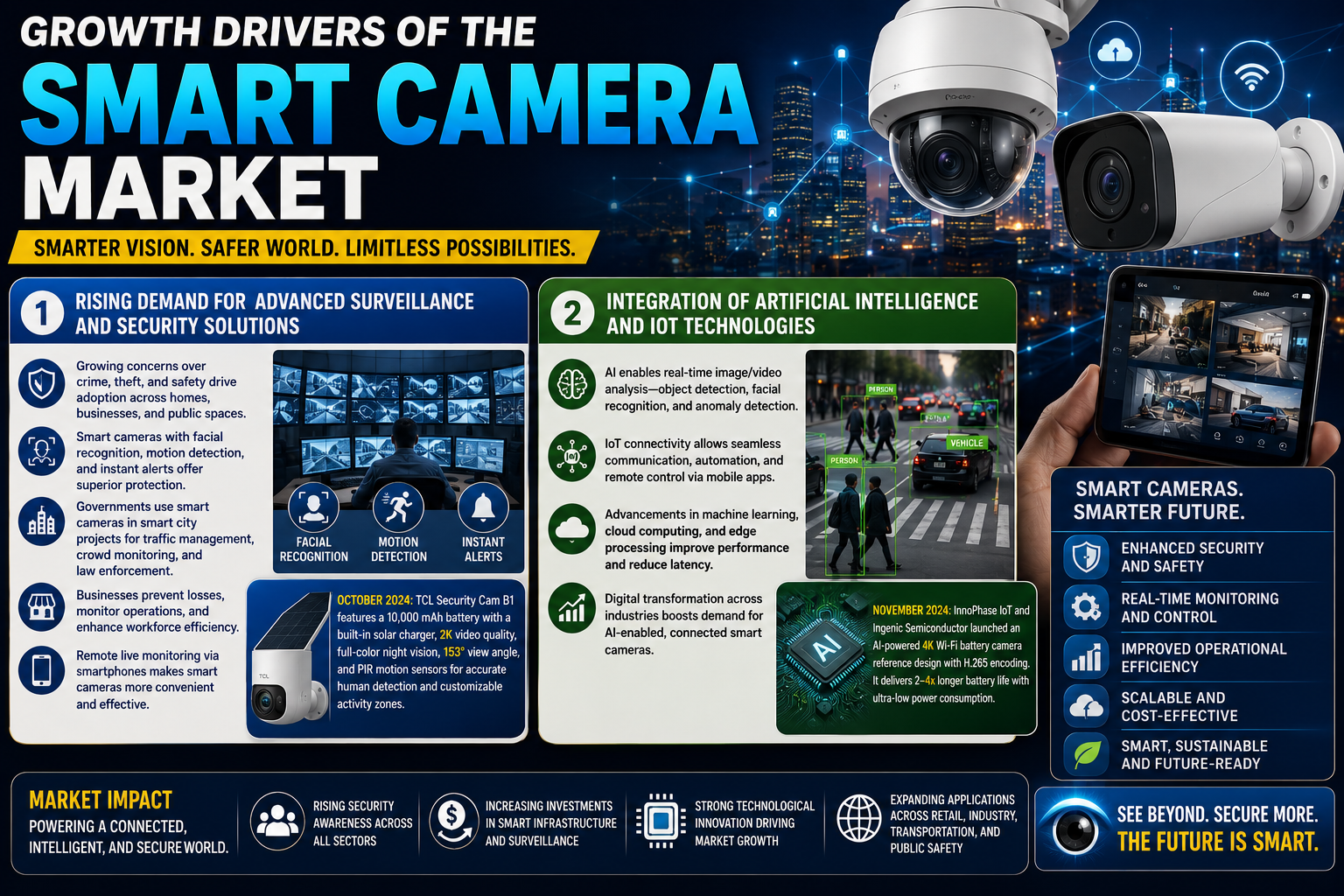
Growing concerns regarding crime, theft, vandalism, and public safety remain among the strongest drivers of the smart camera market.
Governments, enterprises, and homeowners are investing heavily in advanced surveillance technologies capable of providing more effective security than traditional systems.
Smart cameras equipped with facial recognition, motion detection, behavior analysis, and instant notification capabilities enable faster identification of threats and suspicious activities.
Public infrastructure projects increasingly incorporate intelligent surveillance systems to improve urban safety and emergency response capabilities.
Businesses also utilize smart cameras to reduce losses, monitor facilities, and enhance employee safety.
The increasing need for proactive security solutions continues driving adoption across both public and private sectors.
AI Integration Is Transforming Camera Capabilities
Artificial intelligence has become one of the most important technological advancements shaping the smart camera industry.
AI enables cameras to interpret visual information with unprecedented accuracy and speed.
Functions such as facial recognition, license plate identification, crowd monitoring, anomaly detection, and predictive analytics are now standard features in many advanced systems.
Machine learning algorithms continuously improve performance by learning from captured data and adapting to changing environments.
AI-powered cameras can distinguish between people, vehicles, animals, and objects, reducing false alarms and improving operational efficiency.
As AI technology becomes more sophisticated and affordable, its integration into smart cameras is expected to accelerate significantly.
Internet of Things Enhances Connectivity
The Internet of Things has further expanded the functionality of smart cameras by enabling seamless communication between connected devices.
Smart cameras can now integrate with alarms, door locks, lighting systems, sensors, smartphones, and cloud platforms.
This connectivity allows users to remotely monitor locations, receive alerts, and control devices from virtually anywhere.
Businesses benefit from centralized management systems that provide visibility across multiple facilities and locations.
IoT integration also supports automation, enabling cameras to trigger predefined actions when specific events occur.
The continued growth of connected ecosystems is expected to remain a major catalyst for market expansion.
Smart Homes Are Fueling Consumer Demand
The rapid expansion of smart home technology represents one of the most significant growth opportunities for the smart camera market.
Consumers increasingly seek solutions that enhance convenience, safety, and energy efficiency.
Smart cameras have become central components of modern home security systems, offering features such as remote monitoring, mobile alerts, voice control compatibility, and cloud storage.
Integration with smart doorbells, lighting systems, and home automation platforms creates comprehensive security ecosystems.
As broadband connectivity improves and smartphone usage continues rising, adoption of smart home cameras is expected to increase substantially.
Growing consumer awareness regarding residential security further supports market growth.
Edge Computing Improves Performance
Edge computing is revolutionizing how smart cameras process and analyze data.
Traditionally, captured footage was transmitted to centralized servers for analysis.
With edge computing, processing occurs directly within the camera, enabling real-time decision-making without requiring constant cloud connectivity.
This approach reduces latency, conserves bandwidth, enhances privacy, and improves reliability.
Edge AI cameras are particularly valuable in environments where rapid response is essential, such as industrial facilities, transportation systems, and security applications.
The growing adoption of edge computing technologies continues strengthening the value proposition of smart cameras.
Commercial Sector Leads Market Adoption
Commercial applications represent one of the largest segments within the smart camera market.
Retailers, office complexes, warehouses, shopping centers, financial institutions, and hospitality providers increasingly utilize intelligent cameras for security and operational optimization.
Retail businesses leverage smart cameras to analyze customer behavior, monitor store traffic, optimize layouts, and reduce theft.
Office environments use cameras to enhance workplace security and manage access control.
Cloud-based video analytics platforms provide organizations with valuable insights that support business decision-making.
As commercial enterprises continue investing in digital transformation, demand for intelligent surveillance solutions is expected to remain strong.
Retail Industry Embraces AI-Powered Analytics
Retailers are increasingly using smart cameras for purposes that extend beyond traditional security.
Advanced analytics capabilities enable stores to track customer movement patterns, evaluate product engagement, and measure conversion rates.
These insights help optimize merchandising strategies and improve customer experiences.
AI-powered cameras can also identify queue lengths, monitor inventory levels, and detect suspicious behavior.
Several multinational retailers introduced AI-enabled customer behavior tracking systems during 2024, highlighting the growing role of visual analytics within the retail sector.
As retailers seek competitive advantages through data-driven decision-making, smart camera adoption is expected to expand further.
Residential Camera Market Experiences Rapid Growth
The residential smart camera segment is experiencing remarkable expansion.
Consumers increasingly view home surveillance as an essential component of personal security.
Indoor cameras, outdoor cameras, smart doorbells, and connected monitoring systems have become mainstream products.
Features such as facial recognition, motion alerts, cloud recording, and smartphone integration enhance user convenience.
Manufacturers are also emphasizing privacy protections through data encryption, local storage options, and user-controlled access settings.
The growing popularity of home automation platforms continues creating opportunities within this segment.
Industrial Automation Creates New Opportunities
Industrial environments are increasingly adopting smart cameras to improve productivity, quality control, and workplace safety.
Manufacturers utilize machine vision systems for automated inspections, defect detection, assembly verification, and process monitoring.
AI-powered imaging systems help identify production issues in real time, reducing waste and improving operational efficiency.
Smart cameras also support predictive maintenance initiatives by monitoring equipment performance and detecting anomalies.
As Industry 4.0 adoption accelerates, intelligent visual systems are becoming critical components of industrial automation strategies.
Military and Defense Applications Continue Expanding
The military and defense sector remains a significant user of advanced smart camera technologies.
Defense organizations deploy intelligent imaging systems for surveillance, reconnaissance, border monitoring, threat detection, and situational awareness.
Modern military cameras often incorporate thermal imaging, night vision, artificial intelligence, and drone integration capabilities.
The ability to process and analyze visual data in real time provides valuable tactical advantages.
Growing geopolitical tensions and national security concerns continue driving investments in advanced surveillance technologies worldwide.
Memory Technology Supports Advanced Functionality
Memory components play a vital role in enabling smart camera performance.
High-resolution video recording, AI-powered analytics, and edge computing applications require substantial storage and processing capabilities.
Advanced memory technologies such as DRAM and solid-state storage support real-time data handling and local processing.
Recent developments in low-power memory solutions have improved performance while reducing energy consumption.
In 2024, semiconductor manufacturers introduced next-generation memory technologies specifically designed for edge AI camera applications.
These innovations are expected to support future market growth.
Image Sensors Remain a Core Technology
Image sensors represent one of the most critical components within smart cameras.
CMOS sensors have become the dominant technology due to their superior performance, low power consumption, and cost efficiency.
Advancements in sensor technology continue improving image quality, low-light performance, dynamic range, and processing speed.
The introduction of ultra-high-resolution sensors exceeding 200 megapixels demonstrates the rapid pace of innovation within the industry.
Improved image quality enhances the effectiveness of AI-powered analytics and expands application possibilities across multiple sectors.
CMOS Sensors Continue Dominating the Market
CMOS sensors have largely overtaken CCD technology in mainstream smart camera applications.
Their advantages include lower manufacturing costs, reduced power requirements, faster processing speeds, and easier integration with AI systems.
Applications ranging from surveillance and automotive safety to medical imaging and industrial automation increasingly rely on CMOS technology.
Continuous innovation is further strengthening CMOS performance capabilities.
As demand for intelligent imaging systems grows, CMOS sensors are expected to maintain their dominant position.
CCD Sensors Retain Importance in Specialized Applications
Despite the rise of CMOS technology, CCD sensors continue serving niche markets where image precision and sensitivity remain critical.
Medical imaging, scientific research, aerospace applications, and specialized surveillance systems still benefit from CCD technology.
Recent advancements have improved noise reduction and image quality, helping maintain relevance within high-performance applications.
Although market share has declined, CCD sensors continue playing an important role in specialized use cases.
United States Leads Global Market Development
The United States remains one of the largest smart camera markets globally.
Strong adoption of smart home technologies, advanced surveillance systems, industrial automation, and AI-driven solutions continues driving growth.
The presence of major technology companies and significant investment in research and development supports ongoing innovation.
Recent product launches from companies such as Canon further demonstrate the country's leadership in imaging technologies.
The U.S. is expected to remain a key market throughout the forecast period.
India Emerges as a High-Growth Market
India is becoming one of the fastest-growing smart camera markets worldwide.
Rapid urbanization, increasing security concerns, smart city initiatives, and expanding internet connectivity are fueling demand.
Government infrastructure projects and growing adoption of AI-powered surveillance systems are creating significant opportunities.
Affordable pricing and increased smartphone penetration are further supporting consumer adoption.
The country's strong digital transformation agenda positions India as a major growth engine for the global market.
Privacy and Cybersecurity Remain Key Challenges
Despite strong growth prospects, privacy concerns remain one of the industry's most significant challenges.
Smart cameras collect substantial amounts of visual data, raising questions regarding surveillance practices, consent, and personal privacy.
Organizations must comply with evolving data protection regulations and implement robust cybersecurity measures.
Consumers increasingly expect transparency regarding how their data is collected, stored, and used.
Failure to address privacy concerns could hinder adoption and damage public trust.
High Costs Limit Adoption in Some Markets
Advanced smart cameras often involve substantial upfront investment.
Systems equipped with AI capabilities, high-resolution imaging, cloud services, and edge processing technologies can be expensive.
Additional costs related to installation, maintenance, software subscriptions, and system integration may further increase total ownership expenses.
These factors can present barriers for small businesses and cost-sensitive consumers.
However, growing competition and technological advancements are gradually reducing costs across the industry.
Final Thoughts
The smart camera market is entering a period of extraordinary growth driven by artificial intelligence, IoT connectivity, edge computing, and increasing security requirements.
From smart homes and retail environments to industrial facilities and defense operations, intelligent cameras are transforming how visual data is captured, analyzed, and utilized.
Although challenges related to privacy, cybersecurity, and affordability remain important considerations, continuous technological innovation continues expanding the capabilities and accessibility of smart camera solutions.
With the market projected to grow from US$ 6.04 billion in 2025 to US$ 15.74 billion by 2034, smart cameras are expected to become one of the most influential technologies supporting the future of digital transformation, automation, and intelligent security systems worldwide.
About the Creator
Enjoyed the story? Support the Creator.
Subscribe for free to receive all their stories in your feed.
Comments
There are no comments for this story
Be the first to respond and start the conversation.