
Will the Global Smart Hospitals Market Reach US$ 187.55 Billion by 2034 as AI and Digital Healthcare Revolutionize Patient Care?
Rapid adoption of artificial intelligence, IoT-enabled medical devices, telemedicine, and healthcare automation is transforming hospitals into intelligent healthcare ecosystems worldwide.

Healthcare systems around the world are undergoing a fundamental transformation driven by digital technologies, automation, and data-driven decision-making. As hospitals strive to improve patient outcomes, reduce operational costs, and address growing healthcare demands, the concept of the smart hospital has emerged as one of the most significant innovations in modern medicine.
Smart hospitals leverage advanced technologies such as artificial intelligence (AI), the Internet of Things (IoT), robotics, cloud computing, big data analytics, and telemedicine to create interconnected healthcare environments capable of delivering faster, safer, and more personalized patient care.
These next-generation healthcare facilities not only improve clinical efficiency but also enhance patient experiences through intelligent monitoring, predictive diagnostics, automated workflows, and real-time data accessibility.
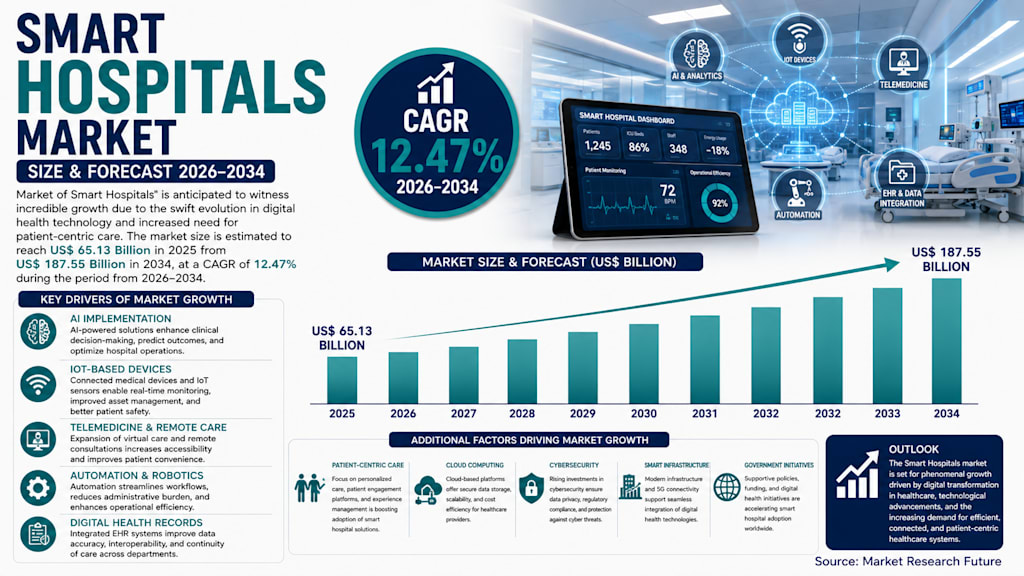
According to Renub Research, the Global Smart Hospitals Market is projected to grow from US$ 65.13 billion in 2025 to US$ 187.55 billion by 2034, registering a remarkable CAGR of 12.47% during 2026–2034. The increasing adoption of AI, digital health technologies, telemedicine platforms, and connected medical devices continues to fuel market growth globally.
Smart Hospitals Are Redefining Healthcare Delivery
Smart hospitals integrate advanced digital technologies across clinical, operational, and administrative functions.
Unlike traditional healthcare facilities, smart hospitals rely on connected ecosystems where medical equipment, patient records, healthcare professionals, and hospital infrastructure communicate seamlessly.
Technologies such as AI-powered diagnostics, IoT sensors, electronic health records (EHRs), predictive analytics, cloud-based data management systems, and robotic automation enable hospitals to deliver more efficient and patient-centric care.
Smart hospitals also incorporate intelligent building management systems that improve energy efficiency, optimize resource utilization, and enhance safety for patients and staff.
As healthcare systems increasingly focus on quality outcomes and operational excellence, smart hospitals are becoming the future of healthcare delivery.
Rapid Adoption of Digital Health Technologies Drives Growth
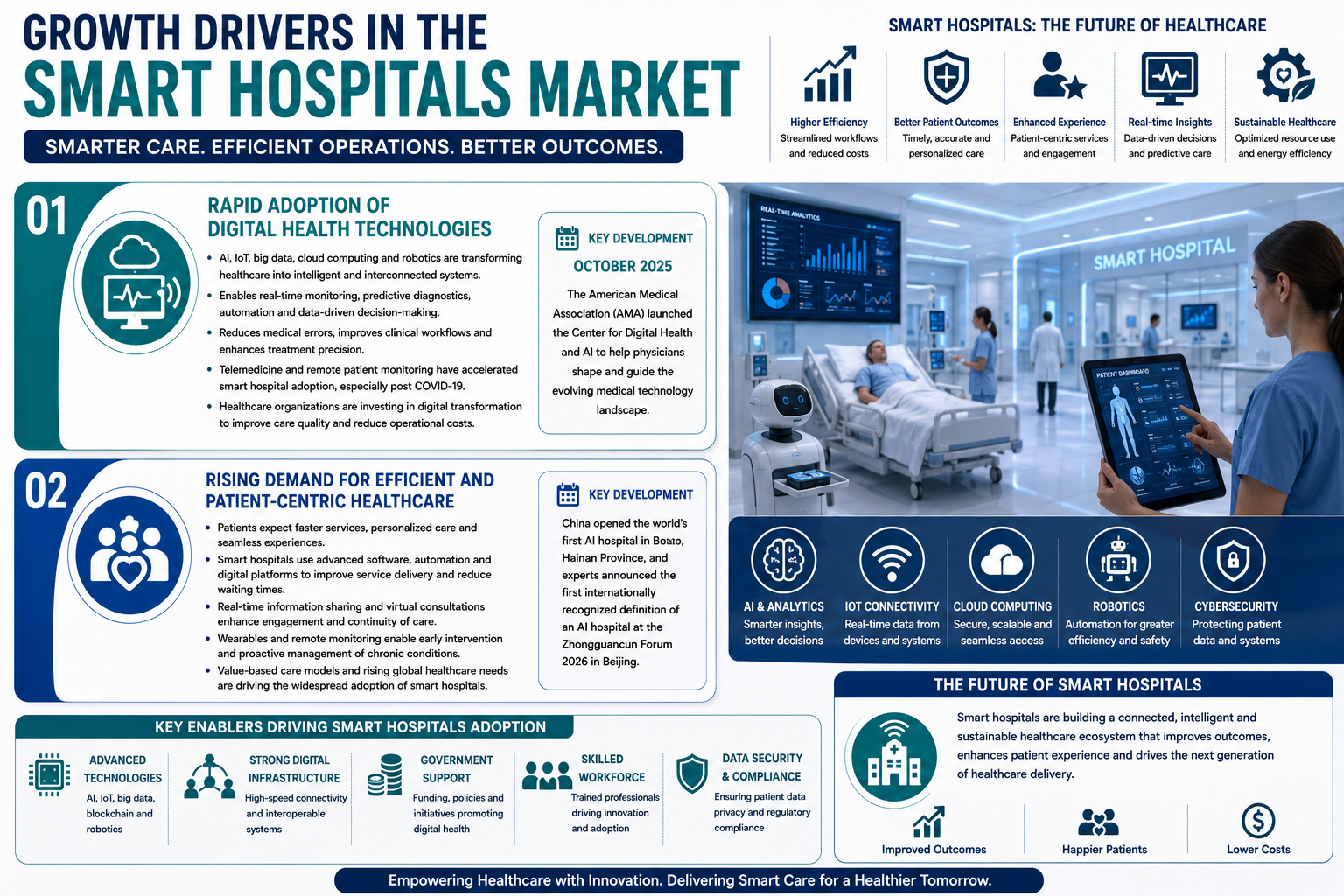
One of the most important factors accelerating the smart hospitals market is the widespread adoption of digital health technologies.
Healthcare providers worldwide are investing heavily in artificial intelligence, IoT, cloud computing, robotics, machine learning, and big data analytics to improve clinical decision-making and operational efficiency.
These technologies allow hospitals to collect, analyze, and utilize healthcare data in real time.
Digital health solutions support predictive diagnostics, automated workflows, intelligent patient monitoring, and personalized treatment planning.
The COVID-19 pandemic further accelerated digital transformation by highlighting the importance of remote healthcare services, telemedicine, and virtual patient engagement.
In October 2025, the American Medical Association launched its Center for Digital Health and AI to help physicians guide the development and implementation of emerging healthcare technologies.
As healthcare organizations continue modernizing operations, digital technologies will remain central to market expansion.
Artificial Intelligence Is Transforming Clinical Decision-Making
Artificial intelligence has become one of the most influential technologies within smart hospitals.
AI systems can process massive volumes of healthcare data, identify patterns, assist with diagnoses, and support clinical decision-making.
Applications include medical imaging analysis, disease prediction, treatment recommendations, patient triage, and personalized medicine.
Machine learning algorithms help physicians detect abnormalities earlier and improve diagnostic accuracy.
Natural Language Processing (NLP) technologies streamline documentation processes and reduce administrative burdens on healthcare professionals.
AI-powered virtual assistants and chatbots are also enhancing patient engagement and communication.
As AI capabilities continue evolving, hospitals are increasingly integrating intelligent solutions throughout their operations.
Rising Demand for Patient-Centric Healthcare Accelerates Adoption
Modern patients increasingly expect healthcare services that are personalized, convenient, efficient, and digitally accessible.
Smart hospitals are uniquely positioned to meet these expectations through integrated patient management systems, automated scheduling platforms, remote consultation services, and real-time communication tools.
Patients can access health information, schedule appointments, communicate with healthcare providers, and receive treatment updates through digital platforms.
Remote monitoring solutions allow physicians to track patient health continuously and intervene proactively when necessary.
This patient-centered approach improves satisfaction while enhancing clinical outcomes.
As healthcare systems transition toward value-based care models, smart hospitals are becoming increasingly attractive to providers and policymakers.
Growing Chronic Disease Burden Creates Demand
The rising prevalence of chronic diseases is another major factor driving smart hospital adoption.
Conditions such as diabetes, cardiovascular disease, cancer, respiratory disorders, and neurological illnesses require ongoing monitoring and coordinated care.
Smart hospital technologies enable healthcare providers to manage chronic diseases more effectively through real-time monitoring, predictive analytics, and integrated patient records.
Wearable devices and connected monitoring systems provide continuous data that supports early intervention and personalized treatment plans.
The growing elderly population further increases demand for advanced healthcare solutions capable of managing complex medical needs.
As chronic disease rates continue rising globally, smart hospitals will play an increasingly important role in healthcare delivery.
Government Initiatives and Healthcare Investments Support Expansion
Governments worldwide are actively supporting healthcare digitalization initiatives.
Public investments, favorable regulatory frameworks, and strategic healthcare modernization programs are accelerating adoption of smart hospital technologies.
Many countries are prioritizing electronic health records, telemedicine services, healthcare interoperability, and digital infrastructure development.
Emerging economies are also investing heavily in advanced healthcare facilities to improve accessibility and quality of care.
In February 2026, the Canadian government introduced the Connected Care for Canadians Act through Bill S-5, aimed at improving interoperability and empowering patients through enhanced digital healthcare connectivity.
Such initiatives continue creating favorable conditions for market growth.
Smart Hospital Hardware Forms the Foundation
Hardware remains a critical component of smart hospital infrastructure.
Connected medical devices, smart beds, wearable sensors, patient monitoring systems, RFID technology, imaging equipment, and automated dispensing systems all contribute to intelligent healthcare operations.
Smart beds equipped with pressure sensors help prevent falls and pressure ulcers while continuously monitoring patient conditions.
Wearable devices enable real-time tracking of vital signs and support remote patient management.
Advanced imaging systems improve diagnostic precision while robotic technologies enhance surgical outcomes.
As hospitals expand digital capabilities, demand for intelligent healthcare hardware continues to rise.
Wireless Connectivity Enables Seamless Healthcare Operations
Wireless technologies play a vital role in enabling smart hospital functionality.
Wi-Fi, Bluetooth, Zigbee, RFID, NFC, and increasingly 5G networks facilitate communication among connected devices, healthcare professionals, and patients.
Reliable wireless connectivity supports telemedicine, mobile health applications, remote monitoring systems, and real-time information sharing.
The deployment of 5G infrastructure is particularly important due to its ability to provide ultra-fast data transmission, low latency, and improved reliability.
These capabilities support advanced applications such as robotic surgery, augmented reality-assisted procedures, and real-time diagnostics.
As healthcare becomes increasingly connected, wireless technologies will remain essential to smart hospital ecosystems.
Outpatient Vigilance Improves Long-Term Patient Outcomes
Outpatient vigilance has emerged as one of the most important applications within smart hospitals.
Remote patient monitoring technologies enable healthcare providers to continue monitoring patients after discharge.
Wearable devices, mobile health applications, and cloud-based monitoring platforms allow clinicians to track vital signs, medication adherence, and health conditions remotely.
This capability is especially valuable for managing chronic illnesses, post-surgical recovery, and elderly patients.
Early identification of complications reduces hospital readmissions while improving overall patient outcomes.
As healthcare increasingly shifts toward home-based care models, outpatient vigilance technologies are expected to experience strong growth.
Medical Assistance Technologies Enhance Clinical Efficiency
Medical assistance technologies are helping healthcare professionals deliver more accurate and efficient care.
These solutions include robotic surgical systems, AI-powered diagnostic tools, virtual nursing assistants, automated medication management systems, and clinical decision support platforms.
Advanced technologies reduce human error, improve treatment precision, and streamline hospital workflows.
Voice-controlled systems, augmented reality applications, and digital assistants also support physicians during procedures and clinical evaluations.
Automation helps alleviate staffing pressures while enabling healthcare professionals to focus on patient care.
The continued development of medical assistance technologies is expected to strengthen smart hospital adoption globally.
High Implementation Costs Remain a Challenge
Despite strong growth potential, implementation costs remain a significant obstacle for many healthcare organizations.
Building a smart hospital requires substantial investment in hardware, software, networking infrastructure, cybersecurity systems, and staff training.
Small and medium-sized healthcare facilities often face budget constraints that limit their ability to adopt advanced technologies.
Legacy infrastructure may also require extensive upgrades before smart solutions can be effectively implemented.
These financial barriers can slow adoption, particularly in developing regions.
Reducing deployment costs and improving affordability will be important for expanding market penetration.
Cybersecurity and Interoperability Concerns Persist
As healthcare becomes increasingly digitized, concerns regarding cybersecurity and data privacy continue to grow.
Smart hospitals generate and process vast amounts of sensitive patient information, making them attractive targets for cybercriminals.
Healthcare organizations must invest heavily in data protection, encryption, access controls, and cybersecurity frameworks.
Interoperability challenges also remain significant because many healthcare systems utilize different technologies and platforms.
Difficulties in data exchange can create inefficiencies and hinder collaboration among healthcare providers.
Addressing these issues will be critical for maximizing the benefits of smart hospital ecosystems.
United States Leads Global Adoption
The United States remains the largest and most technologically advanced smart hospital market globally.
High healthcare spending, strong digital infrastructure, extensive research activity, and widespread adoption of advanced technologies continue driving growth.
American hospitals are investing heavily in AI, robotics, predictive analytics, telemedicine, and cloud-based healthcare solutions.
In March 2026, Stryker introduced its SmartHospital Platform, an integrated digital ecosystem designed to connect devices, data, and healthcare personnel within hospital environments.
The country's focus on precision medicine and value-based care ensures continued leadership in smart healthcare innovation.
India and Saudi Arabia Emerge as High-Growth Markets
India is experiencing rapid smart hospital adoption due to initiatives such as Digital India and Ayushman Bharat.
Growing healthcare investments, expanding digital infrastructure, and rising demand for quality healthcare services are supporting market growth.
Meanwhile, Saudi Arabia is transforming its healthcare sector through Vision 2030 initiatives.
Investments in AI, telemedicine, smart medical devices, and digital health infrastructure are accelerating adoption across the Kingdom.
In June 2025, Saudi Arabia launched the world's first AI-doctor clinic in Al Ahsa through a partnership between Synyi AI and Almoosa Health Group.
These emerging markets are expected to become important contributors to future industry growth.
Final Thoughts
The global smart hospitals market is entering a transformative era driven by digital innovation, artificial intelligence, connected healthcare devices, and growing demand for patient-centered care.
As healthcare systems seek to improve efficiency, reduce costs, and enhance patient outcomes, smart hospitals are becoming a strategic priority worldwide.
While challenges related to implementation costs, cybersecurity, and interoperability remain, continued technological advancements and supportive government initiatives are creating strong growth opportunities.
With the market projected to expand from US$ 65.13 billion in 2025 to US$ 187.55 billion by 2034, smart hospitals are poised to redefine healthcare delivery and establish a new standard for intelligent, connected, and efficient medical care.
About the Creator
Enjoyed the story? Support the Creator.
Subscribe for free to receive all their stories in your feed.
Comments
There are no comments for this story
Be the first to respond and start the conversation.