
Will South Africa’s Fertilizer Market Accelerate Through 2033 as Sustainable Agriculture and Precision Farming Transform Crop Production?
Rising food security concerns, technological innovation, bio-fertilizer adoption, and government support for sustainable agriculture are reshaping South Africa’s fertilizer industry.

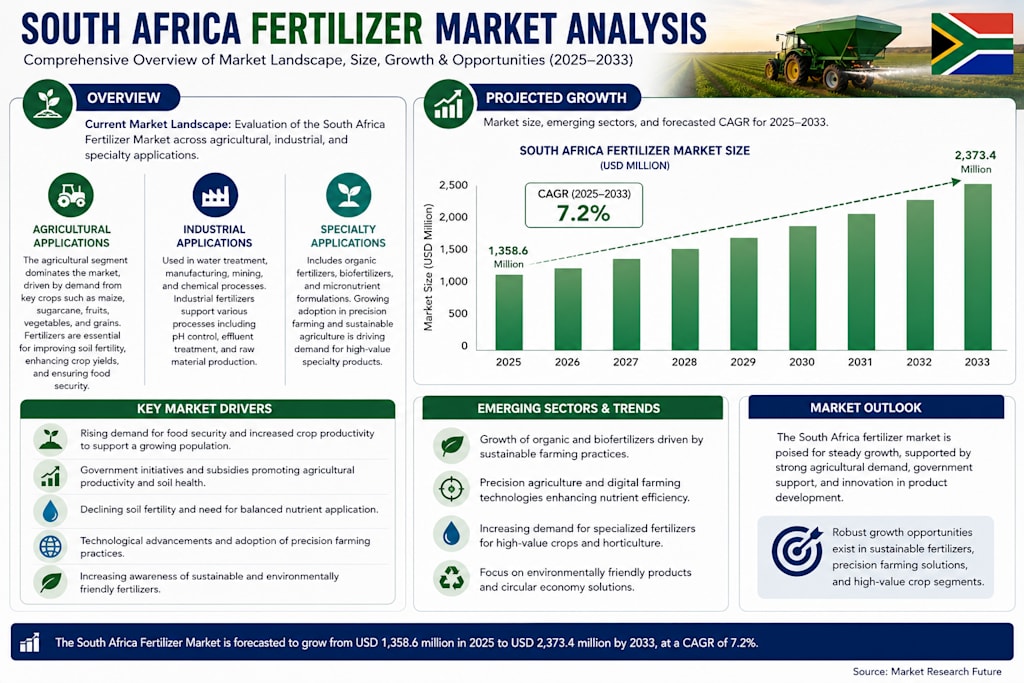
Agriculture remains one of the most important pillars of South Africa’s economy, contributing significantly to food security, employment, exports, and rural development. As the country faces growing pressure to increase agricultural productivity while preserving natural resources, fertilizers continue to play a crucial role in improving crop yields and maintaining soil fertility.
The South African fertilizer market is evolving rapidly as farmers adopt advanced crop nutrition solutions to address challenges such as declining soil quality, climate variability, and increasing food demand. Modern fertilizer technologies are helping producers maximize yields while improving nutrient efficiency and environmental sustainability.
In recent years, innovations such as bio-fertilizers, slow-release fertilizers, customized nutrient blends, precision agriculture systems, and digital farming technologies have transformed traditional fertilizer applications. These developments are creating new opportunities for manufacturers, distributors, and agricultural producers throughout the country.
As agricultural modernization accelerates and sustainability becomes a strategic priority, the South African fertilizer market is expected to witness strong growth across multiple segments during the forecast period.

Growing Food Security Concerns Drive Fertilizer Demand
Food security remains one of the strongest drivers of fertilizer consumption in South Africa.
The country’s population continues to grow, increasing pressure on agricultural producers to deliver higher crop yields from limited arable land. Farmers are under constant pressure to improve productivity while managing environmental challenges such as droughts, soil degradation, and changing weather patterns.
Fertilizers provide essential nutrients that support healthy plant growth and improve agricultural output. Nitrogen, phosphorus, and potassium remain the primary nutrients required to sustain crop productivity and maintain soil fertility.
As demand for staple crops such as maize, wheat, soybeans, and other agricultural products increases, fertilizer usage is expected to rise steadily across South Africa’s farming sector.
The need to enhance agricultural efficiency and ensure long-term food security will continue supporting market expansion throughout the forecast period.
Technological Innovation Is Transforming Crop Nutrition
Technology is reshaping the fertilizer industry worldwide, and South Africa is no exception.
Advanced fertilizer products are being developed to improve nutrient absorption, reduce waste, and minimize environmental impacts. Precision agriculture technologies enable farmers to apply fertilizers more accurately based on soil conditions, crop requirements, and real-time field data.
Modern farming practices increasingly utilize GPS-guided equipment, drones, remote sensing technologies, soil analysis tools, and digital farm management platforms.
These technologies allow farmers to optimize fertilizer application rates, improve nutrient efficiency, and reduce unnecessary input costs.
Nanotechnology-based fertilizers are also gaining attention due to their ability to deliver nutrients more effectively while minimizing environmental losses.
As farmers continue embracing data-driven agricultural practices, demand for technologically advanced fertilizer products is expected to increase significantly.
Sustainable Agriculture Creates New Opportunities
Environmental sustainability has become a major focus within South Africa’s agricultural sector.
Growing concerns regarding soil health, water conservation, greenhouse gas emissions, and environmental degradation are encouraging the adoption of more sustainable farming practices.
Bio-fertilizers and organic nutrient solutions are emerging as attractive alternatives to conventional chemical fertilizers.
These products utilize beneficial microorganisms and natural materials to improve nutrient availability, enhance soil fertility, and support long-term agricultural sustainability.
Consumers are also showing greater interest in sustainably produced agricultural products, encouraging farmers to adopt environmentally responsible cultivation methods.
As sustainability becomes a key consideration throughout agricultural value chains, bio-fertilizers and eco-friendly nutrient solutions are expected to experience strong growth.
Nitrogen Fertilizers Continue to Dominate the Market
Nitrogen-based fertilizers remain the largest segment within the South African fertilizer market.
Products such as urea, ammonium nitrate, and ammonium sulfate are widely used because nitrogen is essential for plant growth and crop productivity.
Nitrogen fertilizers support leaf development, photosynthesis, and overall crop vigor, making them particularly important for grain production.
South Africa’s maize industry, which represents one of the country’s most important agricultural sectors, relies heavily on nitrogen fertilizers to achieve high yields.
As demand for cereals and food crops continues increasing, nitrogen fertilizers are expected to maintain their dominant position within the market.
Manufacturers continue developing more efficient nitrogen formulations that reduce nutrient losses and improve environmental performance.
Phosphorus Fertilizers Support Root Development
Phosphorus-based fertilizers play a critical role in supporting plant root systems, flowering, and seed development.
Products such as monoammonium phosphate (MAP), diammonium phosphate (DAP), and superphosphates are commonly used across South Africa’s agricultural sector.
Phosphorus is particularly important during early crop development stages when strong root systems are essential for healthy plant growth.
Many South African soils require phosphorus supplementation to maintain optimal productivity levels.
As farmers increasingly focus on maximizing crop yields and improving nutrient management, demand for phosphorus fertilizers is expected to remain strong.
Innovations in phosphorus efficiency technologies are also helping improve nutrient utilization while reducing environmental impacts.
Potassium Fertilizers Enhance Crop Quality
Potassium-based fertilizers represent another important segment within the fertilizer market.
Potassium contributes to plant health by improving disease resistance, water management, drought tolerance, and overall crop quality.
Products such as muriate of potash and sulfate of potash are widely used across various crop categories including fruits, vegetables, and specialty crops.
South Africa’s horticultural sector, which includes significant fruit export industries, relies heavily on potassium fertilizers to improve crop quality and marketability.
As demand for high-value crops continues increasing, potassium fertilizer consumption is expected to grow steadily.
Bio-Fertilizers Are Emerging as a High-Growth Segment
Bio-fertilizers are becoming increasingly important within South Africa’s fertilizer industry.
These products contain beneficial microorganisms that enhance nutrient availability and support soil health naturally.
Unlike conventional fertilizers, bio-fertilizers improve long-term soil productivity while reducing dependence on synthetic chemicals.
Farmers are increasingly adopting microbial inoculants, organic nutrient solutions, and biological soil enhancers as part of integrated crop management strategies.
Government initiatives promoting sustainable agriculture and environmental stewardship are further supporting bio-fertilizer adoption.
As awareness regarding soil health and sustainability continues growing, bio-fertilizers are expected to become one of the fastest-growing segments in the market.
Crop Production Represents the Largest Application Segment
Crop production remains the primary application area for fertilizers in South Africa.
Major crops including maize, wheat, soybeans, sunflower, sugarcane, and various grains require consistent nutrient management to achieve optimal yields.
Commercial farming operations depend heavily on fertilizers to maintain productivity and profitability.
Increasing demand for agricultural commodities both domestically and internationally continues supporting fertilizer consumption across crop production activities.
Advancements in customized fertilizer formulations are helping farmers address crop-specific nutrient requirements more effectively.
As agricultural intensification continues, crop production will remain the largest consumer of fertilizer products.
Horticulture Sector Creates Significant Growth Opportunities
South Africa’s horticulture industry is becoming an increasingly important contributor to fertilizer demand.
The country is a major exporter of fruits, vegetables, flowers, and specialty agricultural products.
High-value horticultural crops require precise nutrient management to ensure quality, appearance, and productivity.
Fertilizers play a vital role in supporting fruit size, color development, shelf life, and overall crop performance.
Growing export opportunities and increasing demand for fresh produce are expected to strengthen fertilizer consumption within the horticulture sector.
Precision nutrition solutions tailored to horticultural applications are gaining popularity among commercial growers.
Industrial and Specialty Applications Expand Market Potential
Beyond traditional agriculture, fertilizers are increasingly used in industrial and specialty applications.
Biofuel crop cultivation represents a growing area of fertilizer demand as renewable energy initiatives expand globally.
Specialty applications including golf courses, sports fields, landscaping projects, parks, and lawn care services also contribute to fertilizer consumption.
Urban development and commercial landscaping activities create additional opportunities for manufacturers specializing in specialty fertilizer products.
These niche segments provide attractive growth opportunities beyond conventional agricultural markets.
Precision Farming Drives Market Evolution
Precision agriculture is transforming fertilizer application practices throughout South Africa.
Farmers are increasingly utilizing advanced technologies to monitor soil conditions, assess crop health, and optimize nutrient management strategies.
Precision farming allows fertilizers to be applied only where and when they are needed, reducing waste and improving efficiency.
Benefits include lower input costs, improved yields, enhanced sustainability, and reduced environmental impact.
The growing adoption of smart farming technologies is expected to accelerate demand for specialized fertilizer products designed for precision agriculture systems.
Rising Fertilizer Costs Challenge Market Growth
Despite positive market prospects, rising fertilizer costs remain a major challenge.
Global fluctuations in raw material prices significantly affect fertilizer production expenses.
Inputs such as ammonia, phosphate rock, natural gas, and potash are subject to international market volatility.
Transportation costs, exchange rate fluctuations, and supply chain disruptions further influence fertilizer pricing.
Higher prices can place financial pressure on farmers, particularly small-scale producers with limited resources.
Addressing affordability concerns will be critical for maintaining fertilizer adoption rates.
Environmental Regulations Influence Industry Development
Environmental regulations are becoming increasingly important within the fertilizer sector.
Governments and regulatory agencies are implementing stricter standards regarding fertilizer production, emissions, nutrient runoff, and environmental protection.
Manufacturers must invest in cleaner production technologies and sustainable product development to remain compliant.
While these regulations support environmental objectives, they may also increase operational costs.
Balancing agricultural productivity with environmental sustainability will remain a key challenge for industry stakeholders.
Import and Export Activities Shape Market Dynamics
South Africa remains highly connected to global fertilizer supply chains.
The country imports significant quantities of fertilizer raw materials and finished products to support domestic agricultural demand.
International trade policies, logistics infrastructure, currency fluctuations, and geopolitical developments all influence market conditions.
Import dependence exposes the market to global pricing trends and supply disruptions.
At the same time, opportunities exist for local manufacturers to strengthen domestic production capabilities and reduce reliance on imports.
Competitive Landscape Continues to Evolve
The South African fertilizer market is characterized by strong competition among domestic and international suppliers.
Companies compete through product innovation, pricing strategies, distribution networks, sustainability initiatives, and customer support services.
Manufacturers are increasingly investing in research and development to create advanced fertilizer formulations that improve efficiency and environmental performance.
Strategic partnerships, acquisitions, and expansion initiatives continue shaping the competitive landscape.
Businesses that successfully combine innovation, sustainability, and affordability are expected to gain competitive advantages.
Strategic Opportunities for Market Participants
Several opportunities are expected to drive future growth within South Africa’s fertilizer industry.
Investment in bio-fertilizer research and development represents one of the most promising areas.
Expanding distribution networks into underserved agricultural regions can help increase market penetration.
Digital agriculture platforms offer opportunities to improve farmer education and promote efficient fertilizer use.
Customized fertilizer blends tailored to specific crops and soil conditions are also expected to gain popularity.
Companies that align their strategies with sustainability goals and precision agriculture trends are likely to benefit most from future market expansion.
Final Thoughts
The South Africa fertilizer market is undergoing a significant transformation as technological innovation, sustainability initiatives, and growing food security concerns reshape agricultural practices.
Demand for nitrogen, phosphorus, potassium, and bio-fertilizers continues to grow as farmers seek to maximize productivity while protecting environmental resources.
Although challenges such as raw material price volatility, environmental regulations, and rising production costs remain, the long-term outlook for the market remains highly positive.
As precision agriculture, sustainable farming practices, and advanced crop nutrition technologies become more widely adopted, South Africa’s fertilizer industry is expected to play a critical role in supporting agricultural growth, food security, and economic development throughout the coming decade.
About the Creator
Enjoyed the story? Support the Creator.
Subscribe for free to receive all their stories in your feed.
Comments
There are no comments for this story
Be the first to respond and start the conversation.