
Will Mexico’s Compound Feed Market Reach US$ 11.1 Billion by 2034 as Livestock Modernization and Sustainable Farming Drive Growth?
Rising demand for animal protein, expansion of commercial livestock operations, adoption of precision nutrition, and growing focus on sustainability are accelerating the growth of Mexico’s compound feed industry.

Mexico’s agricultural sector is undergoing a significant transformation as producers strive to improve efficiency, productivity, and sustainability in livestock farming. At the center of this evolution is the compound feed industry, a critical component of modern animal agriculture that supports the production of poultry, pork, beef, dairy, and aquaculture products consumed both domestically and internationally.
As consumer demand for high-quality animal protein continues to rise, livestock producers are increasingly adopting scientifically formulated feed solutions designed to optimize growth, improve animal health, and enhance feed conversion efficiency. Modern compound feed formulations provide balanced nutrition while helping producers meet increasingly stringent quality and sustainability requirements.
The growing industrialization of livestock production, rising export opportunities, and increasing adoption of advanced nutritional technologies are creating substantial opportunities across Mexico’s compound feed sector. At the same time, environmental considerations and sustainability goals are encouraging the use of innovative ingredients and precision feeding strategies that reduce waste and improve resource efficiency.
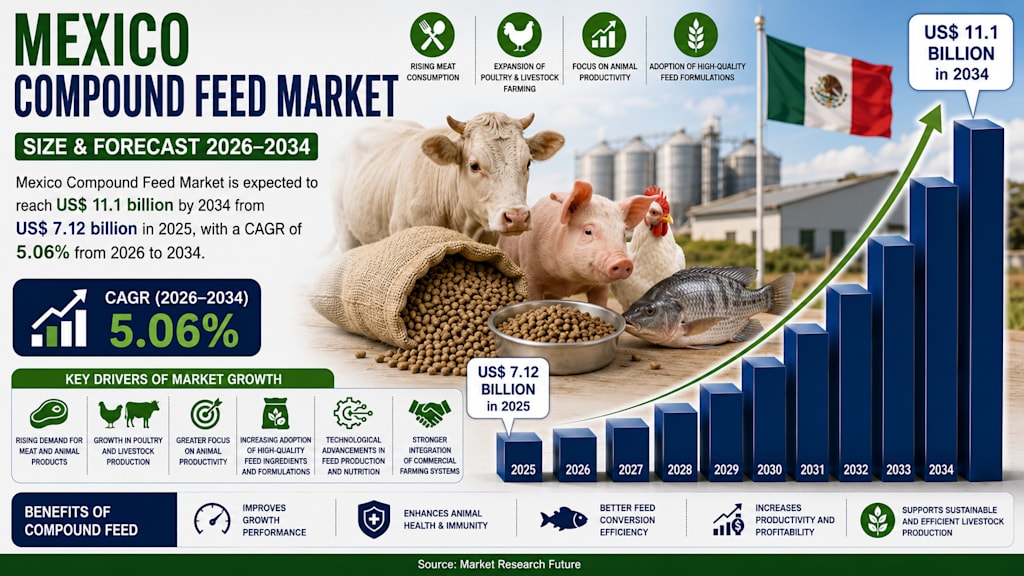
According to Renub Research, the Mexico Compound Feed Market is projected to grow from US$ 7.12 billion in 2025 to US$ 11.1 billion by 2034, registering a CAGR of 5.06% during 2026–2034. Expanding livestock production, increasing meat consumption, technological advancements in animal nutrition, and stronger integration within commercial farming systems are expected to drive long-term market growth.
Compound Feed Has Become Essential for Modern Livestock Production
Compound feed is a carefully formulated mixture of ingredients designed to meet the nutritional requirements of livestock, poultry, and aquaculture species.
Typically composed of cereals, oilseed meals, proteins, vitamins, minerals, and functional additives, compound feed provides animals with balanced nutrition necessary for healthy growth, productivity, and disease resistance.
Unlike traditional feeding methods, compound feed ensures consistency in nutrient delivery, helping producers achieve better feed conversion ratios and improved animal performance.
Modern intensive farming systems rely heavily on scientifically formulated feed to maximize productivity while maintaining animal health and welfare standards.
As Mexico continues modernizing its agricultural sector, compound feed remains a cornerstone of efficient and sustainable animal production.
Rising Demand for Animal Protein Supports Market Expansion
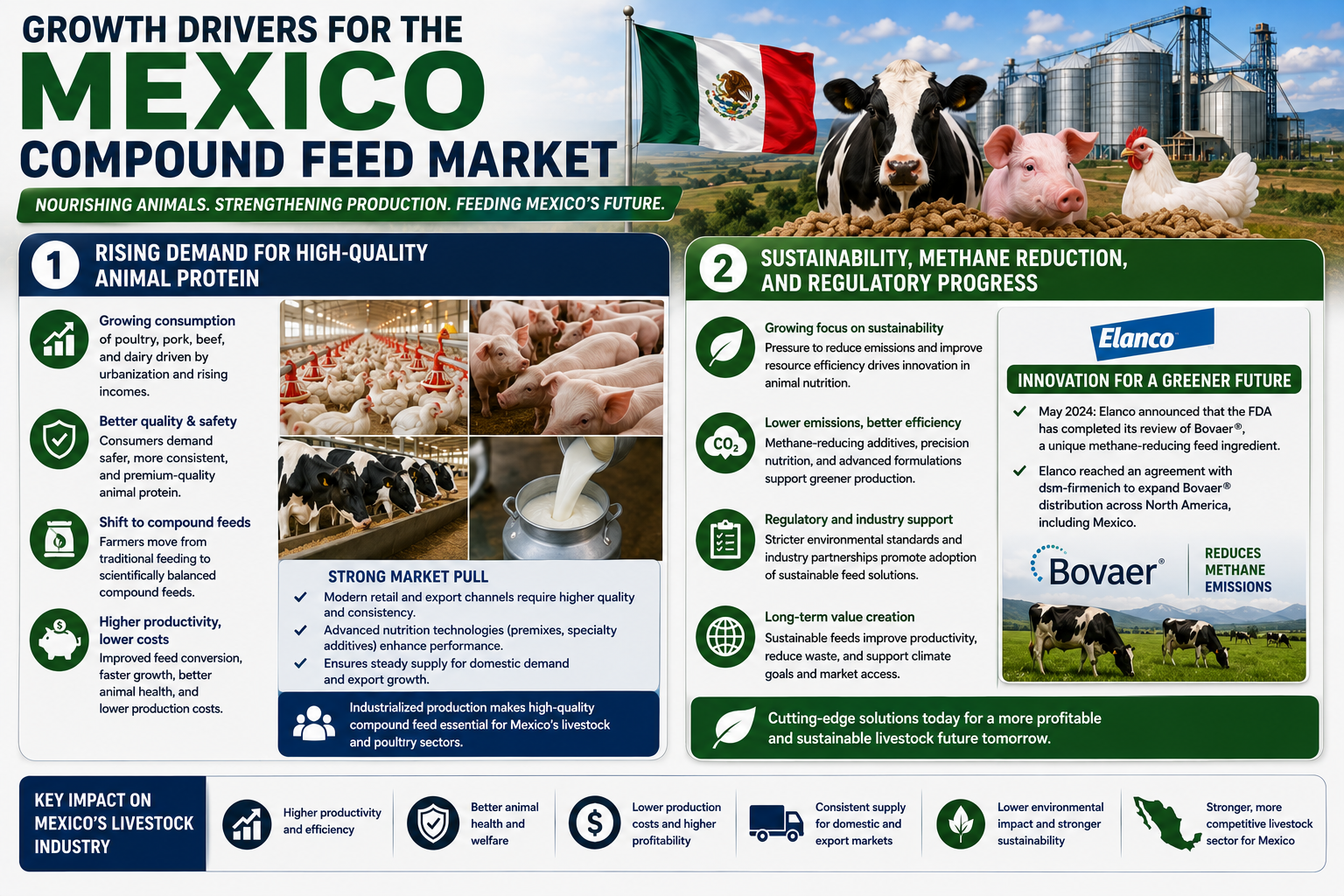
One of the strongest drivers of Mexico’s compound feed market is the increasing consumption of animal protein.
Growing urbanization, population growth, and rising middle-class incomes have significantly increased demand for poultry, pork, beef, dairy products, and eggs.
Consumers are increasingly seeking safe, nutritious, and high-quality protein sources, encouraging producers to improve production efficiency and product consistency.
To meet these expectations, livestock farmers are moving away from traditional feeding practices and embracing fully formulated compound feed solutions that optimize growth rates and animal health.
The expansion of modern retail channels and export markets has further strengthened the need for standardized, high-quality production systems.
As protein consumption continues rising, demand for advanced feed formulations is expected to grow steadily.
Commercial Livestock Farming Is Transforming Feed Demand
Mexico’s livestock sector has become increasingly commercialized over the past decade.
Large-scale poultry, swine, cattle, and dairy operations now account for a growing share of national production.
These intensive farming systems require precise nutritional management to maintain profitability and productivity.
Compound feed enables producers to deliver consistent nutrition while reducing feed waste and improving operational efficiency.
Modern farms increasingly utilize specialized formulations tailored to different growth stages, production goals, and animal species.
As commercial farming expands throughout Mexico, the role of compound feed is becoming more critical than ever.
Poultry Sector Remains the Largest Consumer
The poultry industry represents one of the most important consumers of compound feed in Mexico.
Chicken remains one of the country's most affordable and widely consumed protein sources, creating substantial demand for efficient poultry production systems.
Feed accounts for a significant portion of poultry production costs, making nutritional optimization a top priority for producers.
Compound feed helps improve feed conversion ratios, support immune function, and enhance growth performance.
The increasing popularity of poultry products both domestically and internationally continues driving investment in feed technologies and nutrition programs.
As poultry production expands, feed demand is expected to remain strong throughout the forecast period.
Swine Industry Continues Supporting Market Growth
Mexico’s swine industry is another major contributor to compound feed consumption.
Growing demand for pork products, combined with increasing production efficiency requirements, is encouraging farmers to adopt advanced nutritional solutions.
Compound feed supports faster growth rates, improved feed utilization, and enhanced disease resistance.
Specialized formulations help producers optimize performance while maintaining profitability in an increasingly competitive market.
As pork consumption continues increasing and export opportunities expand, demand for swine feed is expected to strengthen further.
Sustainability Is Becoming a Key Market Driver
Environmental sustainability is emerging as one of the most influential factors shaping the future of Mexico’s compound feed industry.
Agricultural stakeholders face growing pressure to reduce greenhouse gas emissions, improve resource efficiency, and adopt environmentally responsible production practices.
Feed manufacturers are responding by developing innovative formulations that support sustainable livestock farming.
Precision nutrition strategies help reduce nutrient waste while improving feed conversion efficiency.
The industry is increasingly incorporating environmentally friendly ingredients and additives designed to lower the environmental footprint of animal production.
Sustainability is expected to remain a major driver of innovation and investment within the market.
Methane Reduction Technologies Create New Opportunities
Reducing methane emissions has become a major priority within global agriculture.
Livestock production contributes significantly to greenhouse gas emissions, creating pressure for producers to adopt mitigation strategies.
A major industry development occurred in May 2024 when Elanco announced that the U.S. FDA had completed its review of Bovaer®, a methane-reducing feed ingredient developed by DSM-Firmenich.
The companies also expanded plans to distribute the technology throughout North America, including Mexico.
Such innovations provide producers with practical tools to improve sustainability while maintaining productivity.
As climate-related initiatives gain momentum, methane-reducing feed technologies are expected to generate substantial growth opportunities.
Precision Nutrition Improves Farm Efficiency
Precision nutrition is becoming increasingly important across Mexico’s livestock sector.
Rather than relying on generalized feeding approaches, producers are adopting targeted nutritional strategies based on species, genetics, production stage, and performance objectives.
Compound feed plays a central role in this approach by delivering carefully balanced nutrient profiles.
Advanced formulations help maximize feed efficiency while minimizing waste and unnecessary input costs.
The integration of precision nutrition technologies is helping producers improve productivity and profitability while supporting sustainability goals.
Technological Advancements Strengthen the Industry
Technology continues transforming the compound feed market.
Modern feed manufacturing facilities utilize advanced processing systems, automated quality control technologies, and data-driven formulation methods.
These innovations improve product consistency, nutritional accuracy, and production efficiency.
Digital tools are also helping producers monitor animal performance and optimize feeding strategies.
The adoption of advanced manufacturing technologies strengthens the competitiveness of Mexico’s feed industry while supporting long-term growth.
Industry Consolidation Encourages Innovation
Strategic partnerships, acquisitions, and foreign investment continue reshaping the competitive landscape.
Global feed companies are expanding their presence in Mexico through investments that improve manufacturing capacity, distribution networks, and technical expertise.
In June 2023, Amlan International, the animal nutrition division of Oil-Dri Corporation of America, acquired the remaining non-controlling interest in Agromex Importaciones, S.A. de C.V.
The acquisition strengthened Amlan’s position within Mexico’s feed ingredient market while improving access to advanced mineral technologies and toxin-control solutions.
Such corporate activity supports innovation and enhances product availability throughout the country.
Cereals Remain the Foundation of Feed Formulations
Cereals represent one of the most important ingredient categories within compound feed production.
Corn serves as the primary energy source in most livestock diets due to its nutritional value and widespread availability.
Wheat, sorghum, and other grains also contribute to feed formulations depending on regional availability and cost considerations.
As livestock production expands, demand for cereal-based feed ingredients is expected to remain robust.
The segment continues serving as the foundation of modern feed manufacturing.
Cakes and Meals Support Protein Requirements
Oilseed cakes and meals provide essential protein for livestock growth and development.
Soybean meal remains one of the most widely used protein ingredients within Mexico’s feed industry.
These ingredients help support muscle development, reproductive performance, and overall animal productivity.
As producers seek greater efficiency and higher production standards, protein-rich feed ingredients continue playing a critical role in formulation strategies.
Supplements Enhance Animal Performance
Supplements such as vitamins, minerals, amino acids, enzymes, and specialty additives are becoming increasingly important.
These ingredients improve nutrient utilization, strengthen immunity, support digestive health, and enhance overall performance.
The growing emphasis on animal welfare and production efficiency continues driving adoption of advanced supplement technologies.
Manufacturers are investing heavily in research and development to create innovative solutions tailored to specific production challenges.
Aquaculture Creates Emerging Demand
Although smaller than poultry and livestock sectors, aquaculture is becoming an increasingly important contributor to feed demand.
Fish and shrimp producers require specialized feed formulations designed to support growth, health, and water quality management.
The expansion of aquaculture operations is creating new opportunities for feed manufacturers offering high-performance nutritional solutions.
As seafood consumption continues increasing, this segment is expected to contribute meaningfully to future market growth.
Tijuana Benefits from Strategic Trade Position
Tijuana plays a growing role in Mexico’s compound feed market due to its proximity to the United States and strong logistics infrastructure.
Cross-border trade facilitates access to grains, additives, and advanced feed technologies.
The city serves as an important gateway for feed ingredients entering northwest Mexico while supporting regional livestock operations.
Its strategic location continues attracting investment in feed manufacturing and distribution activities.
Ecatepec Supports Central Mexico Distribution
Ecatepec functions as a major commercial and distribution hub within central Mexico.
Its proximity to Mexico City and extensive transportation networks supports efficient movement of feed ingredients and finished products.
The region’s large consumer population indirectly drives demand for livestock products, strengthening feed industry activity throughout surrounding agricultural areas.
León Strengthens Livestock Production
León serves as an important center for cattle, poultry, and swine production within the state of Guanajuato.
The region hosts numerous feed mills and agricultural businesses supporting intensive farming operations.
Strong transportation infrastructure and expanding agribusiness investment continue supporting growth within the local feed sector.
Puebla Remains a Poultry Powerhouse
Puebla is one of Mexico’s most important poultry-producing regions and a major consumer of compound feed.
Large broiler and egg production operations require consistent access to nutrient-rich feed formulations.
The region’s established agricultural infrastructure and proximity to major consumer markets continue supporting strong demand for feed products.
Raw Material Price Volatility Remains a Challenge
Despite strong growth prospects, the market faces several challenges.
Feed production depends heavily on grains such as corn and soybean meal, making manufacturers vulnerable to commodity price fluctuations.
Weather disruptions, geopolitical events, and supply chain constraints can significantly affect ingredient costs.
Currency volatility further complicates procurement and production planning.
These factors can reduce profitability and create uncertainty for both feed manufacturers and livestock producers.
Disease Risks Continue Affecting Production Stability
Animal disease outbreaks remain another significant concern.
Conditions such as avian influenza and porcine reproductive and respiratory syndrome (PRRS) can disrupt production cycles and reduce feed demand.
Biosecurity challenges, particularly among smaller farms, increase vulnerability to disease-related losses.
Outbreaks often force producers to prioritize emergency interventions rather than long-term nutritional investments.
Strengthening biosecurity practices will remain essential for maintaining stable market growth.
Recent Industry Developments Highlight Future Growth
The industry continues witnessing significant investment and innovation.
In January 2026, Alltech and Archer Daniels Midland Company received full regulatory approval for their feed-additive joint venture, focused on natural gut-health solutions for poultry and swine.
In August 2025, Novus International expanded its presence in Mexico by establishing a specialized team dedicated to feed additives, gut health, sustainability, and animal performance.
Additionally, in March 2025, ADM opened a US$39 million wet pet-food manufacturing facility in Morelos, strengthening local supply chains and supporting broader feed industry development.
These developments demonstrate strong confidence in the long-term prospects of Mexico’s animal nutrition sector.
Final Thoughts
Mexico’s compound feed market is entering a period of sustained growth driven by rising protein consumption, expanding commercial livestock operations, technological innovation, and increasing emphasis on sustainability.
Feed manufacturers are playing a critical role in helping producers improve efficiency, enhance animal health, and meet evolving consumer and regulatory expectations.
Although challenges related to raw material costs and disease risks remain, continued investment in advanced nutrition technologies and strategic partnerships is strengthening the industry’s future outlook.
With the market projected to grow from US$ 7.12 billion in 2025 to US$ 11.1 billion by 2034, Mexico’s compound feed industry is well positioned to support the country’s evolving agricultural landscape while contributing to global food security and sustainable livestock production.
About the Creator
Enjoyed the story? Support the Creator.
Subscribe for free to receive all their stories in your feed.
Comments
There are no comments for this story
Be the first to respond and start the conversation.