
Will India’s Ophthalmology Devices Market Reach US$ 1.65 Billion by 2034 as Advanced Eye Care Technologies Transform Vision Healthcare?
Rising prevalence of eye disorders, an aging population, expanding healthcare infrastructure, and breakthrough innovations in diagnostic and surgical technologies are driving strong growth in India’s ophthalmology devices market.

India’s healthcare sector is witnessing rapid modernization, and ophthalmology has emerged as one of the fastest-evolving specialties. With millions of people affected by cataracts, glaucoma, diabetic retinopathy, refractive errors, and age-related vision disorders, the demand for advanced eye care solutions continues to grow across the country.
Ophthalmology devices play a critical role in diagnosing, monitoring, and treating eye diseases. From sophisticated imaging systems and laser surgical equipment to intraocular lenses and vision correction devices, these technologies help ophthalmologists deliver accurate diagnoses and effective treatments that preserve and improve vision.
The increasing burden of eye disorders, combined with rising healthcare awareness, expanding healthcare infrastructure, and technological innovation, is creating significant opportunities within India's ophthalmology devices industry. Public health initiatives aimed at reducing preventable blindness are further accelerating market growth.
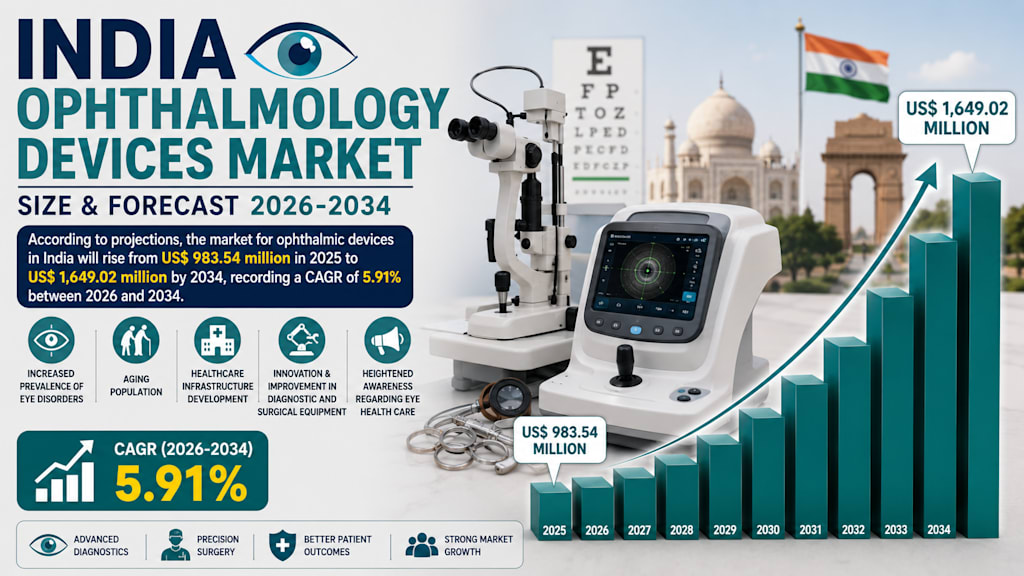
According to Renub Research, the India Ophthalmology Devices Market is projected to grow from US$ 983.54 million in 2025 to US$ 1,649.02 million by 2034, expanding at a CAGR of 5.91% during 2026–2034. The market's growth is supported by rising incidences of eye disorders, increasing adoption of advanced technologies, and ongoing improvements in healthcare accessibility.
Ophthalmology Devices Are Transforming Eye Care
Ophthalmology devices refer to specialized medical instruments used for the diagnosis, monitoring, and treatment of eye diseases and vision disorders.
These include slit lamps, ophthalmoscopes, optical coherence tomography (OCT) systems, corneal topography devices, laser equipment, intraocular lenses, phacoemulsification machines, and contact lenses.
Such devices are essential for detecting conditions at early stages, monitoring disease progression, and performing complex surgical procedures.
Modern ophthalmology technologies have significantly improved patient outcomes by enabling earlier intervention, greater surgical precision, faster recovery times, and enhanced visual results.
As eye care becomes increasingly technology-driven, demand for advanced ophthalmic equipment continues expanding throughout India.
Rising Eye Disorders Are Driving Device Adoption
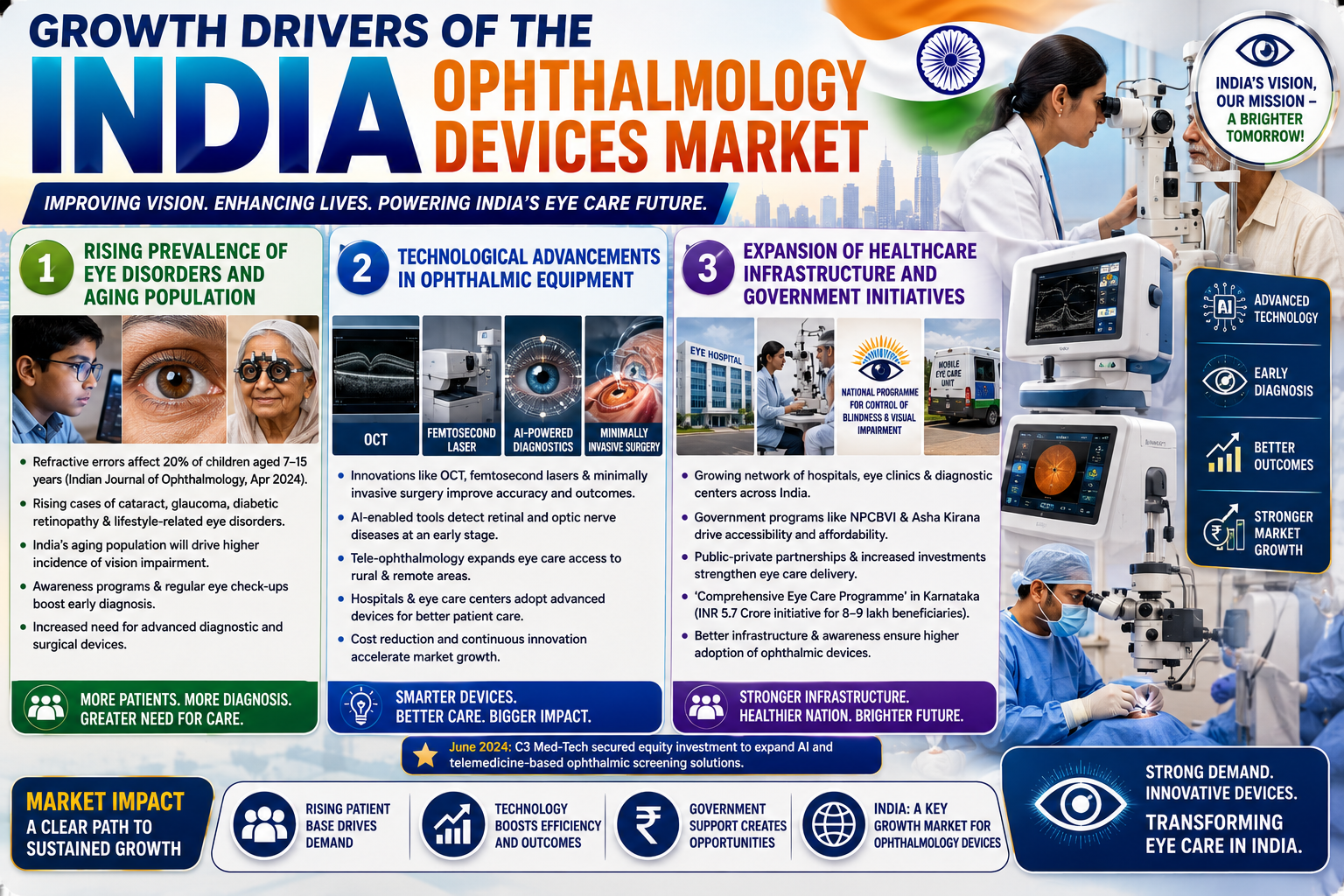
One of the most important growth drivers within the Indian ophthalmology devices market is the increasing prevalence of eye diseases.
Conditions such as cataracts, glaucoma, diabetic retinopathy, age-related macular degeneration, myopia, hyperopia, and refractive errors are becoming increasingly common.
Lifestyle changes, rising diabetes prevalence, increased screen exposure, environmental factors, and longer life expectancy have contributed to this growing burden.
According to findings published in the Indian Journal of Ophthalmology, refractive errors affect a significant percentage of India's population, including nearly 20% of children between seven and fifteen years of age.
The need for timely diagnosis and treatment is encouraging healthcare providers to invest in advanced ophthalmology technologies.
As disease prevalence continues rising, demand for ophthalmic devices is expected to grow substantially.
Aging Population Increases Vision Care Demand
India's rapidly aging population represents another major growth catalyst.
Older adults are significantly more vulnerable to cataracts, glaucoma, retinal diseases, and other age-related vision impairments.
As life expectancy increases, healthcare providers are witnessing growing demand for routine eye examinations, diagnostic services, and corrective surgeries.
Cataract surgery remains one of the most commonly performed procedures across India.
The increasing number of elderly patients requiring ophthalmic interventions continues supporting demand for both diagnostic and surgical equipment.
This demographic trend is expected to remain a long-term driver of market expansion.
Technological Innovation Is Revolutionizing Eye Care
Advances in ophthalmic technology are dramatically improving diagnostic accuracy and treatment outcomes.
Modern systems such as optical coherence tomography (OCT), femtosecond lasers, digital imaging devices, and minimally invasive surgical technologies enable physicians to diagnose and treat complex eye conditions with greater precision.
These innovations reduce surgical risks, improve patient comfort, and shorten recovery periods.
Technology is also enhancing workflow efficiency within hospitals and specialty eye clinics.
As healthcare providers increasingly seek advanced treatment capabilities, investments in next-generation ophthalmology devices continue growing throughout India.
Artificial Intelligence Is Improving Diagnostics
Artificial intelligence (AI) has emerged as a transformative force within ophthalmology.
AI-powered systems assist clinicians in identifying conditions such as diabetic retinopathy, glaucoma, and retinal abnormalities at earlier stages.
Automated image analysis improves diagnostic speed while reducing the risk of human error.
AI technologies are particularly valuable in regions facing shortages of specialized ophthalmologists.
By enabling rapid screening and decision support, AI solutions help improve access to quality eye care services.
The growing integration of AI into ophthalmic devices is expected to significantly influence future market growth.
Tele-Ophthalmology Expands Healthcare Access
Telemedicine has become increasingly important in India's healthcare system, particularly for underserved and rural populations.
Tele-ophthalmology enables remote eye examinations, consultations, and disease monitoring through digital platforms.
This approach improves access to specialized care in regions where ophthalmologists are scarce.
In June 2024, C3 Med-Tech secured investment support to expand telemedicine and AI-based ophthalmic screening technologies aimed at improving disease detection and eye care accessibility.
As digital healthcare adoption increases, tele-ophthalmology is expected to play an increasingly important role in market development.
Government Initiatives Support Industry Growth
Government programs focused on blindness prevention and vision care continue strengthening India's ophthalmology ecosystem.
Initiatives under the National Programme for Control of Blindness and Visual Impairment (NPCBVI) aim to reduce preventable blindness while improving access to affordable eye care services.
Public awareness campaigns encourage regular eye examinations and early disease detection.
Government partnerships with healthcare providers, non-governmental organizations, and research institutions are expanding eye care coverage across both urban and rural regions.
These efforts are generating demand for diagnostic and surgical ophthalmology equipment.
Healthcare Infrastructure Expansion Creates Opportunities
The continuous expansion of healthcare infrastructure is creating favorable conditions for ophthalmology device adoption.
India has witnessed significant growth in hospitals, specialty eye centers, ambulatory surgical facilities, and diagnostic clinics.
Investments from both public and private sectors are improving healthcare accessibility and quality.
The launch of comprehensive eye care initiatives across multiple states is increasing demand for advanced ophthalmic technologies.
For example, Karnataka's Comprehensive Eye Care Programme received significant funding support to enhance eye care accessibility and promote innovative vision care solutions.
Such initiatives continue driving market growth nationwide.
Intraocular Lenses Market Experiences Strong Growth
Intraocular lenses (IOLs) represent one of the largest segments within India's ophthalmology devices market.
IOLs are implanted during cataract surgery to replace clouded natural lenses and restore vision.
Demand for cataract surgery continues increasing due to population aging and growing healthcare awareness.
Premium IOLs such as multifocal and toric lenses are becoming increasingly popular because they provide enhanced vision correction and reduce dependence on spectacles.
Indian manufacturers are expanding production capacity while introducing innovative optical technologies to improve affordability and accessibility.
The IOL segment is expected to remain a major contributor to market growth.
Ophthalmic Laser Devices Gain Wider Adoption
Laser-based ophthalmology devices are increasingly used for refractive surgery, glaucoma treatment, retinal procedures, and cataract surgery.
Technologies such as LASIK, PRK, and femtosecond laser-assisted procedures offer high precision and minimal invasiveness.
Patients benefit from faster recovery times, improved outcomes, and enhanced safety.
The growing number of specialized eye hospitals offering laser procedures is supporting segment expansion.
Although equipment costs remain high, ongoing technological improvements are gradually making laser-based treatments more accessible.
Demand for ophthalmic lasers is expected to continue rising throughout the forecast period.
Ophthalmoscopes Remain Essential Diagnostic Tools
Ophthalmoscopes are fundamental instruments used to examine the retina, optic nerve, and internal eye structures.
These devices play a critical role in detecting diabetic retinopathy, glaucoma, retinal disorders, and systemic diseases that affect eye health.
The increasing prevalence of diabetes in India has significantly strengthened demand for advanced ophthalmoscopes.
Portable and smartphone-based ophthalmoscope technologies are becoming increasingly popular in mobile screening programs and rural healthcare initiatives.
Such innovations are helping improve access to diagnostic services across underserved communities.
Corneal Topography Systems Support Advanced Eye Care
Corneal topography systems are becoming increasingly important for diagnosing corneal disorders and planning refractive surgeries.
These devices generate detailed maps of the corneal surface, enabling physicians to identify conditions such as keratoconus and dry eye disease.
Growing demand for LASIK procedures and specialized eye treatments is driving adoption.
Artificial intelligence integration is further enhancing diagnostic accuracy and efficiency.
Advanced corneal imaging systems are expected to play an increasingly important role within India's evolving ophthalmology landscape.
Contact Lens Market Continues Expanding
The Indian contact lens market is experiencing rapid growth due to rising awareness of vision correction options and increasing demand for cosmetic eyewear.
Urbanization, rising disposable incomes, and fashion-conscious consumers are contributing significantly to market expansion.
Growing incidences of myopia, astigmatism, and other refractive disorders are further supporting demand.
Technological advancements such as silicone hydrogel materials and daily disposable lenses have improved comfort, convenience, and safety.
Manufacturers continue introducing next-generation products designed to enhance user experience and eye health.
Maharashtra Leads the Market
Maharashtra remains one of India's most important ophthalmology device markets.
The state benefits from advanced healthcare infrastructure, leading hospitals, specialized eye institutes, and strong medical tourism activity.
Cities such as Mumbai and Pune host numerous ophthalmology centers equipped with cutting-edge technologies.
High awareness levels and increasing incidences of eye disorders continue driving demand.
The recent renovation and expansion of Aditya Jyot Eye Hospital in Mumbai further highlight the state's commitment to advanced eye care services.
Uttar Pradesh Emerges as a High-Growth Market
Uttar Pradesh represents one of the largest opportunities within India's ophthalmology devices sector.
The state's large population and growing healthcare needs generate significant demand for eye care services.
Government programs, eye camps, and awareness campaigns are improving access to vision care, particularly in rural areas.
The expansion of specialty eye hospitals and diagnostic centers is increasing adoption of advanced ophthalmic technologies.
Recent investments by major eye care providers demonstrate the state's growing importance within the national market.
West Bengal Strengthens Eye Care Infrastructure
West Bengal benefits from a well-established healthcare ecosystem and strong ophthalmology expertise.
Kolkata serves as a major hub for medical education, research, and specialized eye care services.
The increasing prevalence of diabetes-related eye diseases and age-related vision disorders continues supporting demand.
Government and non-governmental organizations actively conduct screening programs and treatment initiatives across rural communities.
The adoption of digital diagnostics and minimally invasive surgical technologies continues accelerating market development.
Andhra Pradesh Benefits from Healthcare Expansion
Andhra Pradesh is witnessing increasing demand for ophthalmology devices due to expanding healthcare infrastructure and growing awareness of eye health.
Cities such as Visakhapatnam and Vijayawada have emerged as important centers for advanced ophthalmic care.
Government programs, telemedicine initiatives, and mobile eye care services are improving access to treatment in remote areas.
The increasing use of digital diagnostic technologies and advanced surgical equipment is helping improve patient outcomes.
The state's growing healthcare investments continue creating favorable conditions for market expansion.
High Costs Remain a Major Challenge
Despite positive growth prospects, the high cost of advanced ophthalmic equipment remains a significant challenge.
Technologies such as OCT systems, laser devices, and premium surgical instruments require substantial capital investment.
Many smaller clinics and rural healthcare facilities face difficulties in acquiring advanced equipment.
These financial barriers can limit access to cutting-edge technologies in certain regions.
Reducing costs through domestic manufacturing and technological innovation will be important for improving accessibility.
Shortage of Skilled Professionals Limits Adoption
The shortage of trained ophthalmologists and skilled technicians represents another key challenge.
Advanced ophthalmic devices require specialized expertise for operation and interpretation.
Highly qualified professionals are concentrated primarily in major metropolitan areas.
Rural regions often face difficulties in utilizing advanced technologies effectively due to workforce shortages.
Investments in medical education, training programs, and telemedicine solutions will be essential for addressing this issue.
Final Thoughts
India’s ophthalmology devices market is entering a period of sustained growth fueled by rising eye disease prevalence, an aging population, expanding healthcare infrastructure, and rapid technological advancement.
Innovations in diagnostics, surgical equipment, artificial intelligence, tele-ophthalmology, and vision correction technologies are transforming the delivery of eye care throughout the country.
While challenges related to affordability and workforce availability remain, ongoing government initiatives and private-sector investments continue strengthening the industry’s foundation.
With the market projected to grow from US$ 983.54 million in 2025 to US$ 1,649.02 million by 2034, India’s ophthalmology devices industry is well positioned to play a crucial role in improving vision health and preventing avoidable blindness across the nation.
About the Creator
Enjoyed the story? Support the Creator.
Subscribe for free to receive all their stories in your feed.
Comments
There are no comments for this story
Be the first to respond and start the conversation.