
Will Commercial Greenhouses Transform Global Food Production by 2034?
As Climate Challenges and Food Security Concerns Rise, Commercial Greenhouses Are Emerging as the Future of Sustainable Agriculture

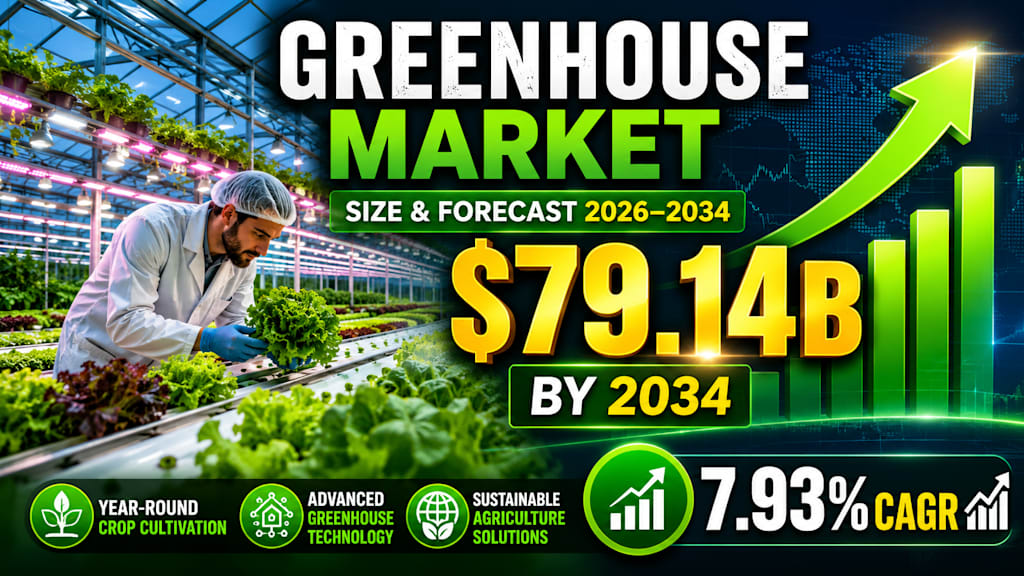
The way the world grows food is changing rapidly. Rising populations, shrinking farmland, unpredictable weather patterns, and growing concerns about sustainability are forcing the agricultural sector to rethink traditional farming methods. As countries seek solutions to produce more food while using fewer resources, commercial greenhouses are becoming a vital part of modern agriculture.
According to Renub Research, the Commercial Greenhouse Market is projected to grow from US$ 39.82 Billion in 2025 to US$ 79.14 Billion by 2034, expanding at a CAGR of 7.93% between 2026 and 2034. This remarkable growth reflects increasing global demand for year-round crop cultivation, advancements in greenhouse technologies, and the growing emphasis on resource-efficient farming practices.
As climate uncertainty continues to impact crop yields worldwide, greenhouse farming offers a controlled environment where farmers can optimize growing conditions and maximize productivity regardless of external weather conditions.
The Rise of Commercial Greenhouses in Modern Agriculture
Commercial greenhouses are specially designed structures made from transparent materials such as glass or plastic that allow sunlight to enter while maintaining controlled temperature, humidity, and light conditions. Unlike traditional farming, greenhouse cultivation enables producers to manage environmental variables with precision.
The popularity of greenhouse farming has surged globally because of increasing food demand and declining availability of arable land. Urbanization continues to consume agricultural space, making it necessary to find innovative ways to produce food efficiently.
Greenhouses provide farmers with an alternative that requires significantly less water and land while delivering higher crop yields. As a result, countries across North America, Europe, Asia-Pacific, and the Middle East are investing heavily in greenhouse infrastructure to strengthen food security and reduce dependence on imports.
Governments are also encouraging greenhouse adoption through subsidies, grants, and modernization programs, recognizing their role in ensuring long-term agricultural sustainability.
Year-Round Crop Production Is Driving Market Expansion
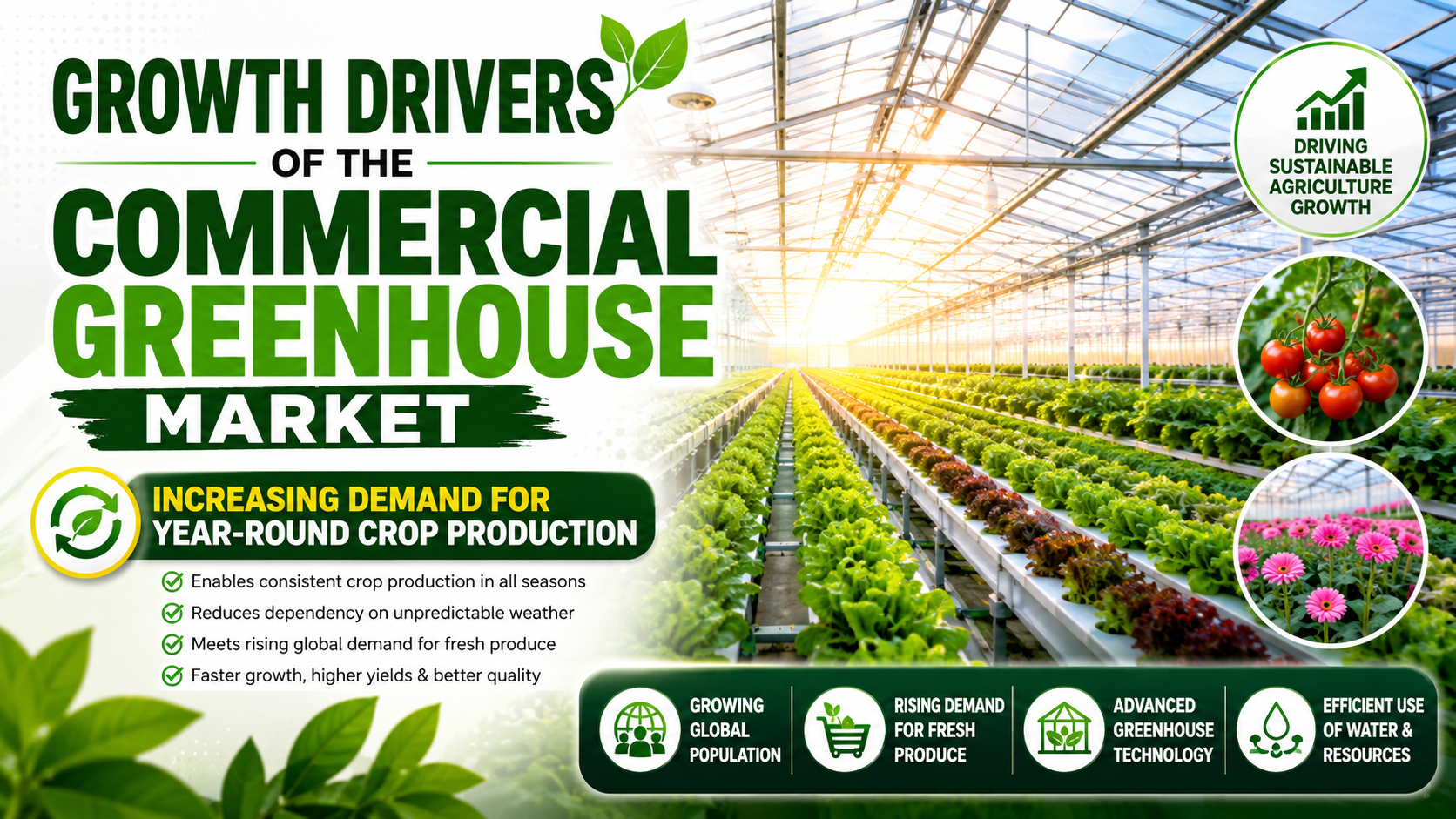
One of the strongest drivers of the commercial greenhouse market is the growing need for continuous crop production throughout the year.
Traditional farming is highly dependent on seasonal weather conditions. Droughts, floods, heatwaves, and cold spells can significantly affect crop yields and disrupt food supply chains. Greenhouses eliminate much of this uncertainty by creating stable growing environments regardless of outdoor conditions.
Consumers today expect fresh fruits, vegetables, and flowers to be available year-round. Retailers and food distributors are therefore seeking reliable supply sources that can meet demand consistently. Commercial greenhouses enable farmers to cultivate crops in every season, ensuring uninterrupted production and stable revenues.
Population growth is further intensifying pressure on agricultural systems. The world's population continues to rise, increasing demand for fresh produce and nutritious food. Greenhouse cultivation helps bridge this gap by producing higher yields in smaller spaces while maintaining crop quality.
This ability to provide year-round harvests is making greenhouse farming increasingly attractive for commercial growers worldwide.
Technology Is Revolutionizing Greenhouse Farming
Technology has transformed commercial greenhouses from simple protective structures into highly sophisticated farming systems.
Modern greenhouses now incorporate advanced climate control systems, automated irrigation, hydroponics, artificial lighting, and smart monitoring technologies. These innovations help farmers optimize growing conditions while reducing waste and resource consumption.
Sensors can continuously monitor temperature, humidity, nutrient levels, and carbon dioxide concentrations. Automated systems then make real-time adjustments to maintain ideal conditions for plant growth.
Hydroponic and aeroponic farming techniques are becoming increasingly popular because they eliminate the need for soil while dramatically reducing water consumption. These methods also allow growers to cultivate crops in locations where traditional farming may not be feasible.
Advanced LED lighting technologies have further improved greenhouse productivity. Growers can now customize light spectra to support different stages of plant development, leading to faster growth cycles and improved yields.
Recent developments in greenhouse lighting technology highlight the pace of innovation within the sector. Companies are introducing next-generation dynamic LED solutions designed to maximize plant growth while reducing energy consumption.
As technology becomes more affordable and accessible, commercial greenhouse operators are expected to achieve even greater efficiency and profitability.
Sustainability Is Becoming a Major Market Catalyst
Environmental concerns are playing a critical role in accelerating greenhouse adoption worldwide.
Conventional agriculture often requires significant amounts of water, fertilizers, and pesticides. These inputs can contribute to environmental degradation, water pollution, and soil depletion.
Commercial greenhouses offer a more sustainable alternative by optimizing resource use and minimizing environmental impact.
One of the most significant advantages of greenhouse farming is water conservation. Many greenhouse systems use closed-loop irrigation methods that recycle water, drastically reducing consumption compared to traditional farming.
Studies have shown that greenhouse agriculture can use up to 95% less water than conventional farming while producing similar or even greater yields. This makes greenhouse cultivation particularly valuable in regions experiencing water scarcity.
Additionally, controlled environments reduce pest infestations, minimizing the need for chemical pesticides. Crops can therefore be grown more sustainably while meeting consumer demand for healthier and safer produce.
The Food and Agriculture Organization has emphasized the need for global food production to increase substantially by 2050 to meet growing demand. Greenhouse farming is increasingly viewed as one of the most practical solutions for achieving this objective while preserving natural resources.
Challenges Continue to Limit Wider Adoption
Despite strong growth prospects, the commercial greenhouse market faces several challenges that could slow adoption rates.
High Initial Investment Costs
Building a modern greenhouse requires significant capital investment. Costs include land preparation, greenhouse structures, climate control systems, irrigation equipment, sensors, lighting systems, and automation technologies.
Materials such as glass, polycarbonate panels, and specialized plastics can be expensive, especially for large-scale operations.
For small and medium-sized farmers, these upfront expenses can be a major barrier despite the long-term productivity benefits offered by greenhouse cultivation.
Rising Operational Expenses
Greenhouses require continuous monitoring and maintenance. Climate control systems often depend on electricity to regulate temperature and humidity.
In regions experiencing extreme weather conditions, energy costs can become substantial. These ongoing expenses may discourage some farmers from transitioning to greenhouse farming.
Need for Skilled Labor
Operating modern greenhouses demands specialized technical knowledge.
Growers must understand environmental controls, irrigation management, nutrient delivery systems, pest prevention, and greenhouse software platforms. The shortage of skilled workers capable of managing these technologies remains a challenge in many markets.
Training programs and educational initiatives will therefore be essential to support future industry growth.
Greenhouse Plastics Are Becoming Increasingly Important
Plastic materials play a crucial role in commercial greenhouse construction.
Materials such as polyethylene, polycarbonate, and polyvinyl chloride are widely used because they are affordable, lightweight, durable, and capable of transmitting sunlight effectively.
Compared to traditional glass structures, plastic greenhouses are often easier to install and maintain. They are particularly popular among small and medium-sized growers seeking cost-effective solutions.
Modern greenhouse plastics also incorporate advanced features such as UV protection and anti-drip coatings. These enhancements improve plant productivity while extending the lifespan of greenhouse structures.
As demand for efficient agricultural systems continues to grow, greenhouse plastics are expected to remain a key segment of the market.
Fruits and Vegetables Lead Commercial Greenhouse Applications
The fruits and vegetables segment represents one of the largest portions of the commercial greenhouse industry.
Consumers increasingly demand fresh produce that is available throughout the year and grown under controlled conditions. Greenhouses enable growers to cultivate crops such as tomatoes, cucumbers, peppers, strawberries, and leafy greens with exceptional consistency.
Controlled environments allow farmers to optimize temperature, humidity, and lighting conditions, improving crop quality and reducing losses caused by adverse weather.
Furthermore, greenhouse-grown fruits and vegetables generally require less water and fewer pesticides compared to field-grown crops.
The trend toward locally produced food is also encouraging investment in greenhouse facilities near urban centers, reducing transportation costs and ensuring fresher produce reaches consumers.
Nursery Crops and Ornamental Plants Gain Momentum
The nursery crops segment is experiencing steady growth as demand increases for landscaping plants, flowers, shrubs, and seedlings.
Greenhouses provide ideal conditions for propagating young plants and protecting them from pests and harsh environmental conditions.
The popularity of home gardening, urban landscaping, and decorative horticulture has expanded significantly in recent years, creating new opportunities for greenhouse operators.
Additionally, many agricultural producers use greenhouse-grown seedlings before transplanting them into open fields, improving survival rates and enhancing overall crop performance.
Tunnel and Hybrid Greenhouses Are Growing in Popularity
Tunnel greenhouses, often referred to as hoop houses or high tunnels, are becoming increasingly popular due to their affordability and simplicity.
These structures offer protection from frost, rain, and wind while extending growing seasons. Their low installation costs make them especially attractive for smaller farming operations.
At the same time, hybrid greenhouse systems are gaining traction among commercial growers seeking maximum efficiency.
Hybrid greenhouses combine multiple technologies—including advanced climate controls, LED lighting, hydroponics, and specialized construction materials—to create optimized growing environments.
These integrated systems deliver higher productivity while improving resource utilization, making them an increasingly important component of commercial agriculture.
Regional Markets Show Strong Growth Potential
The United States remains one of the world's most technologically advanced greenhouse markets. Investments in hydroponics, automation, LED lighting, and controlled-environment agriculture continue to drive expansion.
The United Kingdom is increasingly adopting greenhouse farming to improve domestic food production and reduce dependence on imports. Sustainable greenhouse technologies and urban farming initiatives are contributing to market growth.
India represents one of the fastest-growing greenhouse markets globally. Government support, protected cultivation programs, and rising demand for high-quality horticultural products are encouraging farmers to adopt greenhouse technologies.
Saudi Arabia is also investing heavily in greenhouse agriculture to improve food security and reduce reliance on imported produce. Advanced greenhouse systems are helping overcome challenges related to extreme climate conditions and limited arable land.
These regional developments demonstrate the global significance of greenhouse farming in addressing future food production challenges.
Final Thoughts
Commercial greenhouses are no longer a niche agricultural technology. They are rapidly becoming a cornerstone of modern food production systems worldwide.
With climate change, population growth, water scarcity, and shrinking farmland placing unprecedented pressure on agriculture, greenhouse farming offers a practical and sustainable path forward. Advanced technologies, resource efficiency, and year-round production capabilities position commercial greenhouses as a critical solution for future food security.
As Renub Research forecasts the market to nearly double in value by 2034, the commercial greenhouse industry is poised for significant transformation. Farmers, agribusinesses, technology providers, and policymakers all have an opportunity to shape a future where food production is more resilient, efficient, and environmentally responsible.
About the Creator
Enjoyed the story? Support the Creator.
Subscribe for free to receive all their stories in your feed.
Comments
There are no comments for this story
Be the first to respond and start the conversation.