
Why Transdermal Skin Patches Are Revolutionizing Modern Drug Delivery
Growing Demand for Non-Invasive Treatments, Chronic Disease Management, and Advanced Drug Delivery Technologies Is Fueling Global Market Growth

The healthcare industry has witnessed remarkable advancements in how medicines are delivered to patients. While tablets, capsules, injections, and intravenous therapies remain common treatment options, healthcare providers and patients are increasingly seeking solutions that offer greater convenience, improved compliance, and better therapeutic outcomes.
Among the most promising innovations in modern medicine is the transdermal skin patch. These patches have transformed drug delivery by allowing medications to be absorbed directly through the skin and into the bloodstream over an extended period. The approach offers a controlled, convenient, and non-invasive alternative to traditional medication administration methods.
From chronic pain management and hormone replacement therapy to smoking cessation and neurological treatments, transdermal skin patches are becoming an increasingly important component of patient-centered healthcare. Their ability to provide consistent medication delivery while reducing the burden of frequent dosing has made them highly attractive to both patients and healthcare professionals.
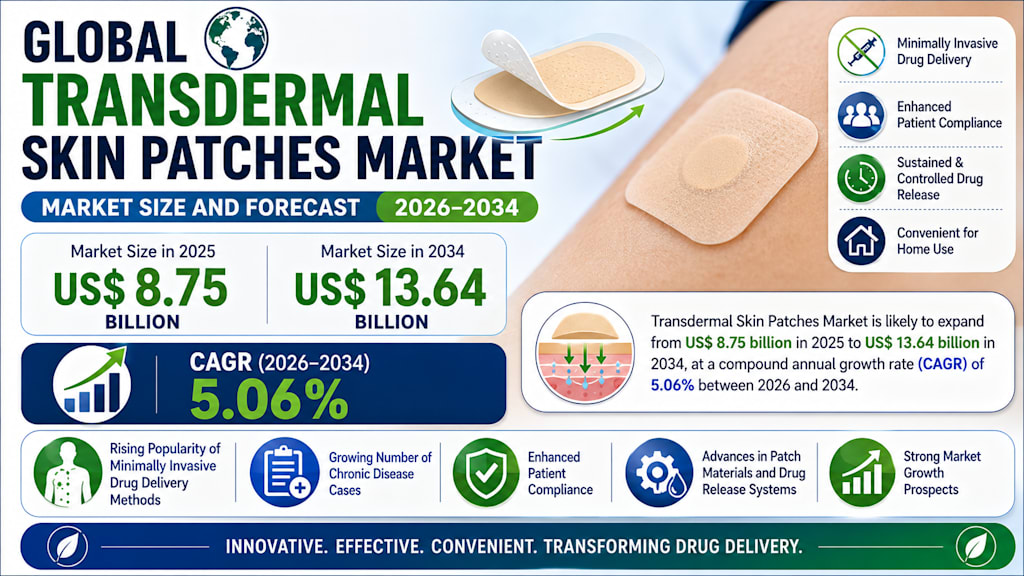
According to Renub Research, the Global Transdermal Skin Patches Market is expected to grow from US$ 8.75 billion in 2025 to US$ 13.64 billion by 2034, expanding at a compound annual growth rate (CAGR) of 5.06% between 2026 and 2034. This growth is being driven by rising demand for minimally invasive drug delivery systems, increasing chronic disease prevalence, technological innovation, and improved patient compliance.
Understanding How Transdermal Skin Patches Work
Transdermal skin patches are specialized drug delivery systems designed to administer medication through the skin and directly into the bloodstream at a controlled rate.
Unlike oral medications, which must pass through the digestive system and liver before reaching circulation, transdermal patches bypass the gastrointestinal tract entirely. This allows medications to maintain more stable concentrations within the body while reducing some of the challenges associated with oral drug administration.
A typical transdermal patch consists of several components, including a drug reservoir or matrix layer, an adhesive layer that attaches the patch to the skin, a protective backing layer, and a release liner. Once applied, the medication gradually diffuses through the skin and enters systemic circulation over a predetermined period.
This controlled-release mechanism helps maintain consistent therapeutic drug levels, reducing fluctuations that can occur with conventional dosing methods. As a result, transdermal systems have become increasingly popular for managing chronic conditions that require long-term treatment.
The Demand for Non-Invasive Healthcare Is Growing
One of the strongest factors driving the transdermal skin patches market is the growing preference for non-invasive treatment options.
Patients today increasingly value convenience, comfort, and ease of use when selecting healthcare solutions. Many individuals prefer treatments that minimize discomfort and reduce the complexity associated with medication administration.
Unlike injections, which can cause pain and anxiety, or oral medications that require regular dosing schedules, transdermal patches offer a simple and patient-friendly alternative. Once applied, the patch delivers medication automatically over an extended period without requiring repeated intervention.
This advantage is particularly important for elderly patients, individuals with swallowing difficulties, and those managing chronic diseases requiring long-term therapy. Healthcare providers also appreciate the ability of transdermal systems to reduce medication errors while improving adherence to prescribed treatment plans.
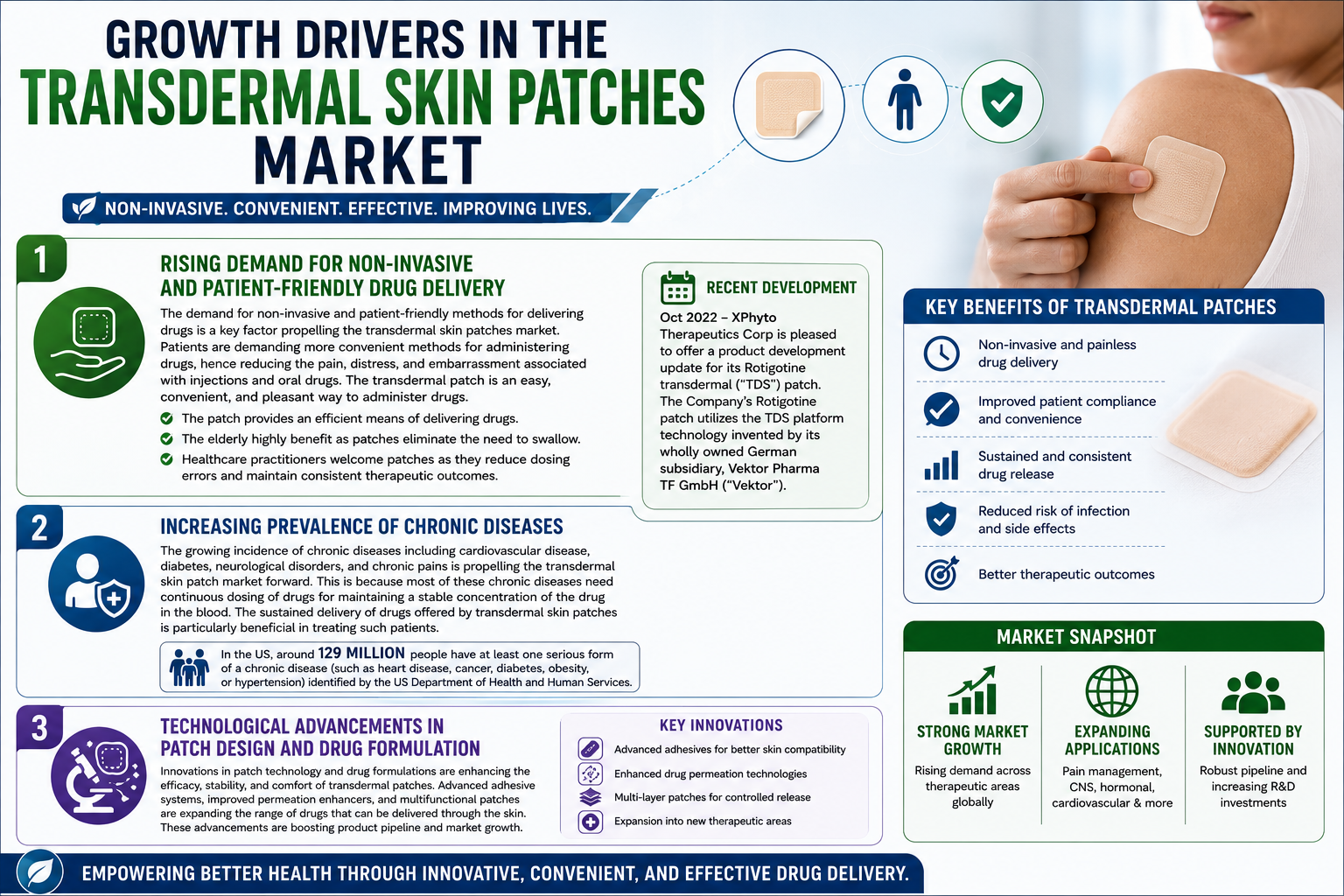
In October 2022, XPhyto Therapeutics announced development progress involving its Rotigotine Transdermal System patch platform, highlighting ongoing efforts to expand therapeutic applications for advanced patch technologies.
Chronic Diseases Are Increasing Demand
The global rise in chronic diseases continues to create significant opportunities for transdermal drug delivery systems.
Conditions such as cardiovascular disease, diabetes, chronic pain disorders, neurological conditions, hypertension, and hormonal imbalances often require continuous medication administration over long periods. Maintaining stable drug concentrations is critical for effective disease management.
Transdermal patches offer a unique advantage by providing sustained and controlled medication release. This helps reduce fluctuations in drug levels while minimizing the need for multiple daily doses.
The burden of chronic illness continues to grow globally. In the United States alone, approximately 129 million people are estimated to be living with at least one major chronic disease, including heart disease, cancer, diabetes, obesity, or hypertension. Such statistics underscore the increasing need for convenient and reliable long-term treatment solutions.
As populations age and chronic disease prevalence rises, demand for transdermal therapies is expected to continue expanding.
Technology Is Expanding the Potential of Transdermal Delivery
Advances in pharmaceutical technology are significantly improving the effectiveness and versatility of transdermal skin patches.
Innovations in material science, adhesive systems, drug formulations, and delivery mechanisms have enhanced patch performance while improving patient comfort. Modern transdermal systems are thinner, more flexible, and capable of delivering medications more efficiently than earlier generations.
One of the most exciting developments involves microneedle technology. These microscopic structures create tiny pathways through the outer layer of the skin, allowing larger and more complex drug molecules to be delivered transdermally.
Another emerging innovation is iontophoresis, a technology that uses mild electrical currents to enhance drug penetration through the skin. Such approaches are expanding the range of medications that can be administered using patch-based delivery systems.
Controlled-release technologies are also becoming increasingly sophisticated, enabling more precise dosing and longer treatment durations. These advancements are helping manufacturers develop patches for a wider variety of therapeutic applications.
A notable example occurred in September 2023 when Corium announced positive results related to ADLARITY, the first FDA-approved donepezil transdermal system for patients with mild, moderate, and severe Alzheimer's disease. The development demonstrated how transdermal technologies are expanding into increasingly complex treatment areas.
Matrix Patches Continue to Gain Popularity
Among the different types of transdermal systems available today, matrix patches represent one of the most widely adopted designs.
In matrix-based systems, medication is uniformly dispersed throughout a polymer matrix that controls drug release through diffusion. This design offers several advantages, including flexibility, patient comfort, and simplified manufacturing processes.
Compared to some traditional reservoir-based designs, matrix patches are often thinner and less prone to issues associated with sudden drug release. Improvements in polymer science and adhesive technologies have further enhanced patch stability, adhesion, and overall performance.
These benefits have contributed to the growing popularity of matrix patches across multiple therapeutic applications worldwide.
Pain Management Remains a Major Application
Pain relief represents one of the largest application segments within the transdermal skin patches market.
Millions of people worldwide suffer from chronic pain conditions, including arthritis, musculoskeletal disorders, neuropathic pain, and other long-term conditions that require ongoing treatment. Traditional oral pain medications can sometimes create gastrointestinal side effects or require frequent dosing.
Transdermal pain patches offer a convenient alternative by delivering medication steadily over time. Patients often prefer patches because they provide prolonged relief while reducing the need for repeated medication administration.
The growing emphasis on non-opioid pain management strategies has further strengthened demand for transdermal pain therapies. Pharmaceutical companies continue investing in advanced formulations that improve effectiveness while minimizing potential side effects.
Hormone Therapy Is Supporting Market Expansion
Hormonal therapy represents another important growth area for transdermal patch technologies.
Transdermal hormone delivery is widely used for menopause management, contraception, and hormone replacement therapy. Compared with oral hormone treatments, patches can provide more stable hormone levels while avoiding first-pass metabolism in the liver.
This approach may reduce certain side effects while improving therapeutic consistency. Patients and healthcare providers increasingly appreciate the convenience and reliability of patch-based hormone therapies.
Growing awareness of women's health issues and increasing demand for personalized treatment approaches continue supporting market growth within this segment. As long-term hormone management becomes more common, transdermal solutions are expected to play an increasingly important role.
Online Pharmacies Are Changing Distribution Patterns
The rise of digital healthcare is transforming how patients access prescription medications, including transdermal skin patches.
Online pharmacies offer convenience, privacy, home delivery services, and competitive pricing, making them increasingly attractive to consumers. The growth of telemedicine has further accelerated online prescription fulfillment and pharmaceutical distribution.
As digital healthcare platforms continue expanding, online pharmacies are becoming an increasingly important distribution channel for transdermal therapies. Improved logistics systems and supportive regulatory frameworks are helping strengthen consumer confidence in online medication purchasing.
This trend is expected to continue as healthcare delivery becomes increasingly digital and patient-centered.
Challenges Continue to Affect Market Growth
Despite strong growth prospects, the transdermal skin patches market faces several challenges.
One of the most significant limitations involves drug compatibility. Not all medications possess the molecular properties required for effective skin penetration. Large molecules and certain chemical compounds may not be suitable for transdermal delivery without additional technological enhancements.
Skin irritation also remains a concern for some patients. Prolonged use of patches may lead to redness, itching, allergic reactions, or dermatitis caused by adhesives or active ingredients. Manufacturers continue investing in improved formulations designed to minimize these side effects.
In addition, regulatory requirements for safety, efficacy, and quality remain stringent. Extensive clinical testing and detailed documentation can increase development costs and extend product approval timelines.
Addressing these challenges will be important for supporting long-term industry growth and expanding patient access to transdermal therapies.
Regional Markets Continue to Expand
The United States remains one of the world's largest and most lucrative transdermal skin patch markets. High adoption of innovative healthcare technologies, widespread chronic disease prevalence, and strong patient awareness continue driving demand. The expansion of home healthcare and digital pharmacy services further supports market growth. In August 2023, Yaral Pharma launched Lidocaine Patch 5%, an AB-rated equivalent to Lidoderm, expanding non-opioid pain treatment options available to patients.
The United Kingdom benefits from a patient-centered healthcare system and strong adoption of chronic disease management solutions. Ongoing investments in innovative drug delivery technologies continue supporting market expansion.
India is emerging as an important growth market due to rising chronic disease prevalence, increasing healthcare awareness, and expanding pharmaceutical manufacturing capabilities. Urbanization and improved healthcare access are further contributing to market development.
Saudi Arabia is also witnessing steady growth as healthcare modernization efforts and rising awareness of patient-friendly treatment options encourage broader adoption of transdermal therapies.
Looking Ahead
The future of the transdermal skin patches market appears highly promising. Continued advances in material science, microneedle technology, controlled-release systems, and pharmaceutical formulations are expected to unlock new therapeutic possibilities.
Healthcare providers increasingly recognize the value of patient-centered treatment approaches that improve compliance and enhance quality of life. As a result, transdermal technologies are likely to gain broader acceptance across a growing range of medical applications.
Leading companies including Teva Pharmaceutical Industries, 3M, Nitto Denko, Johnson & Johnson, Bayer, Novartis, Beiersdorf, Viatris, Abbott Laboratories, and Luye Pharma continue investing in innovation and product development, reflecting confidence in the market's long-term growth potential.
Final Thoughts
Transdermal skin patches represent one of the most patient-friendly innovations in modern medicine. Their ability to provide consistent, controlled, and non-invasive drug delivery offers significant advantages over many traditional treatment methods.
As chronic diseases become more prevalent and healthcare systems increasingly prioritize convenience, compliance, and personalized care, transdermal technologies are expected to play an even greater role in future treatment strategies.
With the market projected to exceed US$ 13.6 billion by 2034, transdermal skin patches are well positioned to transform drug delivery across numerous therapeutic areas. Continued innovation and expanding clinical applications will ensure that these convenient treatment solutions remain an important part of modern healthcare for years to come.
About the Creator
Enjoyed the story? Support the Creator.
Subscribe for free to receive all their stories in your feed.
Comments
There are no comments for this story
Be the first to respond and start the conversation.