
Why the Server Chassis Market Is Becoming a Critical Foundation of the Digital Economy
The explosive growth of cloud computing, artificial intelligence, edge computing, and hyperscale data centers is driving unprecedented demand for advanced server chassis solutions worldwide.

Every digital activity we perform today, whether streaming a movie, conducting an online transaction, using artificial intelligence tools, participating in video conferences, shopping online, or storing files in the cloud, depends on a vast network of servers operating behind the scenes. These servers process, store, and transmit enormous amounts of data every second, making them the backbone of the modern digital economy.
While processors, memory modules, and storage systems often receive most of the attention in discussions about computing infrastructure, another component plays an equally important role in ensuring performance, reliability, and scalability: the server chassis.
The server chassis serves as the physical framework that houses and protects critical server components while managing airflow, cooling, cable organization, and hardware accessibility. As organizations increasingly adopt cloud computing, artificial intelligence, machine learning, big data analytics, and edge computing technologies, demand for advanced server chassis solutions is growing rapidly.
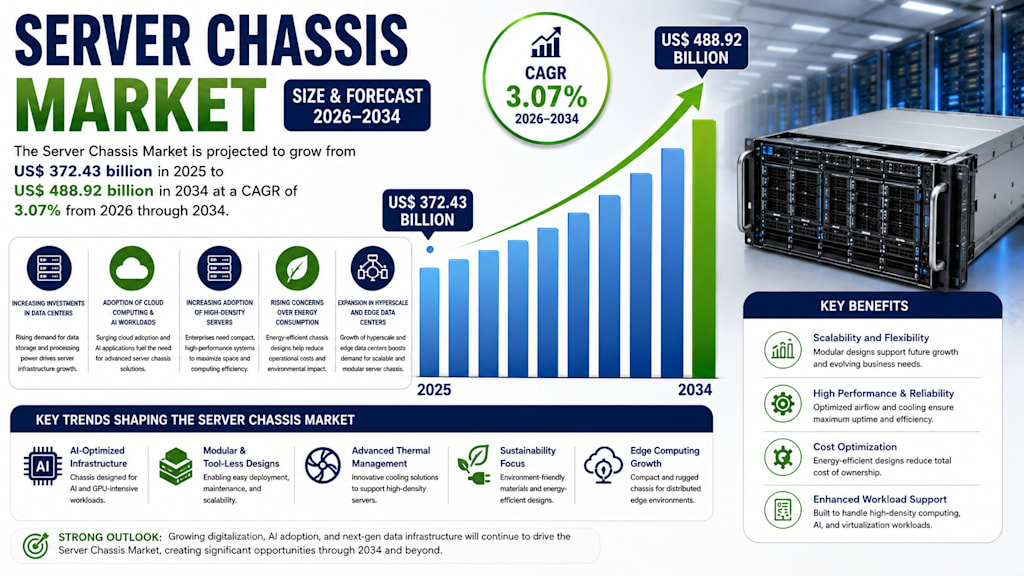
According to Renub Research, the Server Chassis Market is projected to expand from US$ 372.43 billion in 2025 to US$ 488.92 billion by 2034, registering a compound annual growth rate (CAGR) of 3.07% between 2026 and 2034. The market's growth is being driven by rising investments in data centers, increasing adoption of cloud computing, expansion of AI workloads, growing demand for high-density servers, and the rapid development of edge computing infrastructure.

Understanding the Importance of Server Chassis
At first glance, a server chassis may appear to be little more than a metal enclosure.
In reality, it is one of the most critical components within modern computing infrastructure.
A server chassis provides structural support and protection for processors, motherboards, memory modules, storage drives, power supplies, networking components, and cooling systems. It also plays a vital role in managing airflow and thermal performance, ensuring that servers can operate continuously under demanding workloads.
Without an efficient chassis design, even the most powerful server hardware would struggle to maintain optimal performance.
Modern server chassis are engineered to maximize computing density, simplify maintenance procedures, improve cooling efficiency, and support future scalability.
As data center operators seek to process more information within limited physical space, the importance of advanced chassis solutions continues to increase.
The Digital Economy Is Fueling Infrastructure Growth
One of the most significant drivers behind the server chassis market is the rapid expansion of digital services.
Organizations across every industry are generating and processing unprecedented volumes of data. Cloud applications, streaming platforms, e-commerce services, social media networks, financial technologies, and enterprise software solutions all depend on robust server infrastructure.
As demand for these services continues to grow, organizations are investing heavily in data centers capable of supporting increasingly complex workloads.
Every new server deployment requires reliable chassis systems that can accommodate advanced hardware configurations while ensuring operational efficiency.
The expansion of digital infrastructure worldwide is therefore creating sustained demand for server chassis manufacturers.
This trend is expected to continue as businesses accelerate their digital transformation initiatives and consumers increasingly rely on online services.
Cloud Computing Continues to Drive Demand
Cloud computing remains one of the most powerful forces shaping the global server chassis market.
Organizations are increasingly migrating applications, storage systems, and business processes to cloud environments in order to improve flexibility, scalability, and operational efficiency.
Cloud service providers operate massive hyperscale data centers that contain thousands of servers arranged in highly optimized configurations.
To maximize computing power while minimizing space requirements, these facilities rely heavily on advanced rack-mounted server chassis capable of supporting dense hardware deployments.
High-density chassis designs enable cloud operators to increase processing capacity without significantly expanding physical infrastructure.
As cloud adoption continues expanding globally, investments in supporting hardware infrastructure, including server chassis, are expected to remain strong.
Artificial Intelligence Is Creating New Requirements
Artificial intelligence has emerged as one of the most transformative technologies of the modern era.
Organizations across industries are investing heavily in AI applications that require significant computational resources. Training machine learning models, processing large datasets, and running AI-driven analytics demand specialized server configurations equipped with powerful processors, graphics processing units (GPUs), and accelerators.
These advanced systems generate substantial amounts of heat and require sophisticated cooling solutions.
As a result, server chassis manufacturers are developing designs specifically optimized for AI and high-performance computing environments.
Modern AI-ready chassis often incorporate enhanced airflow management, modular architectures, liquid cooling compatibility, and support for multiple accelerator cards.
The rapid growth of AI adoption is therefore creating significant opportunities for innovation within the server chassis market.
Data Centers Are Expanding Worldwide
The expansion of data center infrastructure represents another major growth driver.
Hyperscale, colocation, enterprise, and government data centers continue to increase capacity to meet growing digital demand.
Data centers require server chassis that balance performance, energy efficiency, reliability, and ease of maintenance.
Operators seek solutions that maximize computing density while minimizing operational costs associated with cooling, power consumption, and facility management.
Modern chassis designs support these objectives through optimized airflow systems, hot-swappable components, modular architectures, and advanced thermal management technologies.
As investments in data center construction continue accelerating across North America, Europe, Asia-Pacific, and the Middle East, demand for server chassis is expected to rise accordingly.
Edge Computing Is Opening New Opportunities
While traditional data centers remain essential, computing infrastructure is increasingly moving closer to end users through edge computing.
Edge computing enables data processing to occur near the source of data generation rather than relying entirely on centralized facilities. This approach reduces latency, improves performance, and supports applications requiring real-time decision-making.
Industries such as telecommunications, manufacturing, healthcare, transportation, and smart cities are investing heavily in edge computing deployments.
These environments often require compact, rugged, and energy-efficient server chassis capable of operating outside traditional data center settings.
Manufacturers are responding by developing specialized chassis solutions designed for remote installations, industrial environments, and telecommunications facilities.
As edge computing adoption continues expanding, it is expected to become an increasingly important source of market growth.
The Rise of 5G Is Supporting Infrastructure Investment
The global rollout of 5G networks is creating additional demand for server infrastructure.
5G technology enables faster data transmission, lower latency, and greater connectivity, supporting applications such as autonomous vehicles, industrial automation, augmented reality, and Internet of Things devices.
These applications generate enormous volumes of data that require rapid processing and analysis.
To support these requirements, telecommunications providers are deploying edge computing infrastructure and expanding network capacity.
Server chassis play a critical role in these deployments by housing the hardware necessary to process and manage data efficiently.
As 5G adoption continues growing worldwide, associated investments in server infrastructure are expected to benefit the chassis market significantly.
High-Density Computing Is Reshaping Design Priorities
Modern computing environments increasingly emphasize density and efficiency.
Organizations want to maximize computing capacity within limited physical space while controlling energy consumption and operating expenses.
This trend has accelerated demand for rack-mounted server chassis, particularly 2U configurations.
The 2U segment remains especially popular because it provides an effective balance between performance, storage capacity, cooling capabilities, and deployment flexibility.
Compared with smaller 1U systems, 2U chassis can accommodate additional storage devices, expansion cards, GPUs, and enhanced cooling solutions.
These advantages make them well-suited for virtualization, cloud computing, database management, and AI workloads.
Thermal Management Is Becoming Increasingly Important
As computing power increases, managing heat has become one of the most significant challenges facing the industry.
Modern processors, GPUs, and accelerators generate substantial thermal output that must be dissipated effectively to maintain performance and reliability.
Poor thermal management can result in reduced processing efficiency, hardware failures, and increased operational costs.
Consequently, server chassis manufacturers are investing heavily in advanced cooling technologies.
Enhanced airflow systems, liquid cooling compatibility, optimized component layouts, and intelligent thermal monitoring are becoming standard features in many high-performance chassis designs.
Balancing performance with energy efficiency remains a critical priority as organizations pursue sustainability goals and seek to reduce operating expenses.
Challenges Facing the Market
Despite strong growth prospects, the server chassis industry faces several challenges.
One major concern involves supply chain disruptions.
The market depends on raw materials such as steel, aluminum, and specialized electronic components. Fluctuations in material availability, transportation costs, and global logistics networks can affect manufacturing schedules and profitability.
Another challenge involves cost pressures.
Data center operators continually seek ways to reduce infrastructure expenses while maintaining performance and reliability. This creates intense competition among manufacturers and places pressure on profit margins.
At the same time, evolving technology requirements demand ongoing investment in research and development.
Successfully balancing innovation, affordability, and operational efficiency remains a key challenge for industry participants.
Regional Markets Continue to Expand
The United States remains the largest server chassis market globally.
The country's leadership in cloud computing, artificial intelligence, hyperscale data centers, and digital transformation initiatives continues driving substantial demand for advanced server infrastructure. Major investments by cloud providers and technology companies support ongoing market expansion.
Germany represents a significant European market characterized by strong industrial digitization, Industry 4.0 initiatives, and growing demand for energy-efficient computing solutions. Enterprises increasingly prioritize high-quality infrastructure capable of supporting advanced manufacturing and data-intensive operations.
India is emerging as one of the fastest-growing opportunities globally.
Rapid digitalization, cloud adoption, fintech expansion, e-commerce growth, and government-led digital initiatives are creating substantial demand for scalable server infrastructure. The increasing importance of data localization and edge computing further supports market growth.
Saudi Arabia is also investing heavily in digital transformation, smart cities, and local data infrastructure. These initiatives are encouraging adoption of advanced server technologies throughout the region.
The Future of the Server Chassis Market
The future of the server chassis market appears highly promising.
Several powerful trends are converging simultaneously, including cloud computing expansion, artificial intelligence adoption, edge computing growth, 5G deployment, digital transformation initiatives, and increasing global data generation.
Future chassis designs will likely emphasize modularity, sustainability, energy efficiency, liquid cooling compatibility, and support for increasingly powerful computing hardware.
Manufacturers that successfully address these evolving requirements will be well-positioned to capitalize on long-term market opportunities.
As digital infrastructure becomes increasingly important to economic growth and technological innovation, server chassis will remain an essential foundation of modern computing ecosystems.
Final Thoughts
Although server chassis rarely receive public attention, they play a vital role in enabling the digital services that power modern life.
From cloud computing and artificial intelligence to streaming media and e-commerce, virtually every digital experience depends on reliable server infrastructure supported by advanced chassis designs.
The growing demand for computing power, combined with expanding investments in data centers and edge infrastructure, is creating significant opportunities for the industry.
With the global server chassis market projected to approach US$489 billion by 2034, the sector is positioned for sustained growth. As organizations continue pursuing digital transformation and next-generation technologies, server chassis will remain one of the most important yet often overlooked components of the global digital economy.
About the Creator
Enjoyed the story? Support the Creator.
Subscribe for free to receive all their stories in your feed.
Comments
There are no comments for this story
Be the first to respond and start the conversation.