
Why Prediction Markets Are Calling a Democratic Wave in 2026?
The crowd has spoken. Millions of dollars in real money are betting on a political shift. Here's what the data actually says.

Polls get headlines. Pundits get airtime. But when real money is on the line, people tend to think harder.
That's the core idea behind prediction markets — platforms where traders buy and sell contracts tied to real-world outcomes. Unlike a survey where someone can answer carelessly, prediction markets demand skin in the game. And right now, with the 2026 midterms approaching, those markets are sending a clear, loud signal: a Democratic wave may be coming.
With over $7 million already traded on congressional control outcomes, and months still remaining before Election Day, the numbers are too significant to ignore.
What Prediction Markets Actually Are (And Why They Matter)
Before diving into the data, a quick primer for the uninitiated.
Prediction markets are platforms — think Polymarket and Kalshi — where users trade contracts on future events. If you believe Democrats will win the House, you buy a contract. If you're right, you profit. If you're wrong, you lose money.
This mechanism creates a powerful incentive for accuracy. Traders who consistently get things wrong lose capital. Those who are right gain it. Over time, the market price of a contract becomes a remarkably reliable probability estimate — often more accurate than polls or expert forecasts.
The "wisdom of crowds" isn't just a catchy phrase here. It's backed by decades of research showing that aggregated informed predictions frequently outperform individual experts.
The House: An 81% Probability Is Not a Toss-Up
Let's start with the most striking number: Democrats currently hold an 81% implied probability of flipping the House in 2026 on leading prediction market platforms.
That is not a close race in market terms. That's a strong consensus.
Why are traders so confident? Two structural reasons dominate.
First, there's history. The party in the White House almost always loses seats in midterm elections — it's one of the most reliable patterns in American political science. With all 435 House seats on the ballot, and Republicans holding a razor-thin majority, traders are pricing in a Blue Wave as the base case, not a long shot.
Second, the math is brutal for Republicans. Their current majority leaves almost no margin for error. A handful of competitive districts flipping is all it takes to change control. Traders see that fragility — and they're pricing it accordingly.
The Senate: A Closer Fight, But Democrats Are Closing In
The Senate picture is more nuanced. Republicans currently hold approximately a 52% probability of retaining their majority, per current market pricing — meaning the chamber is genuinely competitive.
With 33 Senate seats up for election, traders are watching individual race dynamics closely. Markets on granular outcomes — exact seat counts, margin of control — show significant activity, with millions traded across different scenarios. The 52/48 split suggests the Senate could genuinely go either way, making it the more interesting bet for sophisticated traders.
The Balance of Power: Four Scenarios, One Clear Leader
Perhaps the most telling data comes from the balance-of-power markets, where traders bet on the combination of outcomes. According to the latest 2026 midterm election odds tracked on prediction markets, the scenarios shake out like this:
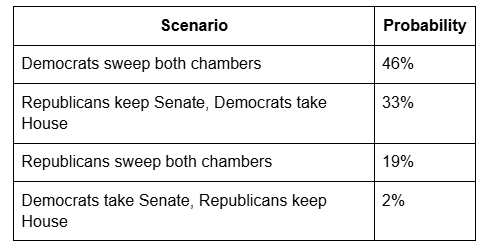
The dominant scenario — nearly a coin flip on its own — is a full Democratic sweep. The second-most-likely outcome still involves Democrats taking the House. Add those together and you get roughly 79% probability that Democrats control the House after November 2026.
That's not spin. That's the market speaking.
Why This Matters Beyond the Betting Angle
You don't need to place a single bet to care about prediction market data.
These markets aggregate the views of thousands of informed, financially-incentivized participants — political analysts, policy wonks, traders, insiders. The resulting probabilities are arguably the best real-time snapshot of collective political intelligence available. They update instantly when new polls drop, when candidates stumble, when national sentiment shifts.
For voters, journalists, campaign strategists, and policy watchers, prediction markets offer something traditional media often can't: a constantly updated, financially-weighted consensus on where things actually stand.
The Bottom Line
The 2026 midterms are still months away. Markets can and do shift. A strong Republican candidate recruitment cycle, a change in economic conditions, or a major news event could move the odds significantly.
But right now, the crowd — the collective judgment of thousands of real-money traders — is calling a Democratic wave. An 81% House probability isn't noise. A $7 million trading volume isn't casual speculation. These are informed participants putting real capital behind a conviction.
Whether you follow politics closely or just want to understand where Washington might be headed, prediction markets are one of the sharpest tools available. And in 2026, they're pointing in one direction.
About the Creator
Poly Punter
Poly Punter covers prediction market news, Polymarket trends, crypto forecasting, trader insights, and real-time event trading. We publish informative content about decentralised prediction markets and forecasting culture.
Enjoyed the story? Support the Creator.
Subscribe for free to receive all their stories in your feed.
Comments
There are no comments for this story
Be the first to respond and start the conversation.