
Why Is Organic Starch Becoming a Critical Ingredient in North America’s Clean-Label Food Revolution?
How Organic Food Demand, Non-GMO Preferences, Sustainable Manufacturing, and Expanding Industrial Applications Are Driving Growth in the North America Organic Starch Market

Consumers across North America are paying closer attention than ever to the ingredients used in the products they consume. As awareness surrounding health, sustainability, and food transparency continues to increase, manufacturers are under growing pressure to replace artificial additives and chemically modified ingredients with natural alternatives. Among the ingredients benefiting most from this shift is organic starch.
Organic starch has become a key component in food manufacturing due to its versatility, clean-label appeal, and compatibility with organic and non-GMO product formulations. Derived from organically grown crops such as corn, potato, wheat, cassava, and tapioca, organic starch serves as a natural thickener, stabilizer, binder, and texture enhancer across a wide range of applications.
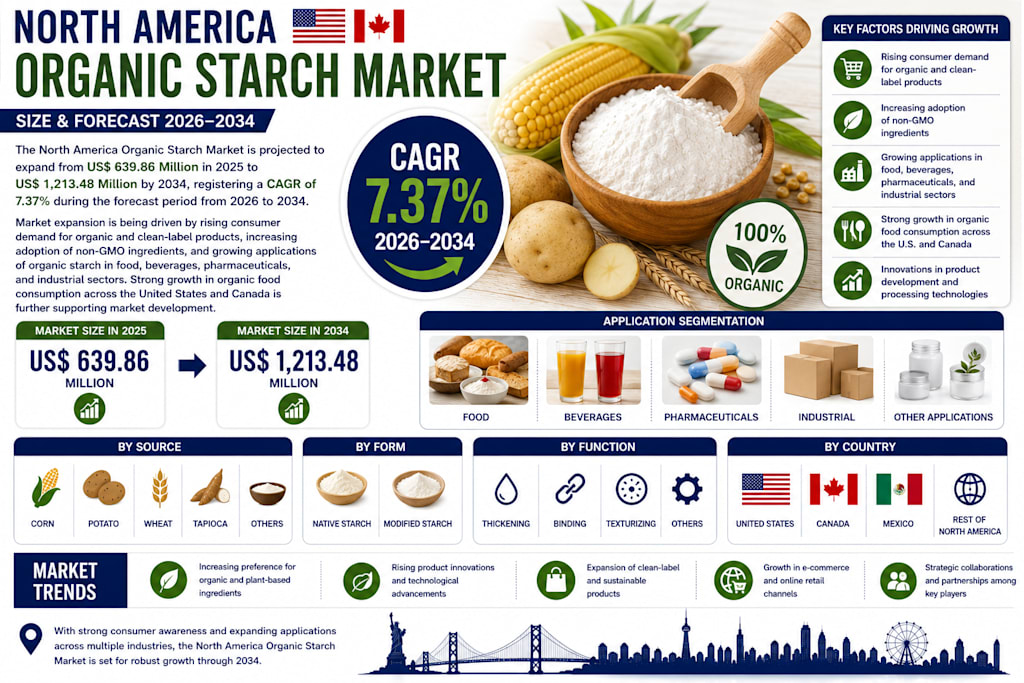
According to Renub Research, the North America Organic Starch Market is projected to expand from US$ 639.86 million in 2025 to US$ 1,213.48 million by 2034, registering a compound annual growth rate (CAGR) of 7.37% from 2026 to 2034. Rising demand for organic and clean-label products, increasing adoption of non-GMO ingredients, and expanding applications across food, beverage, pharmaceutical, personal care, and industrial sectors are major factors driving market growth.
As consumer preferences continue evolving toward healthier and more transparent products, organic starch is becoming an increasingly important ingredient throughout North America's manufacturing ecosystem.
Understanding the Growing Importance of Organic Starch
Organic starch is a carbohydrate extracted from organically cultivated crops without the use of synthetic pesticides, fertilizers, or genetically modified organisms.
Unlike conventional starch products, organic starch aligns with consumer demand for natural, minimally processed ingredients. It performs multiple functional roles, including thickening, stabilizing, binding, moisture retention, and texture enhancement.
The ingredient is widely used across food and beverage products such as soups, sauces, bakery items, dairy alternatives, snacks, confectionery products, and ready-to-eat meals. Beyond food applications, organic starch is also utilized in pharmaceuticals, paper manufacturing, textiles, and personal care products.
Its versatility and sustainability make it an attractive solution for manufacturers seeking environmentally responsible ingredient alternatives.
As organic product demand continues increasing, organic starch is emerging as a cornerstone ingredient across numerous industries.
Clean-Label Demand Is Accelerating Market Growth
One of the most powerful drivers behind the North America organic starch market is growing consumer demand for clean-label products.
Today's consumers increasingly seek foods containing recognizable ingredients and minimal processing. Many actively avoid products containing artificial additives, preservatives, synthetic chemicals, and genetically modified ingredients.
Organic starch supports these preferences by providing essential functionality while maintaining a natural and transparent ingredient profile.
Food manufacturers are reformulating products to satisfy evolving consumer expectations regarding ingredient transparency and product authenticity.
The growing popularity of clean-label foods is encouraging greater adoption of organic starch across multiple product categories, including bakery goods, dairy alternatives, sauces, soups, snacks, and beverages.
As clean-label trends continue gaining momentum, demand for organic starch is expected to rise substantially.
Rising Organic Food Consumption Supports Expansion
The continued growth of the organic food industry is creating significant opportunities for organic starch producers.
According to the Organic Trade Association's 2026 Organic Market Survey, organic products continue capturing increasing shares across major food categories. Organic produce accounted for 29.6% of organic sales, grocery products represented 20.5%, beverages held 13.3%, dairy and eggs contributed 12.5%, and snacks and candy represented 7.0% of total organic product sales in 2025.
As organic foods become increasingly mainstream, manufacturers require greater volumes of certified organic ingredients that support both functionality and regulatory compliance.
Organic starch plays a vital role in helping brands meet these requirements while maintaining product quality and performance.
The expansion of organic food consumption throughout North America is expected to remain a major catalyst for market growth.
Food and Beverage Applications Continue Expanding
The food and beverage industry remains the largest consumer of organic starch products.
Manufacturers use organic starch to improve texture, consistency, viscosity, stability, and shelf life across numerous product categories. Its ability to perform multiple functions while maintaining organic certification makes it highly valuable in modern food production.
Organic starch is increasingly incorporated into ready-to-eat meals, frozen foods, soups, sauces, confectionery products, bakery goods, beverages, baby food, dairy alternatives, and gluten-free products.
The growing popularity of plant-based and vegan foods is creating additional opportunities because organic starch helps enhance texture and mouthfeel in meat substitutes and dairy-free formulations.
As consumer demand for premium organic products continues increasing, food manufacturers are expected to expand their use of organic starch ingredients.
Product Innovation Is Strengthening Market Development
Innovation continues playing a major role in the evolution of the organic starch industry.
Leading ingredient manufacturers are investing heavily in research and development to create starch solutions that meet evolving food industry requirements.
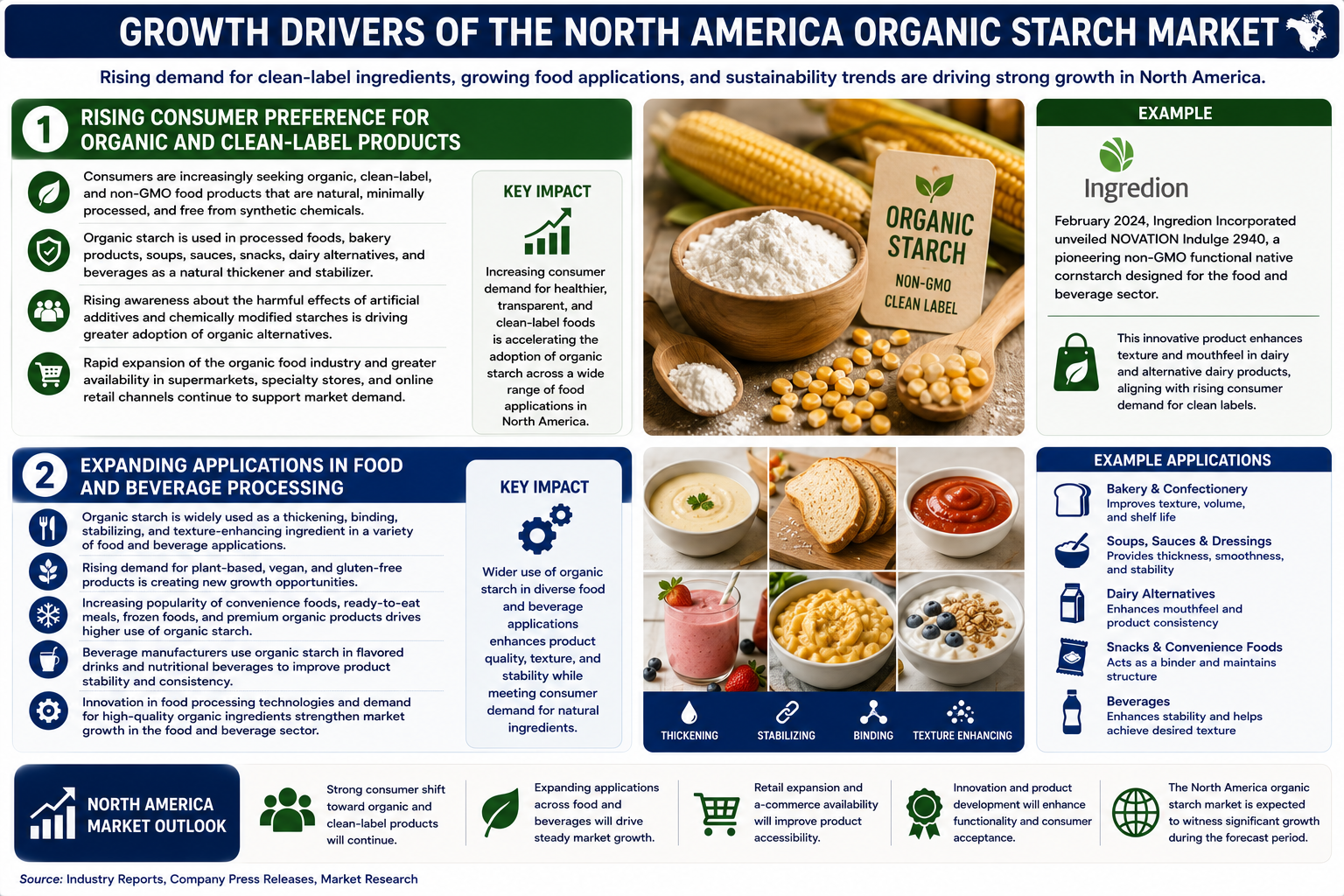
In February 2024, Ingredion introduced NOVATION® Indulge 2940, a non-GMO functional native corn starch developed for clean-label dairy and plant-based food applications. The product was designed to improve texture, gelling characteristics, and mouthfeel while supporting clean-label product positioning.
Ingredion also expanded its portfolio of clean-label native starches aimed at supporting minimally processed food formulations.
These innovations reflect growing industry efforts to deliver functionality without compromising natural ingredient positioning.
As food technology advances, innovation is expected to remain a key growth driver throughout the organic starch market.
Sustainability Is Driving Industry Adoption
Environmental sustainability has become a major factor influencing purchasing decisions among both consumers and manufacturers.
Organic starch is produced from crops cultivated without synthetic pesticides, fertilizers, or genetically modified organisms. This production method reduces environmental impact while supporting biodiversity and sustainable agricultural practices.
Governments, agricultural organizations, and food manufacturers increasingly promote organic farming as part of broader sustainability initiatives.
The appeal of organic starch extends beyond food products. Industries such as paper manufacturing, textiles, pharmaceuticals, and personal care increasingly utilize organic starch due to its biodegradable and renewable characteristics.
As sustainability becomes an increasingly important consideration across industries, organic starch adoption is expected to accelerate further.
Industrial Applications Are Creating New Opportunities
Although food applications dominate the market, industrial demand for organic starch continues expanding.
Manufacturers in sectors such as paper production, textiles, cosmetics, personal care, and pharmaceuticals increasingly seek sustainable ingredients that align with environmental goals.
Organic starch offers excellent biodegradability while providing functional benefits such as binding, coating, and stabilization.
The growing focus on reducing chemical usage and incorporating renewable raw materials into manufacturing processes is creating new opportunities for organic starch suppliers.
As industries continue pursuing environmentally responsible production methods, industrial applications are expected to contribute meaningfully to future market growth.
Organic Potato Starch Continues Gaining Popularity
Organic potato starch represents one of the most important product segments within the market.
Its neutral flavor, smooth texture, and exceptional water absorption properties make it highly desirable across food manufacturing applications. Organic potato starch is commonly used in bakery products, soups, sauces, ready meals, and snack foods.
Growing demand for gluten-free products has significantly increased adoption because potato starch provides effective functionality without introducing allergens associated with wheat-based ingredients.
Additionally, its compatibility with vegan and plant-based formulations further strengthens market demand.
As consumers increasingly seek allergen-friendly and clean-label foods, organic potato starch is expected to experience continued growth.
Organic Wheat Starch Supports Premium Food Manufacturing
Organic wheat starch continues experiencing steady demand across North America's food processing industry.
Manufacturers utilize organic wheat starch to improve texture, moisture retention, shelf stability, and product consistency in baked goods, noodles, sauces, and processed foods.
The growing popularity of premium packaged foods and organic convenience products is increasing demand for certified organic wheat-based ingredients.
Advancements in organic wheat cultivation and expanding organic farming acreage are helping support supply stability throughout the region.
As clean-label food production expands, organic wheat starch is expected to remain an important ingredient category.
Bakery Applications Are Driving Significant Demand
The bakery industry represents one of the most important end-use segments for organic starch.
Organic starch improves dough stability, texture, softness, moisture retention, and shelf life in products such as bread, cakes, cookies, pastries, and gluten-free baked goods.
Consumers increasingly prefer bakery products made from natural and organic ingredients, encouraging manufacturers to replace conventional starches with certified organic alternatives.
The growth of artisan bakeries, premium packaged baked goods, and health-conscious snacking trends further supports demand.
As consumers continue prioritizing natural ingredients, bakery applications are expected to remain a major growth area for organic starch suppliers.
Confectionery Manufacturers Are Increasing Adoption
The confectionery sector is also contributing significantly to market growth.
Organic starch is widely used in candies, gummies, chocolates, jellies, marshmallows, and other confectionery products because of its gelling, thickening, and texture-enhancing capabilities.
Manufacturers are increasingly incorporating organic starch into product formulations to satisfy consumer demand for natural sweets free from artificial additives and genetically modified ingredients.
Organic starch also serves as an effective plant-based alternative to gelatin in vegan confectionery products.
The expansion of premium organic confectionery offerings is expected to create additional opportunities for market growth.
High Costs Remain a Significant Challenge
Despite favorable market conditions, production costs remain a major challenge for industry participants.
Organic farming requires strict adherence to certification standards, sustainable agricultural practices, non-GMO seed sourcing, and extensive quality monitoring. These requirements often result in lower yields and higher production expenses compared to conventional farming.
Certification processes, compliance costs, and supply chain complexities further increase overall production costs.
As a result, organic starch products are typically more expensive than conventional alternatives.
Balancing product quality, certification requirements, and affordability remains a critical challenge for manufacturers seeking broader market adoption.
Limited Organic Crop Availability Creates Supply Challenges
Supply constraints represent another important market challenge.
Organic starch production depends heavily on crops such as corn, potato, wheat, cassava, and tapioca that must be cultivated according to certified organic standards. However, organic farming acreage remains relatively limited compared to conventional agriculture.
Weather conditions, seasonal fluctuations, disease outbreaks, and lower organic crop yields can create supply disruptions and price volatility.
Increasing competition for certified organic raw materials across multiple industries further intensifies sourcing challenges.
Expanding organic farming capacity and improving supply chain resilience will be essential to supporting long-term market growth.
United States Leads Regional Demand
The United States represents the largest organic starch market in North America.
Strong consumer demand for organic, non-GMO, gluten-free, and clean-label products continues driving adoption across food and beverage manufacturing. The country's well-developed organic agriculture infrastructure supports stable production and ingredient availability.
Manufacturers increasingly incorporate organic starch into bakery products, snacks, soups, sauces, dairy alternatives, and processed foods to align with changing consumer preferences.
Beyond food applications, growing use within pharmaceutical and personal care industries further strengthens market demand.
The United States is expected to remain the region's dominant market throughout the forecast period.
Canada and Mexico Continue Creating Growth Opportunities
Canada continues experiencing growth driven by increasing consumer preference for sustainable, natural, and environmentally friendly ingredients. The country's strong commitment to organic agriculture and environmental responsibility supports long-term market expansion.
Mexico's organic starch market is gradually expanding as urbanization, health awareness, and demand for organic food products continue increasing. Growing interest in clean-label ingredients and investment in organic agriculture are creating new opportunities throughout the country.
Together, these markets contribute significantly to regional industry development.
Leading Companies Competing in the Market
Major participants in the North America organic starch market include Cargill, Incorporated, ADM, Tate & Lyle, Ingredion, Roquette Frères, BASF, Naturex S.A., The Kraft Heinz Company, Emsland Group, and American Key Food Products. These organizations continue investing in clean-label innovation, sustainable sourcing, and advanced ingredient technologies to strengthen their competitive positions.
Final Thoughts
The North America Organic Starch Market is benefiting from powerful trends centered on health, sustainability, transparency, and natural ingredients.
With the market projected to grow from US$ 639.86 million in 2025 to US$ 1,213.48 million by 2034, opportunities remain substantial for manufacturers capable of delivering certified organic, clean-label, and environmentally responsible starch solutions.
As organic food consumption, plant-based product development, and sustainable manufacturing practices continue expanding, organic starch is expected to play an increasingly important role across both food and industrial markets throughout North America.
About the Creator
Enjoyed the story? Support the Creator.
Subscribe for free to receive all their stories in your feed.
Comments
There are no comments for this story
Be the first to respond and start the conversation.